

Slippery Slope Fallacy Examples: Definition, Types, and How to Identify Them Logically
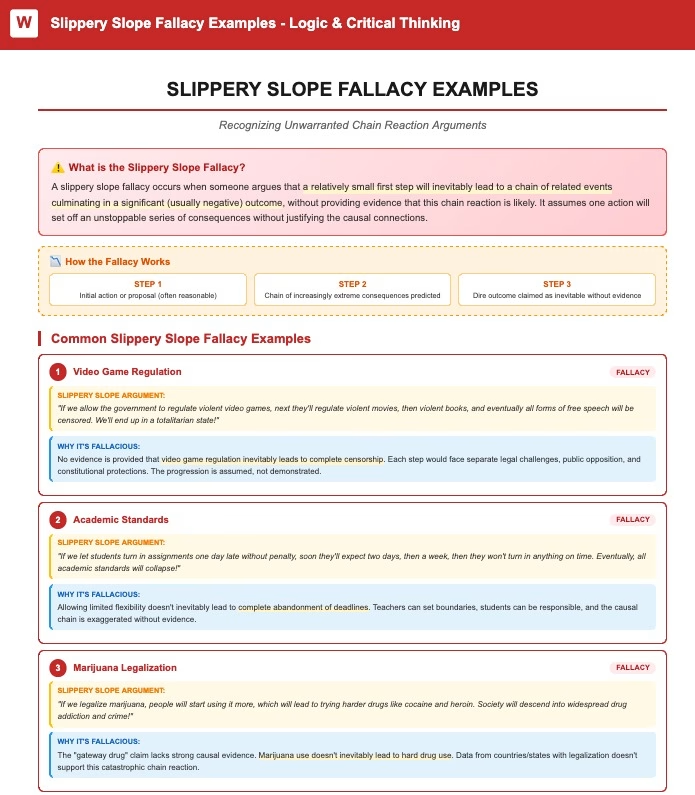
Have you ever heard someone argue, “If we allow this one small change, the next thing you know everything will fall apart”? That’s often an example of a slippery slope argument.
The slippery slope fallacy is one of the most common logical fallacies used in debates, politics, classrooms, and everyday reasoning. But not every slippery slope argument is automatically wrong. The key is understanding when it is logically sound and when it becomes fallacious.
In this guide, we’ll explore slippery slope fallacies, different types of slippery slope arguments, real examples of slippery slope reasoning, and how to evaluate them logically.
Slippery Slope
A slippery slope argument claims that one initial action will inevitably lead to a chain of events that result in an extreme or undesirable outcome.
The structure usually looks like this:
- If we allow Event A,
- It will lead to Event B,
- Which will lead to Event C,
- And eventually to an extreme end point.
The problem arises when the claimed relationship between two or more events lacks evidence. The argument asserts that an event will inevitably lead to another without sufficient logical support.
Example:
“If we legalize marijuana, the next thing you know we’ll legalize all drugs.”
This is often used to argue against a specific decision by predicting negative consequences that may arise in the future.
Fallacy
A fallacy is a logical error in reasoning. When we say the slope fallacy is a logical error, we mean it is considered a fallacy because it assumes certainty in a chain of events without adequate support.
The slippery slope fallacy occurs when someone:
- Argues that one step will inevitably lead to another
- Fails to provide evidence to support the claimed relationship
- Treats hypothetical outcomes as certain
In other words, the fallacy is a logical fallacy because it replaces reason with exaggerated prediction.
Slippery Slope Fallacies
Slippery slope fallacies are often informal logical fallacies. They don’t necessarily violate formal logic rules, but they rely on weak reasoning.
The slippery slope fallacy occurs when:
- An initial action is assumed to lead to an extreme outcome
- The chain of events is speculative
- The argument ignores other factors that may interrupt the sequence
- The connection between two events is weak or unrelated
For example:
“If we give students deadline extensions, soon no deadlines will matter at all.”
Here, the argument assumes that granting deadline extensions for students will lead to total academic chaos. It predicts a series of small changes leading to extreme negative consequences without supporting evidence.
Types of Slippery Slope Fallacies
There are several types of slippery slope fallacies. Understanding the difference between the two major forms helps you evaluate arguments more effectively.
The main types of slippery slope fallacies include:
- Causal slippery slope
- Conceptual slippery slope
- Precedential slippery slope arguments
Each form operates in a slightly different way.
Different Types of Slippery Slope
Let’s examine the different types of slippery slope reasoning more closely.
1. Causal Slippery Slope
A causal slippery slope argues that one event will cause another in a chain of events.
Example:
“If we legalize marijuana, it will inevitably lead to harder drugs being legalized.”
This argument claims a causal relationship between two events but often fails to support the claimed relationship between the initial action and the extreme end point.
The argument assumes certainty without demonstrating how one specific way of legalizing marijuana would logically lead to a series of unrelated outcomes.
2. Conceptual Slippery Slope
A conceptual slippery slope argues that once we accept one idea, we must logically accept another.
Example:
“If we redefine marriage in this specific way, we might as well remove all marriage restrictions.”
This type of argument claims there is no meaningful difference between the two concepts.
However, critics often point out a disconnect between the first event and the alleged extreme outcome.
3. Precedential Slippery Slope Arguments
Precedential slippery slope arguments claim that setting a precedent will inevitably lead to broader changes.
Example:
“If we allow this one restrictive law, next thing you know the government will control every aspect of life.”
This is often used to argue against policy decisions by warning of future negative consequences.
Need Help With a Logic, Philosophy, or Critical Thinking Assignment?
Order your custom paper today and submit with confidence.
Slippery Slope Argument
A slippery slope argument is not automatically illogical. It becomes fallacious when:
- The chain of events lacks evidence
- It assumes certainty
- It ignores factors that may prevent escalation
- It exaggerates the phenomenon in question
However, there are non-fallacious uses of slippery slope reasoning.
Sometimes an initial action truly does lead to another in a predictable way. If there is strong evidence that an event will lead to another event, the argument may be logically sound.
The key question is: does the argument support the claimed relationship between two events?
Examples of Slippery Slope
Let’s look at concrete examples of slippery slope fallacies.
Example 1: Legal Policy
“If we legalize marijuana, the next thing you know all drugs will be legal.”
This assumes that legalizing marijuana will inevitably lead to the legalization of all substances without examining regulatory frameworks.
Example 2: Academic Policy
“If we allow deadline extensions for students, soon no one will respect deadlines at all.”
This exaggerates the potential outcome of a specific decision.
Example 3: Social Norms
“If we relax this rule, society will collapse.”
This assumes a direct chain of events without demonstrating causation.
Example 4: Everyday Conversation
“If you skip the gym today, next thing you know you’ll never exercise again.”
This predicts an extreme end point from one small event or action.
Logically
To evaluate a slippery slope argument logically, ask:
- Is there evidence that the initial action will lead to another event?
- Are the events connected in a specific way?
- Is the chain of events realistic or purely hypothetical?
- Does the argument ignore intervening factors?
A logically sound argument must provide reason and evidence to support the claimed relationship.
Without evidence, the argument is often fallacious.
Final Thoughts
The slippery slope fallacy is a logical fallacy that assumes an initial action will inevitably lead to extreme negative consequences.
While slippery slope reasoning is often used to argue against policy changes or social reforms, it becomes fallacious when it:
- Overstates certainty
- Lacks evidence
- Ignores other factors
- Exaggerates the outcome
Understanding the difference between valid and fallacious slippery slope arguments is essential for critical thinking and logical analysis.
Need Help With a Logic or Philosophy Paper?
If you’re writing about:
- Logical fallacies
- Informal reasoning errors
- Argument analysis
- Critical thinking frameworks
- Causal slippery slope arguments
IvyResearchWriters.com provides:
✔ Expert philosophy and logic writers
✔ Clear argument analysis
✔ APA, MLA, Chicago formatting
✔ Plagiarism-free content
✔ Graduate and PhD-level assistance
Order your custom paper today at IvyResearchWriters.com and submit with confidence.
Frequently Asked Questions
What are examples of slippery slope fallacy?
A slippery slope fallacy occurs when someone argues that one initial action will inevitably lead to a chain of events ending in extreme or undesirable outcomes — without sufficient evidence to support the claimed relationship between two events.
Common examples of slippery slope arguments:
- Policy debate:
“If we legalize marijuana, the next thing you know all drugs will be legalized.”
→ This causal slippery slope assumes one event will inevitably lead to another without showing how that chain of events logically unfolds. - Education setting:
“If we allow deadline extensions for students, soon no one will respect deadlines at all.”
→ This predicts negative consequences from a specific decision without supporting the certainty of that outcome. - Everyday reasoning:
“If you skip one workout, you might as well give up entirely.”
→ This assumes one step will lead to an extreme end point.
In each case, the argument asserts that an action or event will inevitably lead to a series of small escalations — often without proving how those events or outcomes are connected.
When writing about examples of slippery slope reasoning, professors expect you to explain why the argument is fallacious, not just label it. That level of analysis is exactly what IvyResearchWriters.com helps students master.
How do you identify a slippery slope fallacy?
To identify whether a slope fallacy is a logical error, ask the following questions logically:
Key identification markers:
- Does the argument claim that one event will inevitably lead to another?
- Is there a weak or unsupported claimed relationship between two or more events?
- Is the chain of events hypothetical rather than evidence-based?
- Does it exaggerate the phenomenon in question?
- Are there missing factors that may interrupt the progression?
A slippery slope fallacy is a logical fallacy when it assumes certainty in a sequence of events without adequate reason or evidence.
However, not all slippery slope arguments are automatically fallacious. There are non-fallacious uses when strong evidence supports the causal link. The key is whether the argument logically demonstrates how one initial action leads to another in a specific way.
Understanding the difference between the two is crucial in academic argument analysis — and that’s something IvyResearchWriters.com specializes in teaching through expertly written papers.
What is another word for slippery slope fallacy?
Another way to describe the slippery slope fallacy is:
- Slope fallacy
- Causal chain fallacy
- Domino effect fallacy
- Informal logical fallacy
It is considered a fallacy because it often relies on speculative reasoning rather than logical evidence.
It is usually used to argue against a specific decision by predicting extreme negative consequences that may arise in the future.
The argument often includes phrases like:
- “Next thing you know…”
- “It will inevitably lead to…”
- “Might as well…”
- “One step and everything collapses.”
When analyzing such reasoning academically, it’s important to distinguish between valid precedent-based reasoning and precedential slippery slope arguments that lack support.
What is the slippery slope fallacy in relationships?
In relationships, the slippery slope fallacy often appears when one action is assumed to lead to relationship collapse.
Examples:
- “If you forget our anniversary once, next thing you know you won’t care about me at all.”
- “If we argue about this, it will inevitably lead to a breakup.”
- “If you talk to your ex once, you might as well cheat.”
These arguments assume one event will inevitably lead to an extreme outcome without evidence.
The slippery slope fallacy in relationships:
- Treats hypothetical fears as certainty
- Ignores alternative outcomes
- Exaggerates minor issues
- Predicts a chain of events without support
This type of reasoning is often fallacious because it fails to demonstrate how the first event will logically lead to another.
In academic psychology or communication studies papers, analyzing these patterns requires structured argument breakdown and logical evaluation — something IvyResearchWriters.com helps students execute at a high academic level.

