

Relocation Diffusion Example: Clear Definitions, Real-World Cases, and AP Human Geography Insights
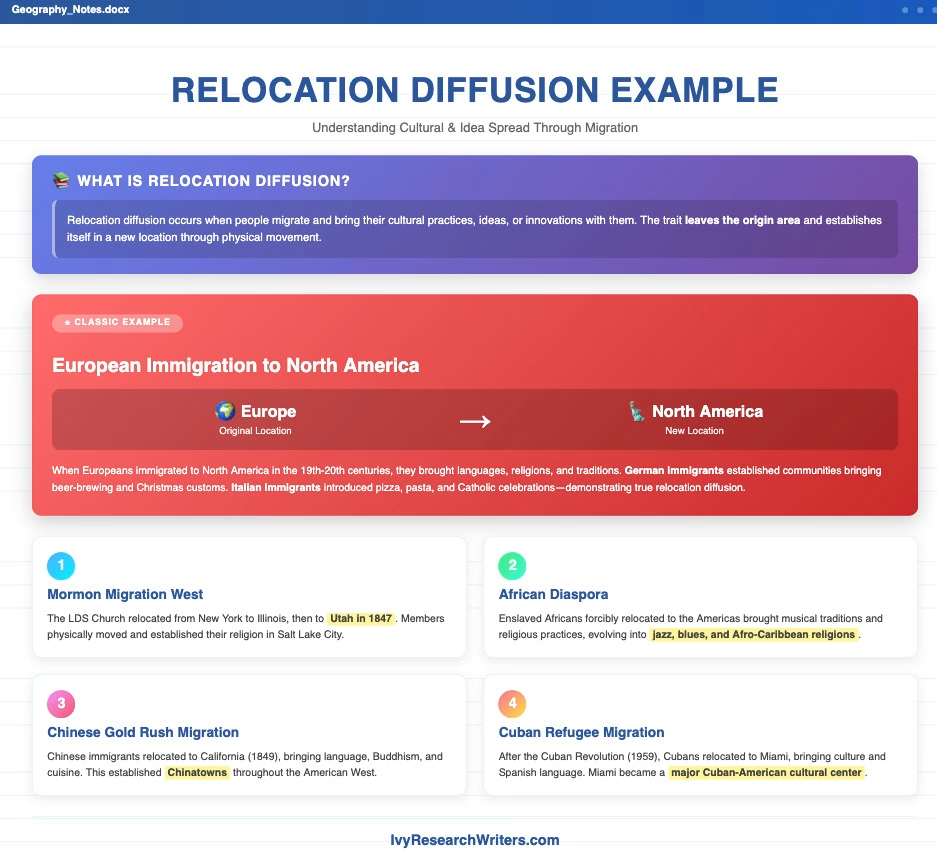
Understanding a relocation diffusion example is essential for mastering key concepts in geography, especially in AP Human Geography. Whether you’re analyzing how religion spreads, how food traditions travel, or how cultural traits move across continents, diffusion explains how culture spreads through space.
In this comprehensive guide, we’ll break down the relocation diffusion definition, compare it with other types of cultural diffusion, and provide strong, exam-ready diffusion examples.
Diffusion: How Culture Spreads Across Space
In human geography, diffusion refers to the spread of ideas, behaviors, technologies, or cultural practices from one location to another. This process is also known as spatial diffusion, because it involves movement across geographic space.
Diffusion can include:
- Religion
- Language
- Food
- Music
- Technology
- Fashion
- Political ideas
At its core, diffusion explains how culture spreads from one place to another.
Relocation Diffusion: Definition and Core Idea
Relocation Diffusion Definition
Relocation diffusion is a type of diffusion that occurs when people move to new places and bring their cultural traits with them.
Unlike other forms of diffusion, relocation diffusion requires migration. When people move, they carry elements of their culture—such as religion, food, language, or traditions—into their new communities.
Key Characteristics
- Depends on migration
- Cultural traits are introduced into new places
- The trait may weaken or disappear in the original location
- Often spreads internationally
Relocation diffusion is one of the most important types of cultural diffusion studied in AP Human Geography.
Cultural Diffusion: The Broader Concept
Cultural diffusion refers to the overall process by which cultural elements spread between societies.
Relocation diffusion is one type of cultural diffusion, but it is not the only one. Other forms include expansion diffusion, hierarchical diffusion, contagious diffusion, and stimulus diffusion.
When examining cultural diffusion, geographers ask:
- How does culture spread?
- Who spreads it?
- Through what mechanisms?
Types of Cultural Diffusion: Understanding the Differences
There are several types of cultural diffusion you must know:
1️⃣ Relocation Diffusion
Occurs when people migrate and bring cultural traits to new places.
2️⃣ Expansion Diffusion
Occurs when a cultural trait spreads outward from a hearth but remains strong in the original location.
3️⃣ Hierarchical Diffusion
Occurs when ideas spread through power structures or influential individuals (e.g., celebrities, political leaders).
4️⃣ Contagious Diffusion
Occurs rapidly and evenly through direct contact, like a virus.
5️⃣ Stimulus Diffusion
Occurs when a cultural trait adapts as it spreads.
Understanding the differences between these forms is crucial for exam success.
Expansion Diffusion vs Relocation Diffusion
Expansion Diffusion
In expansion diffusion, a cultural trait spreads outward but remains strong in its hearth (origin).
Example:
- A religion spreading from its birthplace while remaining dominant there.
- A restaurant chain expanding across a country.
Relocation Diffusion
In relocation diffusion, the trait spreads because people move, and it may diminish in the original location.
The difference lies in whether migration is the driving force.
Need Help With AP Human Geography or Cultural Diffusion Essays?
Struggling to understand relocation diffusion, expansion diffusion, or the main types of diffusion for AP Human Geography? Not sure how to structure your essay or explain examples clearly?
Example of Relocation Diffusion: Religion and Migration
One classic example of relocation diffusion is the spread of religion through migration.
Christianity in the Americas
When European settlers migrated to the Americas, they brought Christianity with them. As they established communities in new places, the religion spread.
This is relocation diffusion because:
- People moved.
- They introduced religion to new places.
- Cultural traits traveled through migration.
Hinduism in the Caribbean
Indian laborers who migrated to the Caribbean brought Hindu traditions with them, establishing religious communities in new regions.
Diffusion Examples You Can Use in AP Human Geography
If you’re studying AP Human Geography, here are strong diffusion examples:
- Language spread: Spanish spreading to Latin America via colonization.
- Food traditions: Italian immigrants introducing pizza to the United States.
- Music genres: Reggae spreading from Jamaica to global cities.
- Cuisine: Sushi becoming popular worldwide after Japanese migration.
Each of these demonstrates relocation diffusion because people moved and carried culture with them.
Contagious Diffusion: Rapid Spread Without Migration
Contagious diffusion occurs when an idea spreads quickly through direct contact.
Example:
- Viral TikTok trends
- Memes
- Fashion crazes
Unlike relocation diffusion, contagious diffusion does not require people to move permanently. Instead, the idea spreads rapidly through interaction.
Hierarchical Diffusion: Influence from the Top
Hierarchical diffusion occurs when ideas spread through a power structure.
Examples include:
- Fashion trends introduced by celebrities.
- Policies promoted by political leaders.
- Technology adopted first by large cities before smaller towns.
This type of diffusion depends on social hierarchy rather than migration.
Stimulus Diffusion: Adaptation as Culture Spreads
Stimulus diffusion occurs when a cultural trait adapts as it spreads to new places.
Example:
- Fast-food chains modifying menus for local tastes.
- Global brands adjusting products to fit cultural norms.
Here, the idea spreads but changes form.
Spatial Diffusion: The Geographic Perspective
Spatial diffusion is the broad concept that includes all forms of cultural diffusion.
Geographers study spatial diffusion to understand:
- Why some ideas spread quickly.
- Why others remain localized.
- How migration patterns shape global culture.
Relocation diffusion is one specific type of spatial diffusion because it relies on migration across geographic space.
Process of Relocation Diffusion: Step-by-Step
The process of relocation diffusion follows a clear pattern:
- A group of people migrates.
- They settle in new places.
- They introduce cultural traits.
- The trait spreads locally.
- The trait may fade in the original location.
For example:
When immigrants move to a new country, they open restaurants, establish religious centers, and form communities. Over time, their traditions become part of the host culture.
Example of Cultural Diffusion in the Modern World
A modern example of cultural diffusion involves global coffee culture.
When Italian migrants moved abroad, they introduced espresso traditions to new places. Today, coffee culture exists worldwide because of both relocation diffusion and expansion diffusion.
This shows how multiple types of diffusion can overlap.
Final Thoughts
A strong understanding of a relocation diffusion example helps students grasp broader patterns in cultural geography.
To summarize:
- Diffusion refers to the spread of cultural traits.
- Relocation diffusion occurs when people move and bring culture with them.
- Expansion diffusion spreads outward while remaining strong at the hearth.
- Contagious diffusion spreads rapidly.
- Hierarchical diffusion spreads through power structures.
- Stimulus diffusion adapts as it spreads.
Mastering these concepts is essential for success in AP Human Geography and college-level courses.
Need Help With Your Geography Essay?
If you’re writing about:
- Relocation diffusion examples
- Types of cultural diffusion
- Religion and migration
- Spatial diffusion patterns
- AP Human Geography exam preparation
IvyResearchWriters.com offers:
✔ Expert geography writers
✔ Clear definitions and structured explanations
✔ APA, MLA, Chicago formatting
✔ In-depth research support
✔ Undergraduate to PhD-level assistance
Order your custom geography paper today at IvyResearchWriters.com and submit with confidence.
Frequently Asked Questions
What is relocation diffusion in simple terms?
In simple terms, relocation diffusion refers to the spread of ideas, cultural characteristics, or practices when people physically move from one place to another.
It is one of the main types of diffusion, alongside expansion diffusion, contagious diffusion, and hierarchical diffusion.
Simply put:
- People relocate.
- They bring their culture with them.
- Their traditions spread in new areas.
Unlike a type of expansion diffusion, where ideas spread outward but remain strong in their place of origin, relocation diffusion depends on human migration and the movement of people.
For example:
- When immigrants move to a new country and introduce food traditions.
- When missionaries travel and encourage the spread of Christianity.
- When African slaves were forcibly transported to the Americas and brought musical traditions with them.
In geography, cultural diffusion is the process by which cultural elements spread. Relocation diffusion is a unique form because it requires physical movement.
If you need help breaking this down clearly for AP Human Geography, IvyResearchWriters.com can provide structured, exam-ready explanations.
Is pizza an example of relocation diffusion?
Yes — Italian pasta and pizza are classic examples of relocation diffusion.
Here’s why:
- Pizza originated in Italy (its place of origin).
- Italian immigrants moved to the United States and other countries.
- They introduced pizza into new cultural landscapes.
- Over time, pizza became part of the existing culture in those places.
This is different from contagious diffusion or hierarchical diffusion. Pizza didn’t spread only because of media influence — it spread first because of human migration.
The diffusion of Italian pasta and pizza into American cities transformed the cultural landscape. Eventually, it evolved into a new and unique form (think Chicago deep dish or New York style).
Other similar examples include:
- The diffusion of Indian curry into Britain.
- Mexican food spreading to new areas through migration.
- The diffusion of modern English across former colonies.
In each case, people relocate and diffuse their culture.
What is an example of a relocation diffusion disease?
An example of disease spreading through relocation diffusion occurred during the Columbian Exchange.
When Europeans traveled from the Old World to the Americas:
- They brought diseases like smallpox.
- These diseases spread to indigenous populations.
- The diffusion happened because of physical movement.
This was relocation and expansion working together, but the initial spread occurred due to migration and exploration.
Another example:
- When infected travelers bring a disease to a new environment.
- The disease then spreads locally.
This differs from contagious diffusion alone because the first step involves relocation diffusion — the disease is brought to a new place through movement.
Understanding how diffusion includes disease spread is critical in geography and AP Human Geography exams.
What does relocation diffusion mean in AP Human Geography?
In AP Human Geography, relocation diffusion is defined as the spread of cultural traits when individuals move and introduce those traits into new areas.
Students must understand that:
- Diffusion happens through several main types.
- Relocation and expansion are two of those types.
- Relocation diffusion depends on physical movement.
Examples commonly used in AP Human Geography:
- The spread of Christianity by missionaries.
- The diffusion of Indian curry into Britain.
- Hip-hop music, a genre of music that originated in the Bronx and was later brought to new regions.
- Musical traditions from West African music, characterized by a style known as call-and-response and often composed in a two-phrase pattern, brought to a new continent by African slaves.
- Agricultural practices as people migrate and introduce new practices.
In each case:
- One culture moves.
- Cultural characteristics enter a new cultural landscape.
- Over time, the innovation spreads.
Diffusion can occur in food, language, religion, music, and even technology. Innovations spread as people relocate, bringing one culture into contact with different cultures.
Diffusion has played a major role in shaping the modern world.

