

Plutocracy vs Oligarchy: Definitions, Examples, and Expert Writing Support
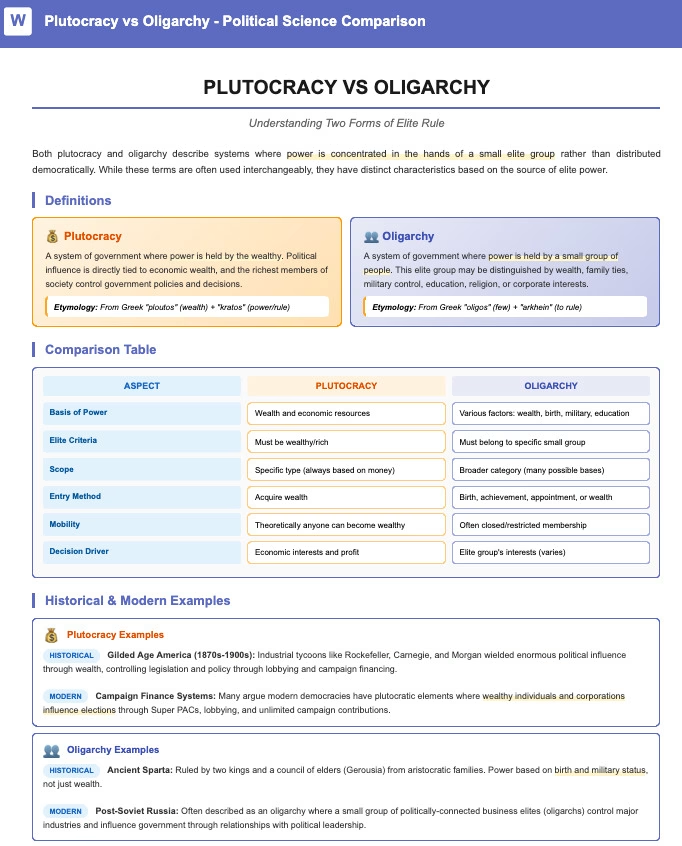
If you are searching for a clear, well-researched explanation of plutocracy vs oligarchy, you are likely working on an essay, discussion post, case study, or policy analysis that needs precise definitions, strong examples, and credible political science framing. At IvyResearchWriters, we help students and professionals write high-quality content that explains how wealth, networks, and institutions shape power and influence in the modern United States and beyond.
This service page explains the core ideas in simple terms, then shows how we help you turn those ideas into strong academic writing.
What we deliver at IvyResearchWriters.com
When you order a paper or request assistance on plutocracy vs oligarchy, we can help you produce:
- Definition-first explanations that compare a form of government where wealth dominates versus a system where a small group of people dominates.
- Case-based examples using billionaires, large corporations, interest groups, and real-world policy debates.
- Strong structure for essays and reports, including clear claims about government policy, public opinion, income inequality, and political influence.
- Arguments that separate democracy from forms of tyranny, including the “tyranny of mere wealth” framing used in historical political rhetoric.
We do not just describe terms. We help you build analysis around who holds power, how power is held, and whose interests shape decisions.
How to use this topic in an essay or policy analysis
A strong paper on plutocracy vs oligarchy usually does three things:
- Defines each concept as a type of government or governance outcome, then distinguishes them.
- Explains mechanisms such as campaign finance, lobbying, agenda setting, and elite networks that create influence and control.
- Uses examples that show when power is concentrated and when it becomes concentrated in the hands of elites rather than average citizens.
You can also strengthen your paper by comparing adjacent concepts like plutocracy vs kleptocracy, where corruption and extraction play a larger role.
Aplutocracy
Some writers use “plutocracy” as a broad label for systems where power rests disproportionately with the wealthy. In practical writing, you will often see plutocracies described as countries where political power becomes tied to financial capacity, elite networks, and the ability to shape political outcomes. In this sense, plutocracy is a form of rule associated with wealthy individuals and their outsized access to decision-makers.
A useful way to frame this in assignments is to describe a plutocracy as a system where:
- power is held by those with money,
- power and influence are concentrated in the hands of a wealthy ruling class, and
- political outcomes tilt toward donors and corporate interests, even when democratic institutions still exist on paper.
Example: In the modern united states, public debates often point to the growing role of mega-donors, corporate spending, and elite networks that shape government policy in ways that do not match the preferences of average citizens. This is commonly connected to america of extreme wealth, where wealth can translate into access, status, and leverage across institutions.
Oligarchy
Oligarchy is defined as a system where authority and decision-making are controlled by the few. In plain language, it is a system where a small group rules, meaning power is held and held by the wealthy or by a connected elite group. An oligarch is a member of that ruling group, and the defining feature is not necessarily money alone, but the durable control of institutions, rules, and outcomes.
In academic writing, you can frame oligarchy as:
- a government where authority is concentrated in the hands of a small group, and
- a system where power is concentrated through control of political parties, media, security forces, key industries, or major networks.
Example: Some analysts argue that an oligarchy is taking shape when elections exist but do not reliably translate mass preferences into outcomes, because elite groups have superior leverage over agendas and policy. When this happens, basic rights and freedoms may still exist, but practical influence over policy can become limited for non-elites.
Geographic example to illustrate concentration: The city of london is often used as a symbolic example of how a dense financial district can cluster elite decision-making. While your paper should avoid simplistic claims, you can use the image of concentration to show how influence can be geographically and institutionally clustered in a small area, sometimes described by size statistics like 2.5 km (often used as a shorthand figure in discussions of dense institutional zones).
Plutocrat
A plutocrat is a wealthy person whose money provides direct or indirect political leverage. A plutocrat can be a donor, a major owner of media or technology platforms, or a key figure in markets that governments regulate. The point is not that every rich person is a plutocrat, but that the system allows wealth to create recurring political advantages.
Examples that work well in student writing:
- High-profile billionaires who fund campaigns, shape narratives, or influence regulation.
- A technology leader such as mark zuckerberg as an example you can discuss carefully in terms of platform power, not as an accusation of wrongdoing.
- Corporate leaders and major shareholders who can shape policy preferences through lobbying, political spending, and revolving-door networks.
In essays, link the plutocrat concept to:
- political influence through campaign donations,
- economic status shaping access to policymakers,
- and institutional pathways where representatives of businesses and professional lobbyists operate more effectively than dispersed publics.
Form of government
Students often lose points by treating these terms as slogans rather than concepts. Your paper should clearly define each form of government and show how it differs from democracy.
- Plutocracy is a form of governance where wealth strongly shapes political outcomes.
- Oligarchy is a form of government where a small, durable group controls decisions.
- Democracy emphasizes broad participation and accountability, but it can be weakened when elite power becomes structurally entrenched.
A strong paragraph can explain that modern systems may blend features. For example, a country can hold elections while also showing oligarchic tendencies if power rests with a narrow set of actors, or plutocratic tendencies if political outcomes track donor and corporate priorities.
This is also where you can discuss forms of tyranny. Some political rhetoric describes a system dominated by wealth as a tyranny of mere wealth, meaning the many live under rules shaped by the few’s financial advantages. You can connect this historically to reform-era critiques, including language associated with president theodore roosevelt, who warned about concentrated economic power and its political consequences.
Turn your plutocracy vs oligarchy idea into a publish-ready research paper.
Start your research paper with IvyResearchWriters.com today. Share your rubric and deadline, and get a structured, evidence-driven draft fast
Plutocracy and oligarchy
Many assignments require you to compare overlap and difference. The simplest, defensible distinction is:
- Plutocracy and oligarchy overlap when the ruling few are wealthy.
- They differ in emphasis: plutocracy highlights wealth as the primary driver, while oligarchy highlights a small group of people holding durable control, which can be economic, political, or institutional.
In writing, show how both can reduce the policy influence of the public:
- public opinion can diverge from government policy.
- average citizens can struggle to achieve outcomes even when preferences are consistent over time.
- interest groups and corporate actors can have disproportionate impact because resources and organization make them more effective in setting agendas and shaping legislation.
Political science framing using Gilens and Page
If your instructor expects scholarly framing, a widely discussed approach in political science highlights how policy responsiveness can differ across groups. Students commonly reference martin gilens and benjamin page when describing evidence that economic elites and organized groups can have stronger policy influence than mass publics.
Use the names carefully and consistently, including institutional identifiers when needed:
- martin gilens of princeton
- martin gilens of princeton university
- princeton university and benjamin page
- benjamin page of northwestern university
- gilens and page
- harvard university and northwestern university may appear in broader discussions of elite research networks and scholarship, depending on your literature review scope.
To strengthen your analysis, connect elite influence pathways:
- donors and u.s donor networks,
- corporate lobbying by elites and organized groups,
- actors representing organized groups representing business interests representing business interests have substantial resources, and therefore have substantial independent interests have substantial independent impacts on policy,
- while average citizens and mass-based interest citizens and mass-based interest groups mass-based interest groups have little little or no independent influence in many policy domains.
Those phrases look repetitive because they often appear in student notes or extracted prompts, but the underlying point is clear: organized, well-funded groups can show stronger influence than dispersed publics.
Adding inequality and mobility
To deepen your paper, tie outcomes to income inequality and social mobility:
- Rapidly rising inequality can increase political gaps between elite agendas and mass preferences.
- Declining mobility can reinforce a ruling class structure because opportunity becomes less evenly distributed.
You can also integrate the critique associated with economist joseph stiglitz, who argues that unequal systems can become self-reinforcing as wealth shapes rules, and rules protect wealth.
U.S.
In the u.s., writers often debate whether the system remains a pluralist democracy or whether elite influence has become too strong. A strong paper avoids exaggeration and instead focuses on mechanisms:
- members of congress respond to electoral incentives, party pressures, and donor ecosystems.
- electoral system design can influence responsiveness and representation.
- large corporations and organized lobbying can shape agendas and regulatory outcomes.
- A small group of people can wield influence across multiple channels at once, which makes wealth and power mutually reinforcing.
Example framing you can use in a U.S. paragraph:
- Some policy areas show high responsiveness to elites because issues are technical, low-salience, or dominated by organized stakeholders.
- Other areas show stronger mass influence when issues are highly salient, media-covered, and connected to core basic rights and freedoms.
Comparing plutocracy vs kleptocracy in U.S.-focused writing
A brief contrast can help:
- plutocracy vs kleptocracy distinguishes influence-through-wealth from outright rule-through-theft.
- In a kleptocracy, extraction and corruption are central.
- In a plutocracy, legal and semi-legal pathways like campaign finance, lobbying, and agenda control often matter more.
You can also note that “plutocracy “oligarchy” are sometimes used interchangeably in popular commentary, but academic work benefits from distinguishing the concepts.
Our Plutocracy vs Oligarchy Writing Service
IvyResearchWriters supports students at high school, undergraduate, graduate, and professional levels. When you order help for a plutocracy vs oligarchy assignment, we can assist with:
- Topic selection and narrowing, including a clear thesis on power and influence.
- Definition-first sections that explain each form of government and related terms like oligarch and plutocrat.
- Evidence-based argument structure that integrates scholarly framing from political scientists and credible sources.
- Examples that connect concepts to contemporary debates, including elite donors, corporate influence, and inequality.
What your finished paper can include
Depending on your brief, your final deliverable can include:
- A comparative table of plutocracy, oligarchy, democracy, and kleptocracy.
- A policy pathway section showing how money shapes agendas, committees, and regulation.
- A case example showing how power is concentrated and how influence policy outcomes.
- A conclusion that links economic status, institutional design, and the gap between policy and mass preferences.
Ready to write a top-grade paper on plutocracy vs oligarchy?
If you need a strong service deliverable, send your prompt, rubric, word count, and any required sources. We will help you produce a coherent, well-structured draft that defines key terms, uses credible examples, and explains how wealth and elite networks shape governance outcomes in the modern united states.
Frequently Asked Questions
What is the difference between oligarchy and plutocracy?
In simple terms: both describe rule by a few, but they emphasize different reasons for why the few rule.
- “Oligarchy” describes a system where power rests in the hands of a small group. The defining feature is control by the few, which can come from family networks, military leadership, party dominance, or corporate-political alliances.
- “Plutocracy” describes a system where wealth drives political power. The defining feature is that money becomes the main pathway to influence, so wealthy actors gain outsized access to decision-makers and shape outcomes.
In a strong academic explanation, you can show that plutocracy can operate inside an oligarchy. For example, an oligarchic “small group” can also be wealthy, so wealth becomes the tool that maintains elite control. This kind of overlap is one reason IvyResearchWriters.com helps writers clearly separate definitions before building an argument.
Policy influence lens used in many papers:
- Research discussions often cite political scientists Martin Gilens and related scholarship because it highlights how some systems show strong responsiveness to elites and organized groups representing specific interests, while many ordinary people have little influence in policy outcomes.
- In that framing, wealth-based power helps explain why business interests have substantial independent impacts on policy, even when broad public preferences remain stable.
What is the difference between oligarchy and kleptocracy?
Quick distinction: oligarchy is about who rules; kleptocracy is about how they rule.
- “Oligarchy” means rule by a small, durable group. That group can govern through formal institutions, party systems, or elite networks.
- Kleptocracy means “rule by theft,” where leaders or ruling groups use government power to extract wealth through corruption, embezzlement, and capture of public assets.
How to explain it in a paper (and how IvyResearchWriters.com strengthens it):
- You can write that “oligarchy” focuses on concentrated authority, while kleptocracy focuses on systematic extraction.
- An oligarchy can become kleptocratic when the ruling group turns the state into a personal revenue system. This is more likely when accountability is weak and oversight fails.
Helpful analytic add-on for high grades:
- In some societies experiencing rapid economic growth, new wealth can intensify competition for state control. If elite capture increases, then elites and organized groups representing narrow priorities can dominate policymaking, while reforms that protect the public interest can face little influence from ordinary stakeholders.
What is an example of oligarchy?
An example of “oligarchy” is any political system where a small group consistently controls key decisions, even if elections or public institutions still exist. In academic writing, you would justify the example by showing who the small group is and how the group maintains influence.
A strong example structure IvyResearchWriters.com can help you write:
- Identify the ruling group: party insiders, military leaders, a small circle of families, or tightly connected economic elites.
- Show the control mechanism: control of candidate selection, media, courts, or major industries.
- Connect to outcomes: laws and priorities repeatedly align with elite interests.
Evidence-style phrasing often used in political science discussions:
- Some analyses draw on work associated with political scientists Martin Gilens and scientists Martin Gilens of Princeton to argue that policy responsiveness can tilt toward elites and organized groups representing powerful sectors, while the general public may have little influence on certain outcomes.
- This does not mean every policy ignores the public. It means the system can show consistent patterns where business interests have substantial independent influence compared with the broader population.
What is the difference between plutocracy and aristocracy?
Core difference: plutocracy is rule by money; aristocracy is rule by inherited status.
- “Plutocracy” describes governance shaped by wealth. Wealth creates leverage through donations, ownership, networks, and control of economic resources.
- Aristocracy describes governance shaped by hereditary rank, lineage, or titled social classes. Status is often inherited rather than acquired.
How they can overlap (and why clarity matters):
- In real societies, wealthy families can become aristocratic-like over time if wealth and influence become intergenerational and socially entrenched. That is why strong writing distinguishes definitions first, then analyzes overlap second. IvyResearchWriters.com specializes in that kind of clean conceptual structure.
Policy influence tie-in that strengthens your answer:
- In many modern debates, researchers point to patterns where elites and organized groups representing concentrated interests exert strong influence, while ordinary people have little influence in comparison. This helps explain how a “plutocracy” can persist even within formal democratic procedures, especially when business interests have substantial independent channels to shape policy.

