

Functional Region in Geography: Definitions, Examples, and Key Concepts for Students
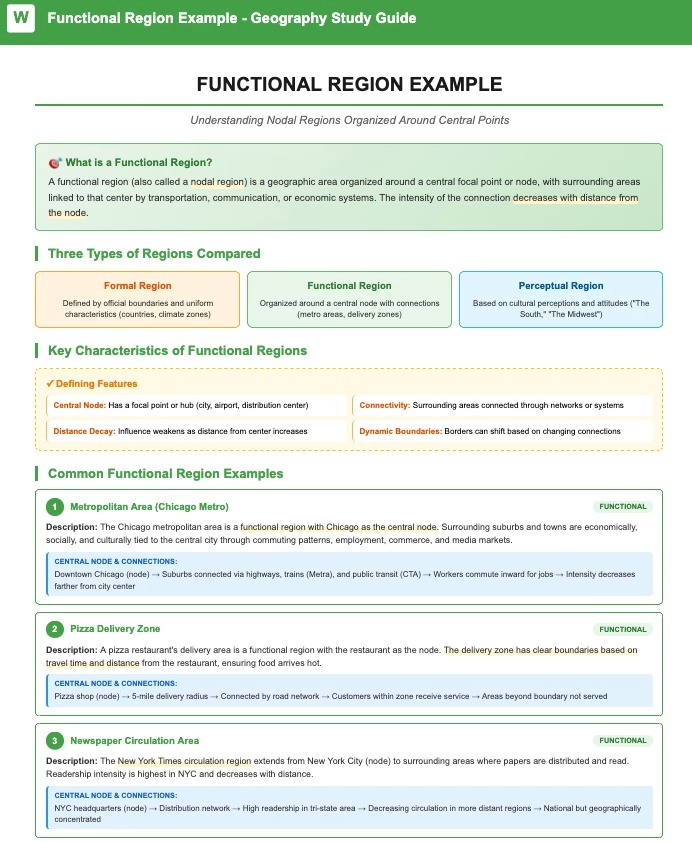
If you’re studying geography, human geography, or preparing for AP Human Geography, understanding regions is essential. Functional region example are one of the foundational concepts in geographic analysis, and they appear constantly in exams, essays, and research papers.
But what exactly is a region? How do functional regions differ from formal and perceptual regions? And why do geographers divide different parts of the world into categories of regions?
In this guide, we break everything down clearly — with definitions, real-life examples, and academic insight.
Functional Region
A functional region is a type of region organized around a central node or focal point. Unlike formal regions, which are defined by uniform characteristics, functional regions are organized around a central point and connected by a set of activities.
Functional Region Definition
A functional region can be defined as an area organized around a central place, where goods and services flow between the core and surrounding areas.
In simple terms:
- It has a central node
- It includes surrounding areas
- It operates as a connected system
- It is based on interaction and movement
Functional regions are often called nodal regions because they are centered around a central node.
Key Characteristics
- Organized around a central city or central place
- Connected through transportation, communication, or economic networks
- Includes a clearly identifiable area served
- Boundaries may change over time
Real-Life Example of a Functional Region
An example of a functional region is a metropolitan area. A metropolitan region includes a central city and surrounding suburbs that depend on it economically and socially.
For example:
- Washington, D.C. (D.C.) serves as a central city
- The metropolitan area extends far beyond its official city limits
- Surrounding areas commute into the central node
- The city area serves as a cultural hub and economic center
This region is organized around a central point — the capital — but includes suburbs and different areas that are economically linked.
Other examples of functional regions include:
- School districts
- Service regions like hospital catchment areas
- Pizza delivery zones
- Television broadcast areas
- Public transportation networks
Functional regions include areas that rely on a central point for goods and services.
Geography
In geography, regions are areas used to simplify and organize spatial information. Geography examines how different areas are connected economically, culturally, and politically.
Regions help geographers:
- Compare different parts of the world
- Identify economic and cultural patterns
- Understand how goods and services move
- Analyze how regions are defined
A region can be defined as an area that shares a common characteristic or is organized around a central place.
Regions are defined based on different criteria:
- Political boundaries
- Economic activity
- Cultural characteristics like language
- Religion or ethnicity
- Shared environmental features
Geography uses regions as tools to interpret spatial relationships across the globe.
Human Geography
Human geography focuses on how people organize space and interact within regions. It studies settlement patterns, cultural landscapes, economic systems, and urban development.
In human geography:
- Regions are areas defined by human activity
- Regions are often divided into categories based on social or economic patterns
- Regions can help explain migration, trade, and urban growth
For example:
- A region of the United States may be defined by industrial activity
- Another region may be defined by religion or ethnicity
- Some regions are based on characteristics like language
Human geography emphasizes that regions are often created by people’s interactions and systems.
AP Human Geography
In AP Human Geography, students must understand the three types of regions and apply them to real-world scenarios.
The three regions include:
- Formal region
- Functional region
- Vernacular (perceptual) region
AP exam questions frequently test:
- Functional region definition
- Differences between formal and perceptual regions
- Examples of functional regions include metropolitan areas
- How regions change over time
Understanding examples of functional regions and how they differ from other types of regions is critical for exam success.
Research Essay Example
(APA Format)
Functional Region Example: Understanding Spatial Organization in Human Geography
Your Name
University Name
Course Name
Instructor Name
Date
Functional Region Example: Understanding Spatial Organization in Human Geography
Abstract
The concept of a functional region is central to geographic analysis, particularly in human geography. Unlike formal regions, which are defined by uniform characteristics, or vernacular regions, which are based on perception, functional regions are organized around a central node and connected by patterns of interaction. This paper defines the functional region, examines its characteristics, and analyzes a metropolitan area as a primary example. Additional real-world examples, including school districts and service regions, further illustrate how functional regions operate. Understanding functional regions enhances spatial analysis by clarifying how economic, social, and transportation systems connect surrounding areas to a central place.
Introduction
Regions are fundamental organizing tools in geography. They allow geographers to divide the world into manageable units for analysis and comparison. In human geography, scholars typically identify three main types of regions: formal regions, functional regions, and vernacular (perceptual) regions (Rubenstein, 2022). Among these categories, the functional region plays a critical role in understanding economic networks, transportation systems, and urban development.
A functional region is defined not by uniform traits but by interaction and connectivity. This essay explores the definition and characteristics of functional regions and provides a detailed real-world example of a metropolitan area to illustrate how such regions function within modern society.
Defining a Functional Region
A functional region can be defined as an area organized around a central node or focal point and connected through patterns of economic, social, or political interaction. It is sometimes called a nodal region because it centers on a central place that coordinates activity within surrounding areas.
Functional regions are characterized by:
- A central node
- Surrounding areas linked to that center
- Movement of goods and services
- Economic and social integration
- Boundaries that may shift over time
Unlike formal regions, which are defined by uniform characteristics such as language, religion, or political boundaries, functional regions are defined by relationships and networks (Knox & Marston, 2016). Their boundaries are determined by the extent of interaction rather than shared traits.
Characteristics of Functional Regions
Functional regions share several defining characteristics that distinguish them from other types of regions.
Central Node
Every functional region is organized around a central point, often referred to as a central place. This node serves as the focal point for economic, administrative, or cultural activity.
Surrounding Areas
The region includes surrounding areas that depend on the central node for services, employment, or governance. These areas may include suburbs, rural communities, or satellite towns.
Flow of Goods and Services
The defining feature of a functional region is interaction. The movement of people, information, and goods connects the region into an integrated system.
Dynamic Boundaries
Functional regions are often dynamic. As transportation networks expand or economic conditions change, the region may grow or contract.
Metropolitan Area as a Functional Region Example
One of the clearest examples of a functional region is a metropolitan area. A metropolitan region includes a central city and surrounding suburbs that are economically and socially integrated.
For example, the Washington, D.C. metropolitan area extends beyond its official city limits into parts of Maryland and Virginia. Although Washington, D.C. serves as the central node, the surrounding suburbs are closely connected through commuting patterns, transportation networks, and economic ties.
In this functional region:
- The central city provides employment opportunities, government services, and cultural institutions.
- Suburbs supply residential space and labor.
- Transportation networks facilitate daily commuting.
- Businesses and services operate across the metropolitan area.
The boundaries of the region are not determined solely by political lines but by patterns of interaction. Commuting flows and economic integration define the area served by the central city (Rubenstein, 2022).
Additional Examples of Functional Regions
Functional regions appear in many everyday contexts beyond metropolitan areas.
School Districts
A school district is organized around educational institutions and administrative offices. Students from surrounding neighborhoods attend schools within the district’s boundaries. The district operates as a service region centered on a focal point.
Hospital Catchment Areas
Hospitals serve patients within a defined catchment area. This area forms a functional region because it is organized around a central medical facility.
Pizza Delivery Zones
A pizza delivery zone is a simple but effective example of a functional region. The restaurant acts as the central node, and its delivery boundaries define the area served. The region exists because of economic interaction between the business and customers.
Media Broadcast Areas
Television and radio stations broadcast signals within specific geographic areas. These areas are functional regions organized around transmission centers.
Functional Regions Compared to Formal and Vernacular Regions
Understanding functional regions requires distinguishing them from formal and vernacular regions.
A formal region is defined by a uniform characteristic, such as climate, language, or political structure. For example, a country with a common government represents a formal region.
A vernacular region is defined by people’s perceptions and cultural identity. These regions may not have official boundaries and are often based on shared understanding.
In contrast, functional regions are defined by interaction and connectivity. They are organized around a central place and structured by a network of activity rather than uniform characteristics or perception (Knox & Marston, 2016).
The Importance of Functional Regions in Geographic Analysis
Functional regions are essential for analyzing urban systems, economic networks, and transportation infrastructure. They allow geographers to examine how central nodes influence surrounding areas and how goods and services move within a system.
By studying functional regions, scholars can better understand:
- Urban growth and metropolitan expansion
- Economic integration
- Infrastructure planning
- Service delivery efficiency
- Regional development
Functional regions simplify complex spatial relationships by identifying focal points and interaction patterns.
Conclusion
A functional region is a type of region organized around a central node and defined by patterns of interaction. Unlike formal regions, which are based on uniform characteristics, and vernacular regions, which are based on perception, functional regions are structured around connectivity and movement.
Metropolitan areas provide the most visible example of functional regions, as they consist of a central city and surrounding suburbs linked by economic, social, and transportation networks. Additional examples include school districts, hospital service areas, delivery zones, and broadcast regions.
Understanding functional regions is fundamental in human geography because it reveals how spatial systems operate and how regions evolve over time. By examining central nodes and their surrounding areas, geographers gain insight into the dynamic processes shaping different parts of the world.
References
Knox, P. L., & Marston, S. A. (2016). Human geography: Places and regions in global context (7th ed.). Pearson.
Rubenstein, J. M. (2022). The cultural landscape: An introduction to human geography (13th ed.). Pearson.
Formal Region
A formal region is defined by a specific characteristic that is uniform throughout the area.
Examples:
- A country with a common government
- A region defined by a specific climate
- Areas sharing characteristics like language
- Regions defined by people’s legal boundaries
Unlike functional regions, formal regions do not depend on a central node. Instead, they share a common attribute.
For instance:
- A state boundary
- A school district boundary
- A linguistic region where people speak the same language
Formal regions are defined by uniform traits rather than interaction.
Vernacular Region
A vernacular region, also known as a perceptual region, is defined by people’s perceptions rather than official boundaries.
These regions are:
- Based on people’s perceptions
- A matter of perception
- Defined by people’s shared understanding
For example:
- “The South” in the United States
- “The Midwest”
- “Silicon Valley”
These areas are perceptual regions because their boundaries are not formally defined but exist in collective understanding.
Type of Region
There are three types of regions in geography:
- Formal region
- Functional region (sometimes called nodal regions)
- Vernacular region
Each type of region serves a different analytical purpose.
A functional region is a city or area organized around a central place.
A formal region is defined by a specific shared characteristic.
A vernacular region is defined by perception.
Regions are often categorized based on how they are created and maintained.
Region Examples
Let’s look at region examples across the three types:
Example of a Functional Region
- A metropolitan area centered around a central city
- Pizza delivery zones
- School districts
- A hospital service region (catchment area)
Example of a Formal Region
- A country with a common government
- A climate zone
- A state boundary
Example of a Perceptual Region
- “The Bible Belt”
- “The Rust Belt”
- A part of town known for nightlife
Each region can be defined differently depending on purpose and perspective.
Perceptual Regions
Perceptual regions are based on people’s perceptions and cultural identity.
They are:
- Defined by people’s understanding
- Shaped by economic and cultural associations
- Influenced by media, history, and shared identity
For instance:
- A cultural hub in a city
- An area known for certain cuisine
- A region associated with a particular religion or ethnicity
Perceptual regions often overlap with formal and functional regions but are not officially codified.
Need Help with Geography Assignments?
Order your custom geography assignment today and submit with confidence.
Perceptual
The term perceptual emphasizes that boundaries are subjective. Unlike formal regions, perceptual regions are not legally defined. They may change over time as cultural identity evolves.
Because they are based on perception, they are flexible and can shift depending on social and political change.
Formal and Perceptual Regions
Understanding the difference between formal and perceptual regions is crucial.
Formal regions:
- Defined by a specific characteristic
- Legally or officially recognized
- Have fixed boundaries
Perceptual regions:
- Based on people’s perceptions
- Informally defined
- May overlap and change
Unlike formal regions, perceptual regions are influenced by cultural narratives.
Why Regions Matter in Geography
Regions help organize complex information. They allow geographers to divide the world into manageable areas for analysis.
Regions are areas that:
- Share a common trait
- Are organized around a central node
- Are defined by perception
- Include different areas linked economically
Creating regions helps scholars analyze patterns of:
- Migration
- Trade
- Urban growth
- Cultural diffusion
Functional regions are often dynamic. They may expand beyond official city limits as metropolitan areas grow. A region called a metropolitan area often extends far beyond its official boundaries because economic connections stretch into surrounding suburbs.
Final Thoughts
Understanding regions in geography requires recognizing the three types of regions:
- Formal region
- Functional region
- Vernacular region
Functional regions are organized around a central node or focal point. Formal regions share a common characteristic. Perceptual regions are based on people’s perceptions.
These categories of regions allow geographers to study different parts of the world in meaningful ways.
Whether you’re preparing for AP Human Geography, writing a college research paper, or analyzing economic and cultural systems, mastering these distinctions is essential.
Need Help with Your Geography Assignment?
If you’re struggling with:
- Functional region definition
- Examples of functional regions include metropolitan areas
- Differences between formal and perceptual regions
- Human geography essays
- AP Human Geography research papers
Frequently Asked Questions
What region is best described as functional?
A region best described as functional is one that is organized around a central node or focal point and connected by patterns of interaction.
Key Characteristics:
- Centered around a central point
- Includes surrounding areas
- Defined by movement of goods and services
- Sometimes called nodal regions
- Organized around a central city or central place
What is the difference between formal and functional regions?
This is one of the most commonly tested concepts in geography and AP Human Geography.
Formal Region
- Defined by a specific shared characteristic
- Uniform throughout
- Officially recognized boundaries
- Examples: a country, climate zone, or region defined by language
A formal region shares a common trait, such as religion, political structure, or ethnicity.
Functional Region
- Organized around a central node
- Based on interaction and activity
- Includes a central city and surrounding areas
- Boundaries may change over time
The Core Difference
Unlike formal regions, which are defined by uniform characteristics, functional regions depend on connection and interaction. A formal region might be a state boundary. A functional region might be the commuting zone around a central city.
For example:
- A region of the United States defined by climate is formal.
- A metropolitan area organized around a central business district is functional.
At IvyResearchWriters.com, we ensure students don’t just memorize definitions — we help them explain these differences clearly in essays and exams.
Which definition best describes a functional region?
The definition that best describes a functional region is:
A region organized around a central node or focal point and defined by patterns of economic, social, or transportation interaction.
Expanded Explanation
A functional region:
- Is centered around a central place
- Includes the area served
- Operates as a connected system
- Is sometimes called a nodal region
- Is defined by movement and activity
For example, a city area served by a transportation system forms a functional region. The region includes the suburbs that rely on the central city for employment and services.
Functional regions are often dynamic and may expand as cities grow beyond their official city limits.
If you need help turning that definition into a polished paragraph for AP Human Geography or a college-level paper, IvyResearchWriters.com provides expert writing support tailored to your assignment requirements.
What characterizes a functional region?
A functional region is characterized by organization around a central point and a network of interaction.
Core Features:
- A central node or focal point
- Surrounding areas linked to the center
- Flow of goods and services
- Economic and cultural connections
- Defined by a set of activities
For instance:
- Pizza delivery zones are centered around a restaurant.
- School districts are organized around educational institutions.
- A hospital catchment area serves patients in surrounding areas.
Each of these is organized around a central place and connected by interaction.
Unlike formal regions, which are defined by uniform traits, functional regions depend on relationships. They may change over time as economic or transportation patterns shift.
Students frequently lose marks because they provide vague answers. At IvyResearchWriters.com, we help transform simple definitions into strong, well-developed academic responses that stand out to professors and exam graders.

