

Examples of Mores: Definition, Types, and Cultural Significance in Sociology
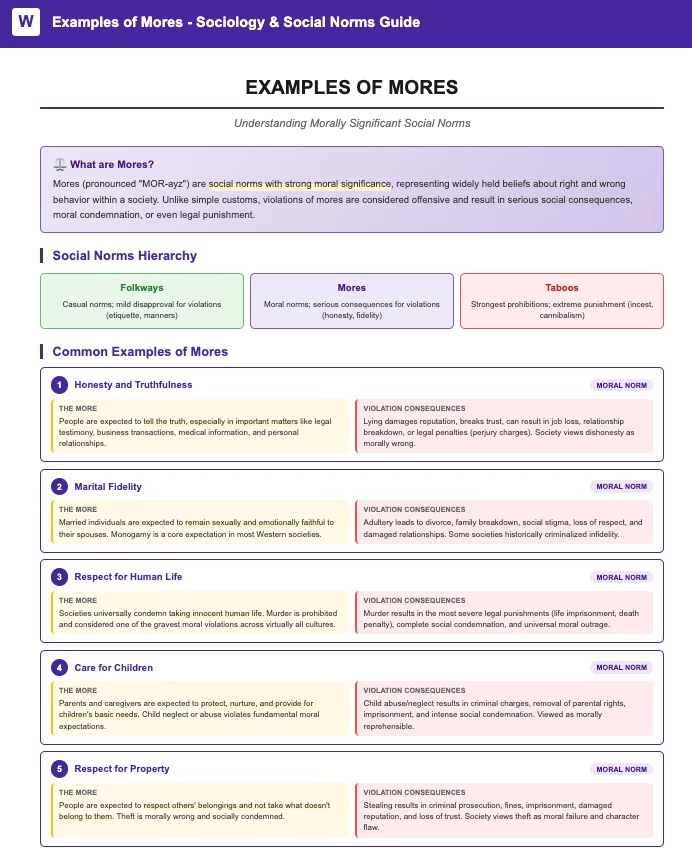
Every society operates according to shared expectations about behavior. Some rules are casual and flexible. Others carry deep moral weight and shape how we define right and wrong. These powerful social rules are known as mores.
In sociology, understanding mores is essential for analyzing moral codes, social norms, and standards of morality within a group or society. In this guide, we’ll explore the definition of mores, examples of mores, how they differ from folkways, and why violating mores can lead to serious consequences.
Mores
In sociology, mores are norms that reflect a society’s deeply held moral principles. They are a type of social norm that carries strong social approval or disapproval.
The definition of mores can be traced to sociologist William Graham Sumner, who introduced the term in the early study of social norms. Sumner argued that mores are deeply ingrained rules that determine what is considered morally right or morally wrong within a society.
Mores are often:
- Deeply ingrained
- Associated with moral and ethical behavior
- Backed by strong social sanctions
- Connected to the values of a society
- Viewed as essential for social order
Unlike casual customs and conventions, mores carry moral significance. Violating mores can lead to serious consequences such as disapproval, punishment, expulsion from a social group, or even legal consequences.
In many societies, mores are so fundamental that they become formally inscribed at the state or federal level as written laws.
Examples of Mores
To understand mores more clearly, let’s explore concrete examples of social mores.
Common Examples Include:
- Prohibition against incest
- Rejection of cannibalism
- Rules against theft and murder
- Expectations of monogamous marriage in certain societies
- Strong prohibitions on dishonesty
These behaviors are considered morally and ethically wrong in nearly all cultures. They carry serious consequences, sometimes even death in extreme historical cases.
Other examples of mores may vary across cultures:
- Expectations about cohabitation with a romantic partner
- Attitudes toward having a romantic partner before marriage
- Views on polygamy versus monogamous marriage
In some societies, cohabitation with a romantic partner before marriage is considered immoral. In others, it is widely accepted. This shows that mores can change over time and differ across cultures.
However, certain mores—such as prohibitions against murder—are common across many societies and carry universal moral weight.
Violating mores can lead to sanctions, including social exclusion, public shame, or legal consequences.
Taboo
A taboo is an extreme form of social mores. It refers to behaviors that are so morally condemned that they are almost universally prohibited.
Examples of taboos include:
- Incest
- Cannibalism
- Desecration of sacred sites
Taboos are often considered essential to maintaining social cohesion. Violating a taboo is not simply considered rude—it is seen as a serious offense.
Taboos represent the strongest forms of social norms and often carry severe punishment.
Norm
A norm is a general expectation about behavior within a society. Norms determine how individuals are expected to act within a social group.
In sociology, there are four different types of norms, also known as the four types of social norms:
- Folkways
- Mores
- Taboos
- Laws
Each form of social norm varies in moral significance and enforcement.
Norms help determine what is considered acceptable behavior within a society. Some norms are flexible; others are rigid and deeply rooted.
Folkways
Folkways are informal social norms that guide everyday behavior. Unlike mores, folkways do not carry strong moral weight.
Examples of folkways include:
- Table manners
- Dress codes
- Greeting customs
- Standards of politeness
If someone violates a folkway—such as interrupting during a conversation—they may be seen as rude, but not immoral.
Folkways include behaviors that are considered proper etiquette. They are part of the customs and conventions of daily life.
Unlike mores, violating folkways usually results in mild disapproval rather than serious punishment.
Morals
Morals refer to individual beliefs about right and wrong. While mores represent collective moral norms within a society, morals may vary from person to person.
Moral principles shape behavior and guide personal decisions. However, when moral principles become widely accepted within a society, they transform into social mores.
Mores are sometimes described as shared moral codes. They represent the collective understanding of moral and ethical behavior.
In many societies, moral norms eventually become written laws. For example:
- Prohibition against theft
- Laws against violence
- Legal restrictions on fraud
These laws reflect the values of a society and enforce standards of morality at the state or federal level.
Sociology
In sociology, mores are studied as part of the broader system of social norms that regulate behavior within a society.
Sociologists examine:
- How mores develop
- Why mores differ across cultures
- How mores change over time
- What happens when mores are challenged
Mores in sociology are considered essential for maintaining social order. Without shared moral norms, behavior within a society would become unpredictable.
Sociologists also study how mores can lead to social change. For example, attitudes toward cohabitation with a romantic partner before marriage have shifted in many societies over the past century.
Social Mores
Social mores are the collective moral standards that govern behavior within a group or society.
Social mores include:
- Expectations about marriage and family
- Standards of sexual conduct
- Norms regarding honesty and integrity
- Prohibitions against immoral acts
Mores often reflect deeply held values. They carry strong social pressure to conform.
Violating mores may lead to consequences like:
- Public disapproval
- Social exclusion
- Expulsion from a community
- Legal punishment
Because mores are deeply ingrained, they are often resistant to rapid change.
Mores in Sociology
Mores in sociology represent a crucial category within the four types of norms. They occupy a middle ground between casual folkways and formal written laws.
Mores:
- Are stronger than folkways
- May be reinforced by laws
- Carry moral weight
- Reflect shared values
Sociologists emphasize that mores are norms tied to moral significance. They define what behaviors are considered essential for the survival of a social group.
Folkway
A folkway is a weaker type of social norm compared to mores.
Folkways include:
- Etiquette
- Politeness
- Greeting rituals
- Dress customs
Breaking a folkway may be considered rude, but not morally wrong.
Unlike mores, folkways do not typically lead to severe punishment. They are flexible and often vary widely across cultures.
Need Help With Your Sociology Assignment?
Order your custom sociology paper today and submit with confidence.
Etiquette
Etiquette refers to socially accepted standards of politeness. It is a form of social norm, but not one with strong moral consequences.
For example:
- Saying “please” and “thank you”
- Waiting your turn in line
- Dressing appropriately for an event
These behaviors are considered polite, but failing to follow them does not usually carry serious sanctions.
Common Across Cultures
Some mores are common across cultures. For instance:
- Prohibition against murder
- Rejection of incest
- Condemnation of cannibalism
These are considered nearly universal moral codes.
However, other mores differ widely across cultures, such as:
- Acceptance of polygamy
- Attitudes toward cohabitation before marriage
- Views on romantic relationships
Mores reflect the unique values of a society.
Across Cultures
Across cultures, the form of social norms may vary, but every society develops moral norms to regulate behavior.
Mores can change over time. Practices once considered immoral may later be accepted, and vice versa.
For example:
- Attitudes toward monogamous marriage versus polygamy
- Views on romantic partner relationships before marriage
Sociologists study how changes in economic systems, technology, and cultural values influence moral codes.
Politeness
Politeness is associated with folkways rather than mores. While politeness is important for social harmony, it does not carry the same moral weight as mores.
Being impolite may lead to mild disapproval. However, committing acts that violate mores can lead to severe consequences.
Final Thoughts
Mores are deeply held social norms that reflect the moral principles and values of a society. They determine what behaviors are considered morally and ethically wrong, and they carry strong sanctions for violation.
Unlike folkways, which govern etiquette and politeness, mores regulate serious moral and ethical behavior. Violating mores can lead to disapproval, punishment, expulsion, or legal consequences.
Understanding examples of mores—from prohibitions against incest and cannibalism to expectations about marriage and family—helps us understand how societies maintain order and cohesion.
Need Help With Your Sociology Assignment?
If you’re writing about:
- The four types of social norms
- Mores vs. folkways
- Social norms across cultures
- Moral codes and sanctions
- Sociology theory and social behavior
IvyResearchWriters.com provides:
✔ Expert sociology writers
✔ APA, MLA, Chicago formatting
✔ In-depth academic research
✔ Plagiarism-free content
✔ Graduate and PhD-level assistance
Order your custom sociology paper today at IvyResearchWriters.com and submit with confidence.
Frequently Asked Questions
What are 5 examples of mores?
Mores are deeply held moral norms that define what a society considers right and wrong. Unlike casual customs, mores carry strong social consequences.
Five clear examples of mores include:
- Prohibition against incest
- Rejection of cannibalism
- Condemnation of murder or theft
- Strong disapproval of child abuse
- Expectations of marital fidelity in monogamous societies
These behaviors are considered morally and ethically wrong in many societies. Violating mores often leads to serious consequences such as public disapproval, legal punishment, or even expulsion from a community.
In sociology assignments, it’s not enough to list examples — you must explain why they qualify as mores and how they reflect the values of a society. That level of structured analysis is exactly what IvyResearchWriters.com helps students achieve.
What are the mores of society?
The mores of society are the moral norms that guide behavior within a group or society. They represent shared standards of morality and define what behaviors are considered acceptable or immoral.
Mores:
- Are deeply ingrained
- Carry strong social pressure
- Reflect the moral principles of a society
- May be reinforced by written laws
- Determine what is considered right and wrong
For example, in many societies, violence against others is not just illegal — it is morally condemned. Similarly, some societies strongly oppose cohabitation with a romantic partner before marriage, while others accept it.
Mores are deeply tied to the moral codes and values of a culture. They can change over time, but they often remain powerful regulators of behavior within a society.
When writing about social mores in academic settings, professors expect clear definitions, examples, and discussion of sanctions. IvyResearchWriters.com ensures your work is organized, analytical, and academically sound.
What is an example of folkways vs mores?
Understanding the difference between folkways and mores is essential in sociology.
Folkways (weaker norms)
- Saying “please” and “thank you”
- Following dress codes
- Observing table manners
- Practicing politeness
If someone violates a folkway — such as interrupting during a conversation — they may be seen as rude, but not immoral.
Mores (stronger norms)
- Prohibitions against incest
- Rejection of cannibalism
- Condemnation of serious crimes
- Moral expectations regarding marriage
Violating mores can lead to severe sanctions, including legal consequences.
The key difference:
- Folkways relate to customs and conventions.
- Mores carry moral significance and are considered essential for social order.
A strong sociology essay will explain that mores are norms tied to morality, while folkways involve etiquette and everyday behavior. IvyResearchWriters.com helps students clearly articulate these distinctions for high grades.
What are examples of mores in the community?
Examples of mores in a community vary depending on cultural values, but they generally include behaviors considered morally binding.
Community-Based Examples of Mores:
- Strong condemnation of domestic violence
- Expectation of honesty in business transactions
- Rejection of racism or discrimination
- Respect for elders in certain cultures
- Expectations surrounding marriage and family roles
In some communities, having a romantic partner before marriage may be accepted. In others, it may be considered morally wrong. This demonstrates that mores can differ across cultures and change over time.
However, certain mores — such as prohibitions against violence — are common across many societies.
Mores help maintain social cohesion by reinforcing shared standards of morality. They define what is considered acceptable behavior within a group or society and often lead to sanctions when violated.
If you need to analyze community norms, compare cultural differences, or explain the four types of social norms in depth, IvyResearchWriters.com provides expert academic support tailored to your assignment.

