

Concepts examples: how the mind builds meaning through categories, generalization, and memory
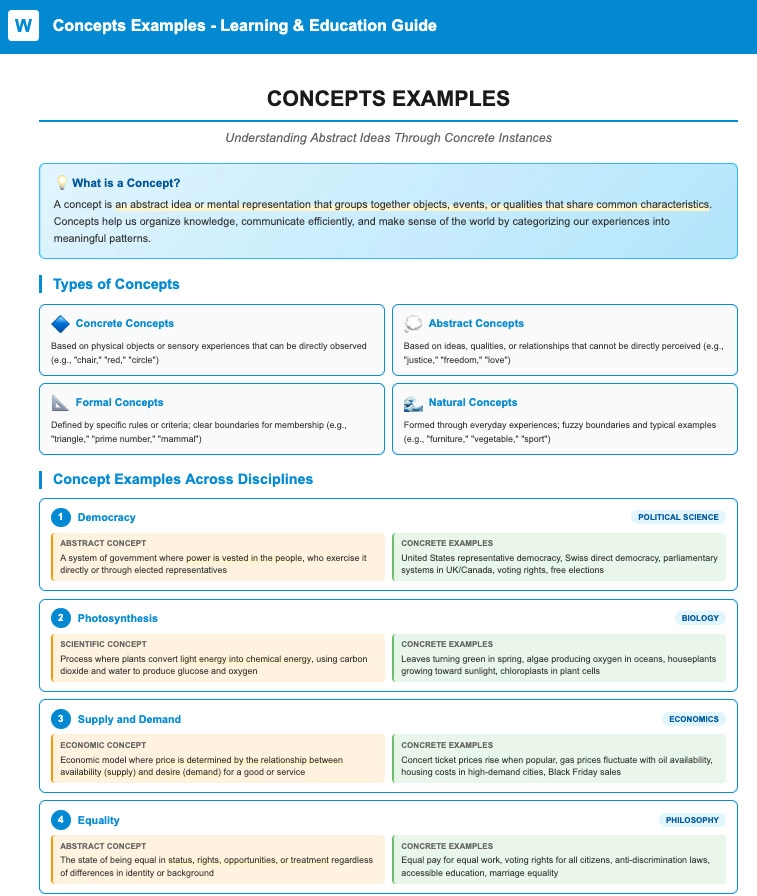
If you are searching for concepts examples, you are probably trying to do one of three things: (1) understand what a concept is, (2) explain how concepts work in real life, or (3) write a strong academic response for psychology, education, linguistics, or research methods. The key idea is simple: concepts are not “just definitions.” Concepts are mental representations that allow us to organize things in the world—including events and objects—so we can think, talk, and act efficiently in our everyday lives.
This blog post explains concepts using classic cognitive science language—prototype, exemplar, typicality, fuzzy boundaries, and memory retrieve—while also giving clear real-world examples (e.g kitchen utensils, birds like the penguin, and abstract ideas like justice). You will also learn why some concepts feel well defined while others have borderline members, why we sometimes put the same item in “different categories,” and why “concepts” shift with cultural trend.
Concept
A concept is a structured mental unit that represents a category or idea. In cognitive science, concepts are mental representations that connect language to experience and support reasoning, decision-making, and learning. Put simply, a concept helps you recognize and interpret things in the world—from the natural world (trees, animals) to human-made artifact (phones, chairs), to complex social events and objects (weddings, exams, contracts).
Concepts in real-world terms
A concept is your mind’s “file” for a category. It can be:
- a concrete concept (spoon, dog, bicycle)
- an abstract concept (freedom, leadership, intelligence)
- an abstract idea that still guides behavior (fairness, responsibility)
Concepts are part of your knowledge of the world, and they guide judgment constantly—often without you noticing. For example, you know what counts as a “safe neighborhood,” a “good job,” or a “serious assignment,” even if you cannot list every rule explicitly.
How do concepts form?
The theory of concepts asks: How do people build and use concepts? Two major approaches are common in introductory cognitive psychology and cognitive science:
- Prototype theory: you compare new items to a “best example” of a category called a prototype. Eleanor rosch showed that categories have graded structure: some members are more typical than others (measured through typicality). Research associated with mervis helped demonstrate how people judge category membership and typicality in everyday categories.
- Exemplar models: instead of one prototype, you store many remembered examples (exemplar) and compare new items to multiple stored cases.
These theories explain why a penguin is a bird but feels “odd.” It is a real category member, yet it is less typical than a robin. People treat it as a weaker match to the prototype of “bird.”
The “Big Book of Concepts” approach (a helpful learning trick)
Think of building your own big book of concepts—a personal catalog of categories you use often: “kitchen tools,” “types of arguments,” “research methods,” “professional behaviors,” “healthy habits,” and so on. This makes concepts easier to learn and recall because it strengthens the structure of your mental representations.
If you are writing academically, IvyResearchWriters.com can help you turn this into a clean explanation with accurate terminology and well-chosen examples that match your course level.
Generalization
Generalization is the process of using what you know about one instance to apply knowledge to new instances. It is one of the core cognitive processes that makes learning efficient.
For example, if you learn that “sparrows are birds,” you can generalize that birds typically have feathers, lay eggs, and can fly—then revise that knowledge when you meet exceptions like a penguin. Generalization is powerful, but it can create errors when categories are flexible, cultural, or context-dependent.
How generalization uses category levels
Many categories are organized into levels:
- superordinate: very broad (animal, furniture)
- basic-level: the “simplest” and most natural everyday level (bird, chair)
- subordinate: specific (penguin, rocking chair)
The basic-level is often what people use most in ordinary conversation because it is informative and easy to process. Researchers such as medin discuss how category learning varies by domain (for example, biology vs tools) and by goals (identifying vs explaining).
A “list of features” approach vs flexible concepts
Sometimes people treat concepts as if they are a strict list of features. That works for some well defined concepts (for example, “triangle” in geometry), but many real-world categories do not work that way. Real categories often depend on purpose, context, and similarity rather than strict rules.
This is why you may notice that items were in different categories depending on who is classifying them or what task they are doing. In academic writing, that variability is evidence that concepts are not always rule-based—they are often similarity- and goal-based.
Fuzzy
Many everyday concepts are fuzzy, meaning their boundaries are not precise. That is, there are clear members, clear non-members, and ambiguous cases called borderline members.
Fuzzy categories in real life: kitchen utensils
Consider the kitchen utensil category. Most people agree that a spoon is a utensil. But what about a sponge?
- Some people include sponge because it is used in the kitchen.
- Others exclude it because it is a cleaning tool rather than a cooking or eating tool.
This is a perfect example of a fuzzy category: category membership depends on function, context, and personal experience. Studies on fuzzy categories (including work where hampton found graded membership judgments) show that some items are seen as “weak” members—sometimes barely considered category members—while others are “strong” members. In practical terms, some items are considered category members and others are disputed.
Typicality: why some members feel “more real”
Typicality explains why a robin feels like a “better bird” than a penguin. Typicality effects are central to prototype theory and help explain why people disagree about category boundaries. Even within objects in categories, some members are naturally rated less typical.
Similarity, perception, and artifacts
Psychologists like tversky studied how people judge similarity, showing that similarity is not purely mathematical—it depends on attention, context, and the features you consider important. Categories also depend on perceptual cues (shape, color, sound) and function. For artifact categories (tools, furniture), function is often crucial.
The cognitive development angle also matters. Work associated with gelman and the principles of categorization emphasizes that children begin categorizing from an early age, learning not only “what looks alike” but also what things are for.
In short: fuzziness is not a flaw. It is a realistic feature of how humans handle complex real-world meaning.
Noun
A noun is not just grammar—it is a cognitive tool. When you name a category with a noun, you stabilize it in memory and communication.
However, many nouns are non-specific. They can hide important differences. For example, the noun “tool” can refer to thousands of objects. The noun “talent” can refer to music, leadership, planning, or design. These broad nouns can create a constraint on thinking because they encourage vague judgments rather than precise classification.
How nouns shape categorization
When you use a noun label, you prompt the mind to categorize. Nouns encourage us to:
- group items by commonality
- assign category membership
- infer unseen properties (“If it is a bird, it has feathers…”)
But nouns can also reduce clarity. You may need to differentiate with more precise labels:
- “Bird” (basic-level) vs “penguin” (subordinate)
- “Furniture” (superordinate) vs “chair” (basic-level)
- “Tool” vs “kitchen utensil”
A useful writing move is to define the noun, then narrow the category. For example: “A concept is a mental representation i.e a structured way of grouping experiences and objects.”
Scholars such as laurence have discussed how concept meaning and categorization relate to language and mental structure. For assignments, IvyResearchWriters.com can help you define nouns precisely and avoid vague descriptions that weaken arguments.
Retrieve
Concepts are useful because they allow you to retrieve information quickly. Retrieval is how the mind pulls a concept from memory when you need it (for example, answering exam questions, writing definitions, or identifying category members).
Why retrieval can be biased
Retrieval is not neutral. It is influenced by:
- temporal factors (recent experiences are easier to recall)
- spatial cues (where you saw it, where it happened)
- salience (vivid, emotional, or unusual examples)
- familiarity (frequently used categories are easier to access)
That means when you are asked for “concepts examples,” you might retrieve the most common school examples (fruit, birds, furniture) even though real-world categories are broader and more interesting.
A practical retrieval technique for students
To retrieve stronger examples quickly, use a structured prompt:
- Pick a domain (food, animals, tools, education, social life).
- List three events and objects in that domain.
- Identify category levels (superordinate → basic-level → subordinate).
- Add one fuzzy case (a borderline member).
- Add one abstract concept from the same domain.
Example set (kitchen domain):
- superordinate: kitchen item
- basic-level: utensil
- subordinate: whisk
- borderline: sponge
- abstract concept: cleanliness
This method improves both clarity and depth in writing.
Want a clear, high-scoring write-up on concepts examples?
Send IvyResearchWriters.com your prompt + word count + deadline, and we’ll deliver a ready-to-paste draft you can submit with confidence.
Trend
Concepts are not static. They change with culture, technology, and social priorities—this is the influence of trend.
How trends reshape concepts
Think about how the concept of “phone” changed:
- older: a device for calling
- now: camera, computer, social portal, wallet, map
As trends shift, categories shift. New subcategories appear. Old prototypes lose dominance. Even abstract concepts shift. “Success,” “productivity,” and “talent” have all changed in how people define them based on social trends and technology.
Trends also affect what people see as category members. Something once “barely considered category members” can become typical when society normalizes it (for example, online learning as “education,” content creation as “work,” smartphone photography as “photography”).
Why trend matters in academic writing
If you are writing about concepts in a “real-world” context, trends provide evidence that conceptual boundaries are flexible and socially influenced. That strengthens analysis, especially in psychology, sociology, education, and communication studies.
Publishers such as MIT Press often publish foundational and advanced cognitive science work (including concept formation, categorization, and semantics). If your assignment requires scholarly support, IvyResearchWriters.com can help you choose credible sources and integrate them in correct academic style.
Concepts examples you can reuse (quick list)
Below are examples you can use in essays and discussion posts—each illustrates a different principle:
- Concrete concept (well defined-ish): “spoon”
- Artifact category: “chair”
- Abstract concept: “justice”
- Prototype and typicality: “bird” with robin vs penguin (penguin is less typical)
- Fuzzy category: kitchen utensil category with sponge as a borderline member
- Superordinate/basic/subordinate: furniture → chair → rocking chair
- Semantic concept: “meaning” in language categories
- Retrieval bias: most recent examples come to mind first (temporal)
Final takeaway
A concept is a mental representation that helps us organize things in the world. Concepts support classification, generalization, and decision-making. Many concepts are fuzzy, with typical members and borderline cases. Language (especially the noun labels we use) shapes how we categorize, while memory influences what examples we can retrieve. And cultural trend can shift category boundaries over time.
If you need to turn this topic into a high-scoring research paper, coursework answer, or research-based explanation with citations, IvyResearchWriters.com can help you structure the argument, select strong e.g examples, and write in a clear academic voice without losing readability.
Frequently Asked Questions
What are concepts and examples?
Concepts are mental representations that help us make sense of things in the world—they let us group, label, and reason about events and objects. In other words, a concept is your mind’s “file” for a category so you can recognize something quickly and decide how to respond.
Examples (with quick notes):
- Dog (object concept): helps you recognize many different dogs as “dog,” even when they vary.
- Chair (artifact concept): includes many shapes and materials, but still fits the same label.
- Birthday party (event concept): a structured idea about what usually happens.
- Justice (abstract concept): an idea you cannot point to physically, but you can reason about.
In academic writing, IvyResearchWriters.com can help you define concepts clearly, then add strong e.g examples that fit your assignment’s rubric and level.
What are some basic concepts?
“Basic concepts” usually means the simplest, most commonly used categories people learn early and use constantly—concepts that organize everyday experience.
Some basic concepts (with examples):
- People (friend, teacher, nurse)
- Places (home, school, hospital)
- Objects (book, phone, spoon)
- Events (meal, exam, wedding)
- Actions (running, cooking, studying)
- Time (yesterday, now, tomorrow)
These concepts help us organize events and objects and connect language to things in the world.
What are the 4 types of concepts?
A useful, widely taught way to explain the four types of concepts is:
- Concrete concepts – physical items you can see or touch (i.e apple, table, pen).
- Abstract concepts – ideas you cannot touch (i.e freedom, honesty, talent).
- Event concepts – structured happenings over time (i.e graduation, job interview, birthday party).
- Relational concepts – concepts defined by relationships (i.e “bigger than,” “friend of,” “cause and effect”).
These categories are especially helpful when writing psychology, education, or research-methods papers—exactly the kind of work IvyResearchWriters.com regularly supports.
What are the types of concepts?
There are several “types of concepts” depending on how your course defines them. In many cognitive psychology and education contexts, you can describe types in two complementary ways:
A) Types by “what the concept is about”
- Objects (dog, chair)
- Events (wedding, lecture)
- Abstract ideas (justice, leadership)
- Relations (cause, similarity, hierarchy)
B) Types by “how category membership works”
Some concepts have clear boundaries, while others have fuzzy edges. That is why we talk about objects in categories and the fact that not every item fits perfectly.
Example: In a category like “games,” some items are obvious members, while others are barely considered category members depending on a person’s definition and experience.
If your instructor wants scholarly grounding, you can cite foundational cognitive science discussions from academic publishers such as MIT Press sources; IvyResearchWriters.com can help you integrate these correctly and keep the explanations simple, accurate, and well-structured.

