

Autocracy vs Dictatorship: Definitions, Differences, and Real-World Examples
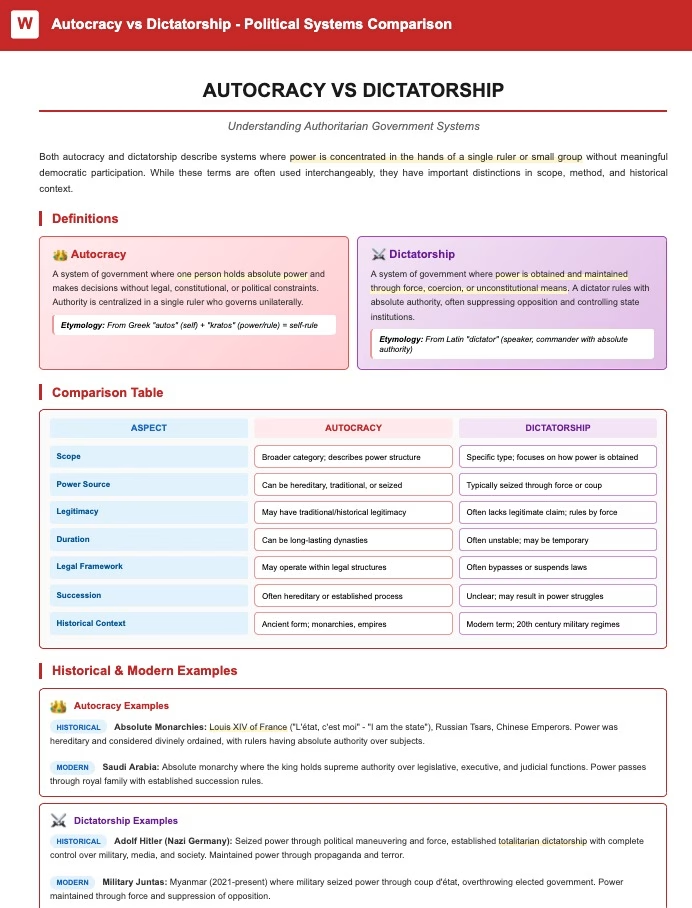
When people debate autocracy vs dictatorship, the terms often get used interchangeably. In everyday conversation, both suggest a single ruler, limited freedom, and power that goes unchecked. But in political science, the picture is more nuanced.
Understanding the difference between autocracy and dictatorship helps us better interpret today’s political landscape — from closed autocracies like north korea, totalitarianism, to hybrid regimes that still hold elections.
Let’s break it down clearly, thoroughly, and with real-world context.
Autocracy
At its core, autocracy is a system of government in which power is concentrated in the hands of one individual. The term comes from the Greek autokratēs, meaning “self-ruler.”
An autocrat is a ruler who holds absolute power and faces few, if any, institutional constraints. In an autocratic system of government:
- The head of state exercises broad authority.
- Separation of powers is weak or nonexistent.
- Checks and balances are minimal.
- The rule of law is often subordinated to the leader’s will.
A government in which absolute power is centralized in one person qualifies as a form of autocracy. However, not all autocracies look the same.
Types of Autocracy
There are several types of autocracy, including:
- Absolute monarchy – A hereditary ruler governs without constitutional limits. Example: Saudi Arabia, where the ruling family exercises dominant political authority.
- Theocracy – Religious leaders hold political power.
- Military rule – Power is seized by armed forces.
- Electoral autocracies – Elections exist but are not free and fair.
In all these forms, power is concentrated at the top, though the structure of legitimacy may differ — whether hereditary, religious, or electoral.
Closed Autocracies
Closed autocracies eliminate meaningful political competition altogether. Political parties may be banned or tightly controlled, civil society is suppressed, and civil liberties such as freedom of expression are heavily restricted.
Dictatorship
A dictatorship refers to a political system where a dictator holds unchecked authority. While every dictatorship is autocratic, not every autocracy is necessarily dictatorial in the same way.
A dictator typically:
- Seized power, often through a coup or revolution.
- Governs through repression and coercion.
- Suppresses opposition and competing political parties.
- Rules through a dominant ruling party or personal loyalty networks.
Historically, the term emerged during the Roman Republic, when a dictator was temporarily appointed during crises. Over time, however, dictatorship evolved to mean long-term, unrestrained rule.
Dictatorial and Totalitarian Regimes
Some dictatorships evolve into totalitarian systems, characterized by:
- Complete control over public and private life.
- A dominant ideology.
- State control of media and education.
- Extensive surveillance and repression.
North Korea is widely considered an example of totalitarianism — a form of dictatorship where the regime exercises extreme control over society.
Similarly, Benito Mussolini led a fascist and dictatorial regime in Italy. Fascist governments combine nationalism, militarism, and authoritarianism under a charismatic leader.
Autocracy vs Dictatorship
Now let’s directly address the question: what’s the difference between autocracy and dictatorship?
The Difference Between Autocracy and Dictatorship
The difference between autocracy and dictatorship lies in scope and structure:
| Feature | Autocracy | Dictatorship |
|---|---|---|
| Core idea | Rule by one person | Rule by one person with coercive control |
| Legitimacy | May be hereditary, religious, or electoral | Often gained after power was seized |
| Political competition | May exist in limited form | Typically suppressed entirely |
| Ideology | Not always ideological | Often tied to authoritarianism or fascism |
Put simply:
- Autocracy describes the structure of power (a single ruler).
- Dictatorship describes the practice of that power, often through repression.
These are subtle differences, but they matter in comparative politics.
Autocratic Governments
Autocratic governments appear in many forms today. Some present themselves as republics but function as centralized systems where elected representatives have little real authority.
Characteristics often include:
- Dominant ruling party
- Weak or symbolic legislatures
- Manipulated elections
- Limited civil society
- Curtailment of personal freedoms
Some autocratic regimes maintain public support through nationalism, economic performance, or patronage networks.
According to indices like Varieties of Democracy Institute (often called V-Dem), many states classified as democracies have gradually become autocratic, especially through erosion of media independence and judicial autonomy.
Research Essay Example
(APA 7 – Student Paper Format)
Autocracy vs. Dictatorship: Structural Authority and the Practice of Absolute Power
Your Name
University Name
Course Name
Instructor Name
Date
Autocracy vs. Dictatorship: Structural Authority and the Practice of Absolute Power
Abstract
Autocracy and dictatorship are frequently used interchangeably in public and political discourse, yet they represent distinct concepts within political science. Both systems centralize power and limit democratic accountability, but they differ in structure, legitimacy, and mechanisms of control. Autocracy refers broadly to a system of government in which authority is concentrated in a single ruler, while dictatorship denotes a more specific and often coercive form of governance characterized by repression and suspension of institutional constraints. This paper analyzes the conceptual differences between autocracy and dictatorship, examines their institutional characteristics, and contrasts them with democratic governance. Drawing on contemporary political science literature, the study further explores processes of autocratization and the implications for civil liberties and rule of law.
Introduction
The classification of political systems remains central to the study of comparative politics. Among the most debated regime types are autocracy and dictatorship. Although commonly treated as synonymous, the two concepts are analytically distinct. Political scientists emphasize definitional clarity because regime classification affects how governance, democratic decline, and authoritarian resilience are measured.
This essay argues that autocracy refers primarily to a structural concentration of authority in a single ruler, whereas dictatorship describes a specific and often coercive form of rule within that structure. By examining institutional features, historical examples, and contemporary developments, this paper clarifies the difference between autocracy and dictatorship and situates both within the broader framework of authoritarian governance.
Defining Autocracy
Autocracy is a system of government in which political power is concentrated in the hands of a single ruler. In autocratic systems, authority is centralized, and institutional constraints such as separation of powers and checks and balances are weak or nonexistent (Svolik, 2012). The rule of law is often subordinated to executive authority.
Autocratic governments can take multiple forms. Absolute monarchy represents a hereditary form of autocracy in which authority is vested in a ruling family. In such systems, legitimacy may derive from tradition, religion, or historical continuity. Contemporary examples include monarchical states such as Saudi Arabia, where political authority remains concentrated in the monarchy.
Another form of autocracy is the electoral autocracy. These systems maintain elections but undermine genuine political competition through manipulation of media, suppression of opposition parties, and institutional bias. While elections may appear free in form, they lack substantive fairness (Levitsky & Way, 2010).
Autocracy is therefore best understood as a structural category describing how authority is organized. It does not necessarily imply total repression, though civil liberties are typically limited.
Defining Dictatorship
A dictatorship refers to a political system in which a dictator exercises unchecked authority, typically acquired through force, coercion, or unconstitutional means. Unlike broader autocratic systems, dictatorships often involve overt repression, suspension of constitutional norms, and systematic suppression of political opposition (Geddes et al., 2018).
Historically, the term “dictator” originated in the Roman Republic, where emergency powers were temporarily granted to a single leader. In modern usage, however, dictatorship refers to prolonged and absolute rule without meaningful institutional accountability.
Dictatorial regimes are commonly associated with authoritarianism and, in extreme cases, totalitarianism. Totalitarian systems seek complete control over political, economic, and social life. North Korea is frequently cited as a contemporary example of totalitarian dictatorship, characterized by centralized authority within a ruling family and extensive repression (Arendt, 1951).
Fascist regimes also exemplify dictatorship. Benito Mussolini’s rule in Italy demonstrates how a leader can seize power, eliminate multiparty competition, and establish ideological control supported by coercion.
Thus, while dictatorship always involves autocratic structure, it is distinguished by its methods of governance—particularly the systematic use of repression and force.
The Difference Between Autocracy and Dictatorship
The difference between autocracy and dictatorship lies primarily in structure versus practice.
Autocracy refers to a system in which authority is concentrated in a single ruler. Dictatorship refers to how that authority is exercised—often through coercion, suppression of opposition, and erosion of legal institutions.
Several distinctions clarify this difference:
- Legitimacy
Autocrats may claim hereditary, religious, or electoral legitimacy. Dictators frequently seize power and rule without broadly accepted constitutional justification. - Institutional Framework
Some autocracies maintain formal political institutions, even if weakened. Dictatorships often suspend or override legal norms entirely. - Degree of Repression
Although autocratic systems restrict civil liberties, dictatorships are more consistently associated with systematic repression. - Ideological Control
Dictatorships, particularly fascist and totalitarian regimes, frequently rely on strong ideological narratives to justify authority.
While every dictatorship is autocratic in structure, not every autocracy necessarily functions as a dictatorship.
Autocracy and Democracy in Comparative Perspective
Democracy provides a useful contrast. Democratic systems are characterized by free and fair elections, multiparty competition, separation of powers, protection of civil liberties, and institutional checks and balances (Dahl, 1971).
Liberal democracy further emphasizes constitutional safeguards, judicial independence, and robust civil society. In such systems, elected representatives are accountable to citizens, and the rule of law limits executive authority.
By contrast, autocratic regimes concentrate power in the executive branch and weaken institutional accountability. Hybrid regimes—sometimes called competitive authoritarian systems—combine formal democratic institutions with authoritarian practices (Levitsky & Way, 2010). These systems illustrate how political structures may gradually become autocratic while maintaining electoral appearances.
Contemporary Autocratization
Recent scholarship documents a global trend of democratic backsliding. The Varieties of Democracy (V-Dem) Institute reports increasing autocratization across multiple regions (Coppedge et al., 2023). Unlike traditional coups, modern autocratization often occurs gradually through legal and institutional reforms.
Mechanisms of autocratization include:
- Weakening judicial independence
- Restricting freedom of expression
- Undermining civil society
- Manipulating electoral laws
- Expanding executive authority
Over time, these changes concentrate power in a single leader or ruling party. Even when elections continue, they cease to function as meaningful mechanisms of accountability.
Implications for Governance and Civil Liberties
Autocratic and dictatorial systems often curtail civil liberties, including freedom of expression, political participation, and assembly. The absence of checks and balances increases the likelihood of governance based on personal discretion rather than institutional constraint.
Without separation of powers and rule of law protections, political systems become vulnerable to despotism and authoritarian consolidation (Linz, 2000). In contrast, democratic governance distributes authority to prevent the accumulation of absolute power.
Understanding these implications is essential for evaluating regime stability, human rights conditions, and prospects for democratic reform.
Conclusion
Autocracy and dictatorship are closely related yet conceptually distinct forms of government. Autocracy refers broadly to a structural concentration of authority in a single ruler, whereas dictatorship describes a more specific and often coercive exercise of that authority.
The difference between autocracy and dictatorship lies in legitimacy, institutional structure, and degree of repression. While both systems limit democratic participation and weaken civil liberties, dictatorships typically rely more heavily on force and suspension of legal norms.
As global patterns of governance continue to evolve, precise conceptual distinctions remain critical. Clear definitions enable more accurate analysis of regime types, democratic decline, and the resilience of authoritarian systems.
References
Arendt, H. (1951). The origins of totalitarianism. Harcourt Brace.
Coppedge, M., Gerring, J., Knutsen, C. H., Lindberg, S. I., Teorell, J., Altman, D., & Ziblatt, D. (2023). V-Dem democracy report 2023: Defiance in the face of autocratization. Varieties of Democracy Institute.
Dahl, R. A. (1971). Polyarchy: Participation and opposition. Yale University Press.
Geddes, B., Wright, J., & Frantz, E. (2018). How dictatorships work: Power, personalization, and collapse. Cambridge University Press.
Levitsky, S., & Way, L. A. (2010). Competitive authoritarianism: Hybrid regimes after the Cold War. Cambridge University Press.
Linz, J. J. (2000). Totalitarian and authoritarian regimes. Lynne Rienner Publishers.
Svolik, M. W. (2012). The politics of authoritarian rule. Cambridge University Press.
Autocracies and Dictatorships
While closely related, autocracies and dictatorships are not identical categories.
An autocracy can be:
- Monarchical (based on monarchism)
- Theocratic
- Military-led
- Electoral
A dictatorship is usually more overtly coercive and often associated with:
- A cult of personality
- Severe repression
- Systematic human rights violations
- A leader acting on personal whim
In both cases, the system of government limits the rule of law, weakens political parties, and removes meaningful accountability.
Autocrat
An autocrat is the individual who governs under autocratic rule. The autocrat may:
- Inherit power (hereditary monarchy)
- Be installed by military coup
- Rise through manipulated elections
Unlike a constitutional monarch in a liberal democracy, an autocrat faces few meaningful institutional restraints.
The autocrat’s authority often depends on:
- Loyalty of security forces
- Control of the political landscape
- Suppression of opposition
- Ability to maintain power through patronage or fear
Autocratic Rule
Autocratic rule centralizes authority and limits pluralism. In such political systems:
- The separation of powers is weak.
- Courts lack independence.
- The press is restricted.
- Elections (if held) are not fully competitive.
Under autocratic rule, governments frequently justify control in the name of stability, religion, nationalism, or economic progress.
However, without checks and balances, governance can slide toward despotism or outright tyranny.
Don’t risk losing marks over unclear definitions or weak analysis.
Order your custom-written political science paper today at IvyResearchWriters.com and submit with confidence.
Democracy
To fully understand autocracy vs, we must contrast both systems with democracy.
In a democracy:
- Power ultimately belongs to the people.
- Leaders are chosen in free and fair elections.
- Multiple political parties compete in a multiparty environment.
- Elected representatives are accountable.
- Civil liberties and freedom of expression are protected.
- There is institutionalized separation of powers.
Modern political science identifies several varieties of democracy, including:
- Liberal democracy
- Electoral democracy
- Parliamentary republic
- Presidential republic
Democracies rely heavily on the rule of law and vibrant civil society to prevent leaders from becoming autocratic.
Autocracy vs Democracy
When examining autocracy vs democracy, the core difference lies in distribution of power.
| Democracy | Autocracy |
|---|---|
| Power dispersed | Power is concentrated |
| Multiparty competition | Often single ruling party |
| Protection of civil liberties | Frequent repression |
| Institutional accountability | Leader dominance |
Some states exist in between — known as hybrid regimes. These combine democratic institutions with authoritarian practices. They may hold elections but manipulate the political system to ensure the ruling party wins.
Autocratic Governments in Today’s Political Landscape
Modern autocratic governments rarely declare themselves dictatorships. Instead, they:
- Maintain controlled elections
- Use state media to shape narratives
- Curtail opposition gradually
- Alter constitutions to extend terms
These autocratic regimes often claim legitimacy through development or stability. Yet over time, they weaken the institutional guardrails that protect democracy.
Become Autocratic
How do political systems become autocratic?
It often happens gradually:
- Weakening independent courts.
- Undermining the press.
- Restricting civil society.
- Expanding executive authority.
- Reducing meaningful political competition.
This process, sometimes called democratic backsliding, does not always involve a coup. Leaders elected in democracies can slowly centralize authority until the system resembles a dictatorship.
Final Thoughts: What’s the Difference Between Autocracy and Dictatorship?
To summarize:
- Autocracy is a system where a single ruler holds concentrated power.
- A dictatorship is typically a more coercive, often ideologically driven form of autocracy.
- Both contrast sharply with democracy, especially liberal democracy.
- The difference between autocracy and dictatorship lies in degree, structure, and method of control.
In the end, whether labeled autocratic, authoritarian, fascist, or dictatorial, the defining feature remains the same: power flows upward to one leader, not outward to the people.
Understanding these subtle differences equips readers, students, and researchers to better interpret global political systems — and recognize when governments begin shifting away from democratic norms toward autocratic rule.
Frequently Asked Questions
Is autocracy the same as a dictatorship?
Not exactly — and this is where a lot of students lose easy marks in political science essays.
While the two terms overlap, they are not identical.
Here’s the distinction in both point and prose form:
Key Points
- Autocracy is a system of government where power is concentrated in a single ruler.
- A dictatorship is usually a more extreme or coercive version of autocratic rule.
- Every dictatorship is autocratic.
- Not every autocracy functions as a classic dictatorship.
- The difference between autocracy and dictatorship often lies in how power is acquired and exercised.
An autocrat governs within an autocratic structure — meaning authority flows upward and institutional checks and balances are weak. This could include an absolute monarchy, a military-led regime, or even certain electoral autocracies where elections exist but are not fully free and fair.
A dictator, however, often seized power, rules in a more openly coercive manner, suppresses political parties, and governs through repression. Dictatorial regimes frequently eliminate meaningful opposition and consolidate complete control over the political landscape.
Understanding this nuance is essential in academic writing — and this is exactly the type of conceptual precision IvyResearchWriters.com helps students master.
Is the USA a democracy or autocracy?
The United States is classified as a democracy, more specifically a constitutional republic and a form of liberal democracy.
Why it is considered a democracy:
- Power is distributed through a system of separation of powers.
- There are institutional checks and balances.
- Leaders are chosen in competitive, multiparty elections.
- Citizens enjoy protected civil liberties and freedom of expression.
- The rule of law constrains government authority.
- Elected representatives are accountable to voters.
What countries are autocratizing?
“Autocratizing” refers to countries that are shifting away from democracy and toward more authoritarian or autocratic regimes.
According to global democracy indices such as Varieties of Democracy Institute (V-Dem), several countries in recent years have experienced democratic backsliding.
Characteristics of Autocratization:
- Weakening of judicial independence
- Restrictions on media
- Reduced civil liberties
- Manipulated elections
- Dominant ruling party
- Increasing executive power
Some countries labeled as hybrid regimes hold elections but undermine democratic norms behind the scenes. These systems are sometimes called electoral autocracies.
Autocratization does not always involve a dramatic coup. Often, power is consolidated gradually until power is concentrated in a way that resembles autocratic rule.
Understanding this process requires examining institutional change, political culture, and governance structures — precisely the kind of deep analytical work that benefits from expert academic guidance.
What is an example of an autocracy?
A commonly cited example of a modern autocracy is North Korea.
Why North Korea is considered autocratic:
- Power is centralized under a single ruler.
- The ruling family has maintained hereditary control.
- Political opposition is not tolerated.
- The regime exercises near-total authority over public life.
- It is widely described as totalitarian, a highly centralized form of autocracy.
In this system of government, authority flows from the top down, and personal freedoms are severely limited. Political competition is effectively nonexistent, and governance is structured around maintaining regime stability.
Another example of a form of autocracy would be an absolute monarchy, such as Saudi Arabia, where the ruling family holds dominant political power in a monarchical structure.
Why These Distinctions Matter
When students ask:
- What’s the difference between autocracy and dictatorship?
- Is a republic automatically democratic?
- How do systems become autocratic?
They are engaging with core debates in comparative politics and political systems analysis.
Clear definitions matter:
- Autocracy focuses on structure.
- Dictatorship emphasizes practice and control.
- Democracy emphasizes institutional accountability and protection of rights.
Academic clarity on these topics can significantly improve essays, research papers, and dissertations.
If you’re writing about autocracies, authoritarianism, democracy, or the global political landscape, having well-researched, properly structured analysis can make all the difference — and that’s exactly where IvyResearchWriters.com positions itself as a trusted academic support partner.

