

What To Know
- While British English is often considered the standard form originating from Britain, Indian English represents a unique variety of English shaped by India’s linguistic heritage, colonial history, and diverse regional dialects.
- Indian English is a hybrid form that has derived from British influence but evolved into a distinct and culturally rich system.
English vs Indian English: Understanding the Linguistic Differences, Variants, and Global Influence
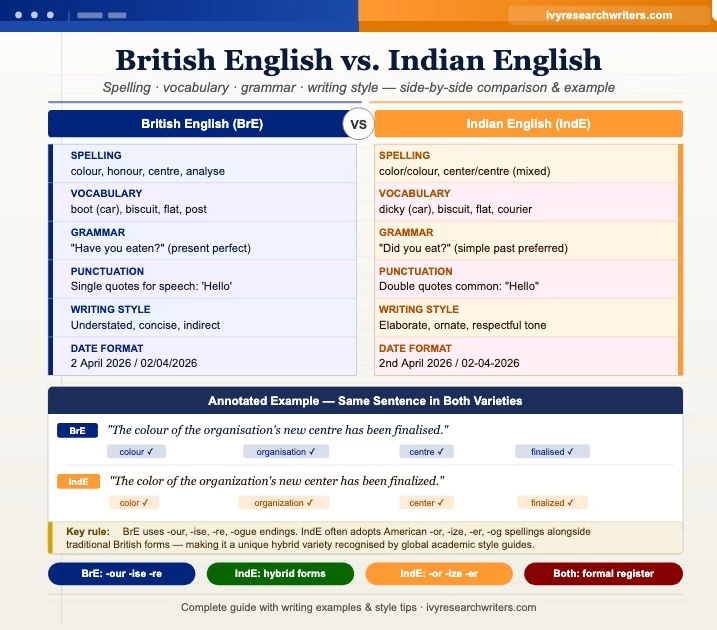
Introduction
The comparison of English vs Indian English reveals how a global language evolves across cultures, regions, and histories. While British English is often considered the standard form originating from Britain, Indian English represents a unique variety of English shaped by India’s linguistic heritage, colonial history, and diverse regional dialects.
Today, India is one of the largest English-speaking populations in the world, where millions of speakers speak English daily. However, the way Indians speak English differs significantly in terms of pronunciation, grammar, vocabulary, and usage. This article explores these differences in depth, offering examples and explanations to help you understand this fascinating linguistic phenomenon.
Indian English & British English: Two Global Variants of a Shared Language
Indian English and British English are both recognized as important variants within the broader category of World Englishes.
- British English originates from Britain and serves as a global reference for formal grammar, spelling, and pronunciation
- Indian English is a hybrid form that has derived from British influence but evolved into a distinct and culturally rich system
While a native speaker of British English may expect standardized forms, Indian English reflects adaptability and cultural integration.
Embrace Language Difference: Why English Evolves in India
India has learned to embrace English not just as a colonial legacy but as a practical and unifying language.
- English is widely used in India in education, governance, and business
- It bridges communication across multiple regional languages
- It reflects a blend of linguistic influence from Hindi and other local languages
This has led to a unique variety of English that differs from traditional norms but remains effective and widely understood.
India, Dialect, and the Evolution of English
In India, English is shaped by a wide range of different dialects.
- Each region has its own way to pronounce, structure, and speak English
- These dialects are influenced by local languages and cultural practices
- Southern Indian English, for example, has distinct phonetic and rhythmic patterns
This diversity highlights the role of dialect in shaping how English is spoken globally.
English vs Regional Accent: Pronunciation and Phonology Differences
One of the most noticeable differences in English vs Indian English lies in accent and pronunciation.
- Indian English often uses rhotic pronunciation, meaning the “r” sound is pronounced clearly
- British English is typically non-rhotic, dropping the “r” in certain words
- Indian speakers may use retroflex consonants (such as the d̪ sound) influenced by local languages
Example:
- British English: “water” → /ˈwɔːtə/
- Indian English: “water” → /ˈwɔːtər/
These differences reflect variations in phonology, syllable stress, and sound patterns.
Vocabulary Differences Between British English and Indian English
The vocabulary used in Indian English often includes unique expressions and culturally specific terms.
Common examples:
- “Do the needful” (Indian English) → “Take necessary action” (British English)
- “What is your good name?” → “What is your name?”
- “Kindly revert” → “Please reply”
These phrases are part of everyday usage in India and are often considered polite or formal.
Indian English also incorporates words like Hindi expressions, resulting in hybrid forms such as Hinglish.
British English vs Grammar: Syntax, Structure, and Usage
There are subtle but important grammar differences between Indian and British English.
- Indian English may follow different word order influenced by local languages
- Greater use of the passive voice in formal and administrative communication
- Slight variations in syntax and grammatical structure
Example:
- Indian English: “The report has been completed by me.”
- British English: “I have completed the report.”
These differences show how grammar adapts to context and culture.
Linguistic Influence: Hindi, Hinglish, and Code-Switching
One of the defining features of Indian English is the strong linguistic influence of Hindi and other local languages.
- Code-switching is common: mixing English with Hindi
- Example: “Let’s prepone the meeting, yaar.”
- This results in a hybrid form known as Hinglish
This blending reflects how language evolves in multilingual societies.
Southern Indian English and Regional Variants
Southern Indian English is a distinct variant influenced by Dravidian languages.
- Clear articulation of vowels
- Unique phonetic patterns
- Strong emphasis on syllables
These features differ from both British English and American English, highlighting regional diversity.
Linguistic Heritage and the Rise of World Englishes
India’s rich linguistic heritage has contributed to the global concept of World Englishes.
- English is adapted to local contexts
- Each region creates its own variety of English
- Indian English is now recognized as a legitimate global form
This reflects the dynamic nature of language evolution.
Idiom, Colloquialism, and Cultural Expression
Indian English includes unique idioms and colloquialisms.
- Reflect cultural norms and values
- Often differ from those common in British English
Example:
- “Timepass” (means something done for leisure)
- “Out of station” (means out of town)
These expressions add richness to communication.
Scottish English and Other Variants: A Comparative Perspective
Just as Scottish English differs from standard British English, Indian English demonstrates how language evolves across regions.
- Highlights diversity within English
- Shows how different dialects shape communication
Pronunciation, Phonetic Features, and Speech Patterns
Indian English includes unique phonetic features:
- Strong articulation of consonants
- Use of cluster sounds differently
- Influence of local pronunciation habits
These differences affect how speakers pronounce words and structure speech.
Politeness, Formality, and Communication Style
Indian English tends to be more polite and formal.
- Frequent use of words like “kindly”
- Indirect communication style
- Reflects cultural values of respect
Related Assignments on English vs Indian English
Students in linguistics, communication, and English studies often complete assignments exploring how english spoken varies across regions and how regional differences shape language use.
1. Comparative Essay: English vs Indian English
- Analyze the origin and evolution of both forms
- Compare pronunciation, vocabulary, and grammar
- Discuss how each variety aims to preserve or adapt language
2. Linguistic Variation Research Paper
- Examine how regional differences influence English usage
- Explore how local Indian languages affect Indian English
- Provide examples (e.g) of dialectal variation
3. Case Study on Workplace Communication
- Analyze phrases like “please do the needful”
- Explain their historical origin and modern usage
- Evaluate effectiveness in global communication
4. Accent and Pronunciation Analysis
- Study how numbers or words are pronounced differently
- Compare Indian and British pronunciation patterns
- Include examples (e.g) of phonetic differences
5. Sociolinguistics Assignment
- Explore how English evolves in multilingual societies
- Discuss how language adapts while attempting to preserve identity
- Analyze how english spoken reflects culture
6. Code-Switching and Hinglish Project
- Examine mixing of English and Hindi
- Analyze influence of local Indian languages
- Provide real-life examples (e.g)
7. Grammar and Usage Comparison Task
- Compare sentence structures in Indian and British English
- Identify key regional differences
- Analyze how grammar reflects linguistic adaptation
8. Presentation on World Englishes
- Discuss global variations of English
- Highlight Indian English as a case study
- Explain how each variety has a unique origin
9. Reflection Essay on Language Learning
- Reflect on your experience learning English
- Discuss how regional differences affected understanding
- Provide examples (e.g) from real-life communication
10. Cultural Linguistics Assignment
- Analyze how language reflects culture
- Explore how Indian English helps preserve cultural identity
- Discuss its global significance
Struggling with linguistics papers, research projects, or complex academic assignments?
IvyResearchWriters.com is your trusted partner for high-quality, well-researched, and expertly written content.
Research Paper Example: Linguistic Variation in English – A Comparative Study of Indian English and British English
Title
Linguistic Variation in English: Examining Regional Differences Between Indian English and British English
Abstract
Linguistic variation is a key concept in sociolinguistics, referring to differences in language use across regions, cultures, and social groups. This research paper explores variation in english spoken in India and Britain, focusing on pronunciation, vocabulary, grammar, and cultural influences. By examining the historical origin and evolution of these varieties, the study highlights how language adapts while attempting to preserve identity. The findings demonstrate that Indian English is a legitimate and distinct variety shaped by strong regional differences and local linguistic influences.
Introduction
Language is not static; it evolves over time and across regions. The study of linguistic variation examines how english spoken differs based on geography, culture, and social context. This paper focuses on the variation between British English and Indian English, two widely used forms of English with shared roots but distinct characteristics.
The origin of Indian English can be traced to British colonial rule, during which English was introduced as an administrative and educational language. Over time, it adapted to the linguistic and cultural context of India, influenced by local Indian languages such as Hindi and Tamil.
This research aims to analyze the regional differences between these two varieties and understand how language evolves while attempting to preserve both communication efficiency and cultural identity.
Literature Review
Linguistic scholars have long recognized that English exists in multiple forms, often referred to as World Englishes. According to Kachru (1985), English has developed into several regional varieties, each shaped by its sociocultural environment.
Studies show that Indian English reflects a blend of British English and local linguistic influences. For e.g, phrases such as “do the needful” and “out of station” are commonly used in India but are less familiar in Britain. These expressions illustrate how language evolves in response to local needs.
Research also highlights that regional differences in pronunciation, grammar, and vocabulary are natural outcomes of language adaptation. These differences do not indicate incorrect usage but rather reflect linguistic diversity.
Methodology
This study adopts a qualitative research approach, analyzing existing literature and examples of language use.
- Data sources include academic journals, textbooks, and online corpora
- Focus on identifying patterns in pronunciation, vocabulary, and grammar
- Comparative analysis of British English and Indian English
This approach allows for a detailed examination of how linguistic variation occurs in real-world communication.
Analysis and Discussion
1. Pronunciation and Accent
One of the most noticeable differences lies in pronunciation.
- British English is typically non-rhotic (the “r” sound is often not pronounced)
- Indian English is generally rhotic, meaning the “r” sound is clearly pronounced
For e.g, the word “car” may be pronounced as /kɑː/ in British English but as /kar/ in Indian English.
These differences are influenced by local Indian phonetic systems and reflect broader regional differences.
2. Vocabulary and Usage
Indian English includes unique vocabulary shaped by cultural context.
- “Do the needful” → means to take necessary action
- “Good name” → refers to a person’s full name
These expressions have historical origin in older forms of British English but have been preserved in Indian usage.
3. Grammar and Sentence Structure
There are also differences in grammar.
- Indian English often uses more formal constructions
- Greater use of passive voice in formal communication
For e.g:
- Indian English: “The work has been completed by me.”
- British English: “I have completed the work.”
These variations reflect differences in communication style and cultural norms.
4. Influence of Local Languages
The influence of local Indian languages is a defining feature of Indian English.
- Code-switching is common (mixing English with Hindi or other languages)
- Example: “Let’s prepone the meeting”
This blending demonstrates how English adapts to multilingual environments.
Implications of Linguistic Variation
Linguistic variation has several important implications:
- It reflects cultural identity and diversity
- It challenges the idea of a single “correct” form of English
- It highlights the adaptability of language
Understanding these differences is essential for effective global communication.
Conclusion
This research demonstrates that linguistic variation is a natural and essential aspect of language evolution. The differences between British English and Indian English reflect historical, cultural, and social influences rather than errors.
By examining pronunciation, vocabulary, and grammar, this study shows how English adapts to different contexts while attempting to preserve its core structure. Ultimately, recognizing and appreciating these variations enhances communication and promotes linguistic diversity.
References (Sample – APA Style)
- Kachru, B. B. (1985). Standards, codification and sociolinguistic realism: The English language in the outer circle.
- Trudgill, P. (2000). Sociolinguistics: An introduction to language and society.
- Crystal, D. (2003). English as a global language. Cambridge University Press.
Conclusion
The comparison of English vs Indian English demonstrates that language is not static—it evolves with culture, geography, and history. While British English provides a standardized framework, Indian English represents a vibrant, adaptive, and culturally rich variant.
Understanding these differences helps learners, professionals, and researchers navigate global communication more effectively. Ultimately, both forms contribute to the richness of global English and reflect the diversity of human expression.
FAQs: English vs Indian English Explained
What is the difference between English and Indian English?
- English (especially British English) has its origin in Britain and follows standardized rules
- Indian English is a localized form of english spoken in India
- Differences exist in pronunciation, vocabulary, and grammar
- Strong regional differences influence how Indian English is used
In explanation: The key difference lies in adaptation. While standard English aims to preserve traditional forms, Indian English reflects cultural and linguistic diversity. It incorporates influences from local Indian languages, making it a distinct yet globally recognized variety.
Why do Indians say “please do the needful”?
- It is a phrase derived from older British administrative English
- Still widely used in formal communication in India
- Reflects politeness and efficiency
In context: The phrase “please do the needful” originates from colonial-era usage and has been preserved in Indian communication styles. It is commonly used in professional emails and workplace communication as a polite request. For e.g, instead of giving detailed instructions, the phrase implies that the recipient understands what action is required.
How do you say 67 in an Indian accent?
- Typically pronounced clearly as “sixty-seven”
- Each syllable is distinctly articulated
- The “r” sound is often pronounced (rhotic pronunciation)
In explanation: In Indian English, pronunciation tends to be more phonetic compared to British English. This reflects regional differences and the influence of local Indian languages. For e.g, speakers may emphasize each syllable, making the number sound more precise and evenly stressed.
What accent is similar to Indian?
- Some similarities exist with other global English accents influenced by colonial history
- Certain features may resemble African or Southeast Asian English accents
- Shared traits include clear pronunciation and syllable emphasis
In context: Indian English is unique, but it shares characteristics with other forms of english spoken in multilingual regions. These similarities arise from historical origin and linguistic adaptation. However, Indian English remains distinct due to its strong regional differences and influence from local Indian languages.

