

Abstract Philosophical Questions: Deep Ideas That Challenge Us to Think
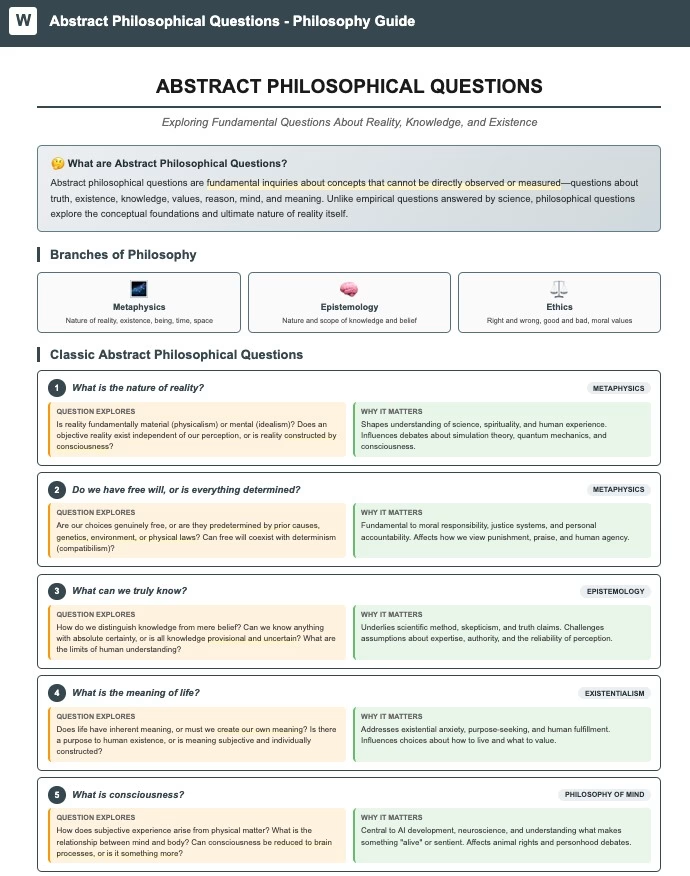
Throughout human history, people have wrestled with abstract philosophical questions that stretch the limits of human understanding. These are not ordinary everyday thinking questions. They are profound philosophical inquiries that explore morality, the nature of reality, the meaning of life, and the fundamental aspects of human existence.
Unlike questions with clear answers, philosophical questions are best known for challenging assumptions, opening new possibilities, and inviting deep thinking. In this guide, we’ll explore definitions, examples, and a carefully curated list of philosophical questions that make you think.
Philosophical Question
A philosophical question is one that investigates fundamental aspects of reality, knowledge, morality, or human consciousness. These questions often lack a single right answer and instead invite multiple points of view.
Questions like:
- What is the meaning of life?
- Do we have personal freedom?
- What is the nature of reality?
- What defines a person’s identity?
A philosophical question challenges us to think beyond surface-level explanations. It pushes us to examine our moral principles, mental states, and personal autonomy.
Ancient philosophers and modern thinkers alike have recognized that such questions shape how we understand ourselves and others.
Philosophical
The term philosophical refers to ideas or discussions concerned with exploring abstract questions about human existence, morality, knowledge, and truth.
Philosophy involves:
- Exploring ideas deeply
- Examining ethical considerations
- Evaluating causality
- Analyzing paradox
- Questioning religious claims
- Reflecting on mathematics and logic
Philosophical concepts are not limited to academia. They influence social cohesion, moral responsibility, and personal fulfillment.
Abstract Philosophical Questions
Abstract philosophical questions focus on ideas that cannot be observed directly but require reasoning and reflection.
Examples include:
- Is human consciousness purely material, or is there something beyond the physical?
- Is morality a construct of human society?
- Does life’s meaning exist independently of our subjective experience?
- Could omnipotence logically exist, or is it a paradox?
These abstract questions bridge the gap between scientific discoveries and human understanding. While science may explain mechanisms, philosophy explores meaning.
Abstract philosophical questions help us connect with others by discussing shared existential concerns.
List of Philosophical
Below is a short preview of a broader list of philosophical topics:
- Morality and ethical considerations
- The nature of reality
- Epistemology and knowledge
- Personal freedom and autonomy
- Human consciousness
- Causality and determinism
- The meaning of life
Each topic opens the door to countless philosophy questions and debates.
List of Philosophical Questions
Here is a curated list of philosophical questions that stimulate deep thinking:
- What is the meaning of life?
- Does free will truly exist?
- What defines a person’s identity?
- Are moral principles universal or subjective?
- Can scientific discoveries fully explain human consciousness?
- Is reality independent of perception?
- What makes an action morally right or wrong?
- Can knowledge ever be certain?
- What is the fundamental question of human existence?
- Does personal fulfillment depend on external success?
- Can mathematics and logic reveal ultimate truth?
- Are religious claims compatible with rational inquiry?
- Is the world fundamentally good or morally neutral?
- Does causality require time?
- Is death the end of subjective experience?
Questions are best when they provoke multiple philosophical positions rather than demand one clear answer.
Epistemology
Epistemology is the branch of philosophy that studies knowledge — how we know what we know.
Epistemologists examine:
- The limits of human understanding
- The difference between belief and knowledge
- Whether certainty is possible
- How perception shapes truth
Epistemological questions include:
- Can we trust our senses?
- Is knowledge objective or subjective?
- Do mental states correspond to external reality?
Epistemology forces us to question whether our worldview is reliable.
Critical Thinking
Philosophy sharpens critical thinking skills. It encourages:
- Evaluating arguments
- Examining underlying assumptions
- Considering possibility of different perspectives
- Identifying logical fallacies
Critical thinking helps us move beyond egocentric viewpoints and understand others more deeply.
A philosophical conversation challenges us to think carefully about moral responsibility and personal autonomy.
Best Philosophical Questions
The best philosophical questions are those that:
- Have no single right answer
- Invite multiple points of view
- Challenge us to think deeply
- Explore human existence
- Connect abstract reasoning to everyday life
Questions like “What gives life meaning?” or “What makes a person morally responsible?” remain central across centuries.
Philosophers argue that these questions help us refine our ethical frameworks and better understand human consciousness.
Deep Philosophical Questions
Deep philosophical questions probe the most profound aspects of existence:
- Is suffering necessary for growth?
- Can humans ever fully understand reality?
- Does personal identity persist over time?
- Is morality dependent on social cohesion?
- Does the world work according to rational principles?
These deep philosophical questions often reveal hidden assumptions in our everyday thinking.
Unanswerable
Some philosophical problems may be considered unanswerable in the traditional sense.
For example:
- Is there ultimate purpose to the universe?
- Can omnipotence logically exist?
- Is there a final cause behind existence?
Although unanswerable questions lack definitive solutions, they still hold power to change how we think.
Philosophy questions do not always seek final answers — they seek deeper understanding.
Questions About Death
Questions about death remain among the most significant existential questions:
- Is death the end of human consciousness?
- Does death give life meaning?
- How should we live knowing death is inevitable?
Such questions help us confront human mortality and explore personal freedom.
Philosophical reflection on death often shapes moral principles and personal fulfillment.
Conversation Starters
Philosophical conversation starters can help bridge the gap between abstract theory and real-life discussion.
Examples:
- If you could know one ultimate truth, what would it be?
- Is happiness more important than truth?
- What would a morally perfect society look like?
These big questions encourage social cohesion and deeper human understanding.
Big Questions
Big questions examine the fundamental aspects of human existence:
- Why is there something rather than nothing?
- What is reality?
- Is human consciousness reducible to biology?
- Does morality require a divine source?
Big questions shape how we understand human existence and our place in the world.
Tough Philosophical
Tough philosophical dilemmas often present ethical considerations with no clear answers:
- Would you sacrifice one person to save many?
- Is it ever morally acceptable to lie?
- Should personal autonomy override social responsibility?
Such dilemmas reveal the complexity of moral responsibility and human values.
Make You Think
Ultimately, abstract philosophical questions make you think deeply about your worldview.
They:
- Challenge us to think critically
- Expand our understanding
- Encourage exploration of new possibilities
- Help us connect with others
- Shape how we understand reality
Philosophy invites us to question whether our assumptions are justified and whether alternative philosophical positions might be equally valid.
Order your custom philosophy paper today!!
Ready to Turn Big Ideas Into A+ Papers?
Abstract philosophical questions are powerful — but writing about them clearly and persuasively? That’s where many students struggle.
Why Abstract Philosophical Questions Matter
Abstract philosophical questions:
- Help us refine critical thinking
- Encourage deeper moral reasoning
- Expand our epistemological awareness
- Bridge scientific knowledge and human experience
- Shape how we approach life
Whether exploring the meaning of life, the nature of reality, or moral responsibility, philosophy enriches both academic study and personal growth.
Need Help Writing a Philosophy Paper?
If you’re working on:
- A list of philosophical questions analysis
- An epistemology essay
- A deep philosophical questions discussion
- A morality or ethical considerations paper
- A dissertation on philosophical problems
IvyResearchWriters.com provides:
✔ Expert philosophy writers
✔ APA, MLA, and Chicago formatting
✔ Plagiarism-free academic content
✔ Graduate and PhD-level research support
✔ On-time delivery
Order your custom philosophy paper today at IvyResearchWriters.com and submit with confidence.
Frequently Asked Questions
What are abstract philosophical questions?
Abstract philosophical questions are deep, conceptual inquiries that explore ideas beyond physical observation or simple factual answers. They deal with themes like existence, morality, knowledge, consciousness, and reality.
Unlike everyday questions (“What time is it?”), abstract questions:
- Do not have a single right answer
- Require critical reasoning and reflection
- Explore ideas that shape a person’s life
- Often spark long philosophical discussions
These are the kinds of questions to ask when exploring meaning, identity, or truth.
For example:
- Is reality independent of perception?
- Is morality objective or subjective?
- Does free will truly exist?
These questions are often debated by philosophers like Plato, Kant, and Descartes. They invite multiple interpretations, including religious, rationalist, and even materialist perspectives.
When students are assigned to analyze abstract philosophical questions, professors expect more than surface-level commentary. At IvyResearchWriters.com, we help transform abstract ideas into well-structured, academically sound arguments.
What are examples of philosophical questions?
Philosophical questions address fundamental issues about human existence, knowledge, and ethics.
Here is a short list of questions often discussed in philosophy courses:
- What is the meaning of life?
- What defines a person’s identity?
- Do humans have free will?
- What makes an action morally right or wrong?
- Can we truly know anything with certainty?
- Is reality purely physical, as a materialist might argue?
These questions to ask are designed to challenge assumptions and deepen understanding.
For example, philosophers like Aristotle explored virtue and morality, while modern thinkers debate whether consciousness can be fully explained through neuroscience.
A good philosophy paper does more than list questions — it analyzes positions, compares viewpoints, and builds logical arguments. That’s where IvyResearchWriters.com ensures your work stands out.
What is the meaning of pondering abstract philosophical questions?
Pondering abstract philosophical questions means engaging in deep reflection about fundamental aspects of existence and human experience.
It involves:
- Thinking critically about a person’s life and purpose
- Exploring competing philosophical perspectives
- Examining moral and ethical dilemmas
- Questioning assumptions we take for granted
When someone reflects on questions like “Is happiness the ultimate goal?” or “Does suffering have meaning?”, they are engaging in philosophical thinking.
This kind of reflection:
- Encourages intellectual growth
- Expands awareness of different points of view
- Helps clarify personal values
- Shapes how we approach life
For students, pondering abstract questions often leads to rich essays and compelling discussions. If you’re unsure how to structure that reflection academically, IvyResearchWriters.com provides expert assistance to turn your thoughts into polished analysis.
What is the abstract question?
An abstract question is one that focuses on ideas rather than concrete facts. It deals with concepts that cannot be directly observed or measured.
An abstract question might be:
- Is justice universal?
- Does reality exist independently of the mind?
- Is personal identity tied to memory?
These are not questions with immediate or simple answers. Instead, they are prompts for a deeper question to discuss in philosophical conversation.
Abstract questions:
- Explore big ideas
- Encourage logical reasoning
- Invite different interpretations
- Challenge us to think beyond everyday thinking
For example, a materialist may argue that everything — including consciousness — is physical, while others propose non-material explanations. These debates illustrate how abstract questions generate diverse philosophical positions.
When writing about abstract questions in academic settings, clarity and structured reasoning are essential. IvyResearchWriters.com helps students craft well-organized philosophy papers that demonstrate depth, originality, and strong critical analysis.

