

Snowball: What It Is and Why Researchers Like It
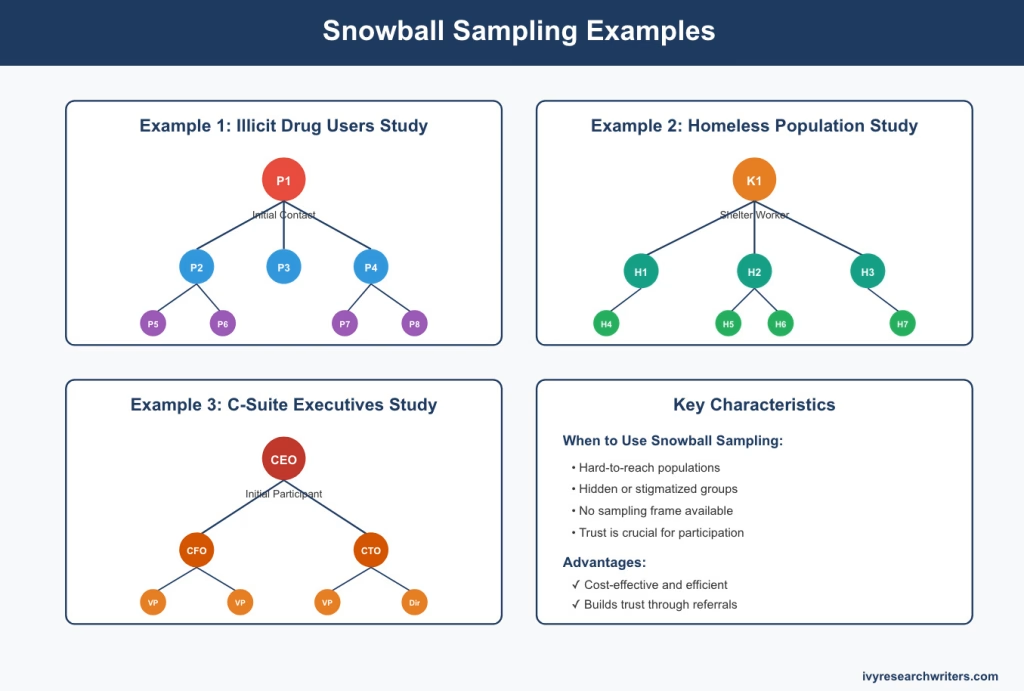
Snowball sampling is a non-probability sampling method that grows through referrals. You begin with a small group of people who fit your study, and you ask them to point you to others who also fit. Each new participant then “rolls” the study forward by recommending more people, so the sample expands like a snowball. This is especially useful when the group you want to study is hard to reach, sensitive, or hidden (for example, drug users, undocumented immigrants, survivors of violence, or members of niche online communities). Explore snowball sampling examples and methods.
Key features:
- Starts with a few people (often called “seeds”)
- Uses trust and social networks to reach others
- Works even when no official list of the population exists
- Practical for real-world fieldwork where ideal sampling is not possible
Snowball Sample: How the Actual Participants Are Formed
A snowball sample is the actual collection of people you end up studying through this rolling process. It is not random. It is built through human links.
How it forms:
- You identify initial participants who are willing to participate.
- You interview them or survey them.
- You ask them to refer others (friends, colleagues, peers in the same situation).
- You contact those referrals and repeat the process.
- You stop when you have enough participants or referrals have dried up.
This kind of sample is powerful for access, but you must always remember it does not represent the entire population equally.
Examples of Snowball Sampling
To make it concrete, below are real-world style uses of snowball sampling:
- Drug users’ networks: one current participant in a rehabilitation programme introduces the researcher to two other users who are not in treatment.
- Undocumented immigrants: a trusted migrant refers others who would never respond to public recruitment because of fear.
- Rare disease communities: a parent in an online group recommends others who have the same diagnosis for a study.
- Survivors of intimate partner violence: participants give the researcher contact with others who will only talk if introduced through someone they trust.
- Student or freelancer networks: a researcher wants graphic designers in Nairobi working fully online; one designer knows three more.
These examples of snowball sampling show its core strength: it travels along relationships when traditional sampling methods cannot reach people.
Type of Snowball Sampling (Main Variants You Should Know)
There is not just one snowball technique. Researchers can adjust the way referrals happen:
- Linear snowball sampling
- Each participant refers only one new participant.
- Growth is slow but controlled.
- Exponential non-discriminative snowball sampling
- Each participant refers several new participants.
- The sample grows very fast.
- Exponential discriminative (controlled) snowball sampling
- Participants give several names, but the researcher chooses which people to include (to keep diversity or relevance).
- Chain/network sampling
- The focus is not only numbers but also connections between people (who knows whom, how information flows, etc.).
These types of snowball sampling give the researcher flexibility depending on how sensitive the topic is and how fast they need participants.
Sampling Methods: Where Snowball Fits
In research, sampling methods are usually divided into two big families:
- Probability sampling (for example, simple random sampling, stratified sampling, cluster sampling): every person has a known chance of being selected.
- Non-probability sampling (for example, convenience, purposive, quota, snowball): we do not know the exact chance of selection.
Snowball sampling sits clearly in the non-probability group. That means:
- It is very good for access.
- It is weaker for making big, population-level generalisations.
- It is honest about being practical rather than perfect.
Use Snowball Sampling: When It Makes the Most Sense
You should use snowball sampling when at least one of these is true:
- The population is hidden or stigmatised.
- The topic is sensitive or personal.
- Current participants know others better than the researcher does.
- You have no ready sampling frame (no list, no registry).
- You are doing exploratory or pilot work and just need enough participants to see patterns.
Quick checklist:
- Hard-to-reach group
- People trust each other more than outsiders
- You can start with at least one person
- You can ask them to refer others
- You can stop when you hit your target
Snowball Sampling Method: Step-by-Step
You can describe the snowball sampling method in a simple sequence:
- Define your target population
Example: “Female domestic workers in city X who are undocumented.” - Identify initial participants (seeds)
Through NGOs, clinics, online groups, gatekeepers. - Collect data from them
Interview, survey, focus group. - Ask for referrals
“Do you know anyone in the same situation who might be willing to talk?” - Recruit the referrals
Contact them, explain confidentiality. - Repeat the process
Each wave gives you more names. - Stop at sufficiency
When you have your desired sample size or no new names appear.
That is how the sampling process works “like a rolling snowball.”
Research Methods: Qualitative, Quantitative, and Mixed
Snowball sampling can be plugged into several research methods:
- Qualitative research
- Life histories, sensitive topics, community studies.
- Snowball recruitment works well because it is relationship-based.
- Quantitative research
- When you must survey a population that cannot be randomly listed.
- You can still run descriptive statistics but must admit that the sample is non-random.
- Mixed methods
- Start with snowball sampling qualitatively to map the field.
- Then expand with a structured questionnaire in the same network.
Limitations of Snowball Sampling
Snowball sampling is practical, but it is not perfect.
Main limitations:
- Sampling bias: people refer people like themselves. Your sample may become very homogeneous.
- Hidden subgroups stay hidden: if no one in the first wave knows them, you may never reach them.
- No known probability of selection: you cannot say your findings represent the entire population.
- Dependence on trust: if participants do not want to refer others (because of confidentiality, illegality, or trauma), the chain breaks.
- Overrepresentation of the well-connected: those with larger networks appear more.
So, snowball sampling helps access, but it reduces representativeness. Researchers must balance those two realities.
Applications of Snowball Sampling
Snowball sampling is used in many applied and academic fields because it follows human networks.
Common applications:
- Public health (sex workers, drug users, people with HIV)
- Migration studies (undocumented immigrants, asylum seekers)
- Social research on sensitive topics (gender-based violence, stigma, mental health)
- Hidden labour markets (informal workers, home-based care workers)
- Online community studies (niche creators, moderators, gamer clans)
In all these, referral is the engine. Current participants help the researcher reach people the researcher cannot reach alone.
Sample Size in Snowball Studies
Unlike probability sampling, sample size here is often emergent.
Ways researchers decide to stop:
- They have reached the desired sample size they planned.
- New participants are no longer adding new information (saturation).
- Referrals have slowed down and no new names are coming in.
- Time or money for data collection has run out.
Because snowball sampling is a non-probability approach, the emphasis is less on “statistical power” and more on “have we talked to enough people in this network to understand the phenomenon?”
Types of Snowball Sampling Methods (Recap)
To make it easy for a reader on ivyresearchwriters.com, here is the recap in point form:
- Linear snowball sampling
- Exponential non-discriminative snowball sampling
- Exponential discriminative / controlled snowball sampling
- Chain / network sampling
- Respondent-driven variations (more structured, used in some epidemiological studies)
Each of these still relies on referral, but the level of control and speed of growth differ.
Market Research: Using Snowball for Hard-to-Reach Customers
Snowball sampling is not only for social work or public health. It can help market research teams too, especially when:
- The product is new and users are few.
- The target group is specialised (for example, procurement officers in hospitals).
- The brand wants to understand communities that are built on trust.
How it helps:
- One satisfied user can introduce two more.
- You can quickly map a professional network.
- You can reach people who do not respond to open online surveys.
Because it is non-probability, insights from this kind of market research should be labelled exploratory or qualitative-driven, not “nationally representative.”
Quantitative Research: Using Snowball Carefully
Yes, you can use snowball sampling in quantitative research, but you must be transparent.
Do:
- Explain that snowball sampling is a non-probability sampling method.
- Describe how many waves you used.
- Show the characteristics of each wave.
- Mention possible sampling bias.
Do not:
- Claim that your findings represent the entire population.
- Hide the fact that recruitment was through referrals.
In quantitative work, snowball sampling is best seen as a practical sampling approach for difficult-to-locate populations, not as a substitute for probability sampling.
Frequently Asked Questions
1. What is a snowball method example?
A snowball method example is when a researcher wants to study a certain population that is difficult to find through traditional sampling methods, due to stigma, illegality, or lack of a public list. So the researcher starts with one subject who fits the research needs and asks that person for one referral to someone else who may be interested, and the process continues in that way.
Prose explanation:
- This is a non probability example because it is not based on random selection.
- The researcher uses a non probability sampling procedure called snowball research sampling.
- The first person provides contact information for potential participants; those people become research participants and then recruit additional people.
- “The snowball sampling” grows like a rolling snowball: each wave of people leads to more people.
- This sampling technique is ideal when members of the population know each other better than the researcher does.
Mini outline of the example:
- Start: snowball sampling begins with one potential research subject.
- Ask them to name 2–3 others.
- Those people are included in the sample.
- Each new person is asked again → snowball sampling involves repeating the request.
- Result: you reach people who were difficult to locate.
How ivyresearchwriters.com helps: we can write this example clearly in your methodology chapter, match it to a sampling model, and show examiners why you had to rely on snowball sampling rather than probability sampling.
2. What is an example of snowball sampling in healthcare?
In healthcare, snowball sampling is often used when the topic of the research is sensitive, for instance studies of networks of drug users, people with HIV, or undocumented caregivers.
Example:
- A nurse-researcher wants to use snowball sampling to study adherence among people in networks of drug users who are not in formal treatment.
- She interviews 5 currently enrolled research participants from a harm-reduction clinic.
- Each participant gives contact information for two peers.
- The researcher contacts them and the process continues.
- This is similar to exponential non-discriminative snowball because each person can name several others.
Why it works in healthcare:
- Snowball sampling is best used when the group is difficult to locate and privacy matters.
- Snowball sampling allows some control over the sampling because the researcher can accept or decline referrals.
- It can also be used for carers of dementia patients, survivors of gender-based violence, or migrant health workers—cases where traditional sampling methods do not reach enough people.
How ivyresearchwriters.com helps: we can frame this as defensible snowball research in your proposal, add a short snowball analysis section explaining recruitment waves, and show that it is relevant to your research problem.
3. What are the advantages and disadvantages of snowball sampling?
Advantages (why people use it):
- Reaches difficult to locate groups.
- Works well for research subject areas that require trust.
- Fast growth when using different types of snowball sampling (for example, exponential).
- Snowball sampling may reduce recruitment costs because participants help you recruit additional people.
- Fits naturally with chain sampling and research process designs that map social ties.
- Snowball sampling also lets you keep the study focused on people most relevant to your research.
Disadvantages (what to report):
- Because sampling means are non-random, it is still non probability sampling and cannot claim representativeness.
- People tend to recommend people like themselves → risk of homogeneity.
- If the first wave is narrow, the whole research study becomes narrow.
- Some people will refuse to refer others, especially in criminalised contexts.
- Hard to know the true number of participants in the whole population.
Short prose summary:
Snowball sampling works wonderfully when you must reach hidden people, but it is weaker when you must generalise to the whole population. That is why good writers explain that sampling refers to access, not to statistical inference. ivyresearchwriters.com can word this balance for you so supervisors see that you understand both sides.
4. What is meant by a snowball sample?
A snowball sample is simply the final group of study participants you end up with after doing this referral-based recruitment.
Key elements:
- It starts small: snowball sampling begins with one or a few seeds.
- It grows through one referral at a time.
- Each referral adds potential subjects who are then included in the sample.
- The researcher can stop when the research needs are met (for example, data saturation or target N).
- In form it is like a rolling snowball: bigger at each step.
You can think of it this way:
- Sampling refers to the way you pick people.
- In snowballing, that way is social and iterative.
- The people you finally interview or survey are the snowball sample.
Because snowball sampling is often used for hidden groups—such as studies of networks of drug users or migrant women—this final sample is the best practical mirror of that group that the researcher can obtain. It is not perfect, but it is workable.
How ivyreearchwriters.com helps: we can describe the sampling model, note that the research participants were “recruited through chain referral,” explain that the process continues until saturation, and show examiners that this was the only feasible method for that certain population.

