

What To Know
- A conclusion in a research paper serves as the cognitive bridge between your research work and your readers’ future understanding and application of your findings.
- Writing a research paper conclusion can feel like trying to stick the landing in an Olympic gymnastics routine – it’s your final chance to impress and leave a lasting impression.
What Is a Conclusion in a Research Paper?

A conclusion in a research paper serves as the cognitive bridge between your research work and your readers’ future understanding and application of your findings. Unlike other sections that focus on specific aspects of your research, the conclusion is where you demonstrate the unified intellectual contribution of your work. It functions as both a summative and generative component – summative in synthesizing your key findings, and generative in spawning new ideas and directions for future research. Master the art of writing a research paper conclusion for a research paper! This step-by-step guide will help you summarize your findings and leave impression.
The conclusion differs from the abstract and discussion sections in several key ways:
- While the abstract previews your research, the conclusion contextualizes it
- Unlike the discussion section that analyzes specific results, the conclusion connects all elements into a coherent whole
- The conclusion emphasizes broader implications rather than specific findings
- It provides closure while simultaneously opening new intellectual horizons
How to Write a Strong Research Paper Conclusion: The Ultimate Guide to Ending Your Paper with Impact
Writing a research paper conclusion can feel like trying to stick the landing in an Olympic gymnastics routine – it’s your final chance to impress and leave a lasting impression. As the last section your readers will encounter, your conclusion needs to tie everything together while reinforcing your paper’s significance. In this comprehensive guide, we’ll explore exactly how to craft a powerful conclusion that gives your research paper the strong finish it deserves.
You may also want to read How to Create a Structured Outline to Write a Research Paper Effectively by Ivy Research Writers.
Why Your Conclusion Matters More Than You Think
The conclusion is far more than just a summary of your main points. It’s your opportunity to:
- Demonstrate the broader implications of your research
- Show readers why they should care about your findings
- Leave readers with something meaningful to consider
- Establish your work’s place in the broader academic conversation
Think of your conclusion as the closing argument in a court case – it’s your last chance to convince readers of your paper’s merit and significance.
Essential Elements of a Strong Research Paper Conclusion
1. Restating Your Thesis
Begin by revisiting your thesis statement, but don’t simply copy and paste it from your introduction. Instead, reframe it in light of the evidence and arguments you’ve presented. For example:
Original thesis: “Social media use among teenagers correlates with increased anxiety levels.”
Restated in conclusion: “Through extensive survey data and clinical observations, this research has demonstrated that increased social media engagement among adolescents is indeed linked to heightened anxiety symptoms, particularly in relation to social comparison and fear of missing out.”
2. Synthesizing Key Points
Rather than listing your main points, weave them together to show how they collectively support your thesis. Focus on the relationships between your arguments and how they build upon each other to form a coherent whole.
3. Discussing Implications
This is where many conclusions fall short. Don’t just recap what you found – explain why it matters. Consider:
- Practical applications of your findings
- Theoretical implications for your field
- Questions your research raises
- Areas for future investigation
4. Providing Closure While Opening New Doors
A strong conclusion should feel both complete and forward-looking. While you want to wrap up your current arguments effectively, you should also point toward future research possibilities and unanswered questions.
Strategies for writing an effective conclusion
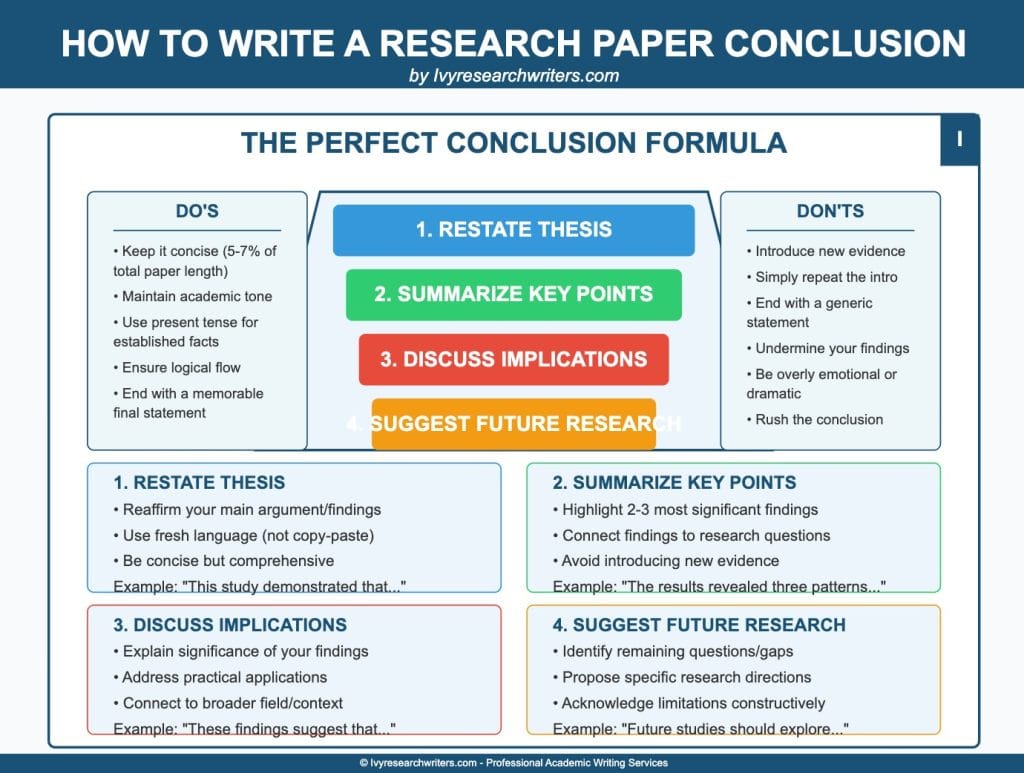
To write your conclusion effectively, begin with a brief summary of your main findings. In conclusion, reiterate how your findings align with the research objectives you set out to achieve. This is especially crucial in a common type of research paper, where a strong conclusion can provide closure and insight.
Ensure that your conclusion important elements highlight the significance of your study. By reflecting on the implications, your paper may resonate more with readers. Always strive to connect your thoughts back to the paper according to the evidence you’ve presented throughout your research.
Conclusion Sentence Starters
Using effective sentence starters can help create smooth transitions and maintain a professional academic tone throughout your conclusion. Here are comprehensive lists of sentence starters for different parts of your conclusion:
For Opening Your Conclusion:
- “This research has demonstrated that…”
- “The findings of this investigation show…”
- “Through careful analysis of…”
- “Based on the evidence presented…”
- “The results of this study indicate…”
- “This investigation into… has yielded several significant findings…”
- “After examining the relationship between…”
- “The data gathered throughout this research reveals…”
For Restating Your Thesis:
- “The evidence supports the initial hypothesis that…”
- “As demonstrated throughout this paper…”
- “The research confirms the central argument that…”
- “The analysis substantiates the claim that…”
- “This investigation validates the premise that…”
- “The findings align with the original proposition that…”
For Synthesizing Main Points:
- “By examining… we can now understand…”
- “The combination of… suggests…”
- “When viewed collectively, these results indicate…”
- “The integration of these findings reveals…”
- “Drawing together the various strands of this research…”
- “The synthesis of these observations demonstrates…”
For Discussing Implications:
- “These findings have significant implications for…”
- “This research extends our understanding of…”
- “The results suggest important applications in…”
- “These conclusions advance the field by…”
- “This study contributes to the growing body of evidence…”
- “The implications of these findings extend beyond…”
For Addressing Limitations:
- “While this study provides valuable insights…”
- “Although the scope of this research was limited to…”
- “Future studies might address…”
- “Additional research is needed to…”
- “One limitation of this study was…”
- “Further investigation could explore…”
For Suggesting Future Research:
- “Future research might investigate…”
- “This study opens up several avenues for further exploration…”
- “Additional studies could build upon these findings by…”
- “Questions remain regarding…”
- “Subsequent research might address…”
- “This work sets the foundation for…”
For Final Thoughts:
- “Ultimately, this research demonstrates…”
- “In the final analysis…”
- “The significance of these findings lies in…”
- “This study marks an important step toward…”
- “Looking ahead, these findings suggest…”
- “The broader implications of this research include…”
For Closing Impact Statements:
- “This work represents a significant advancement in…”
- “These findings reshape our understanding of…”
- “The evidence presented here challenges conventional…”
- “This research provides a foundation for…”
- “Moving forward, these insights offer…”
- “The conclusions drawn here point toward…”
Tips for Using These Sentence Starters:
- Choose starters that match your paper’s tone and discipline
- Avoid using too many similar starters in consecutive sentences
- Adapt the language to fit your specific research context
- Use these starters as jumping-off points, not rigid templates
- Consider your audience when selecting appropriate starters
- Ensure the starter flows naturally into your main point
Remember that while these sentence starters can help structure your conclusion, they should be used thoughtfully and integrated smoothly into your writing. The goal is to maintain a natural flow while guiding readers through your concluding thoughts.
Do I need citations in a conclusion?
Yes, you may need citations in your conclusion if you are referencing any key sources or research findings that support your closing statements. However, the conclusion is not the place to introduce new sources or information. It should primarily reflect on what has already been discussed in the paper. If you mention any key theories or studies in the conclusion, be sure to cite them appropriately to avoid any unintentional plagiarism. Remember that citations should help reinforce your final argument or call to action without overwhelming the reader.
How can I start my conclusion?
Starting your conclusion can be tricky, but a strong beginning often involves a simple transition from your body paragraphs. You might start with a sentence that signals you’re summarizing or wrapping up, such as: “To summarize the findings,” “In light of the evidence presented,” or “Ultimately, the research confirms.” This helps readers know you’re moving toward the final thoughts. Avoid phrases like “In conclusion,” which can be overused and make your conclusion sound formulaic. Instead, focus on restating your thesis and summarizing key points in a fresh way.
How can you restate your thesis using slightly different words?
Restating your thesis involves rephrasing your original argument to emphasize the main findings of your research. Rather than repeating the thesis verbatim, you can look at the broader implications of your argument or reflect on how the evidence supports your central claim. For example, if your original thesis was “Climate change significantly impacts urban communities,” a rephrased thesis could be: “The effects of climate change are increasingly evident in urban areas, influencing both the environment and public health.” This allows you to reinforce your thesis without redundancy.
How do you write a conclusion without sounding repetitive?
To avoid sounding repetitive in your conclusion, focus on synthesizing, rather than summarizing, your main points. Instead of rehashing everything you’ve already said, draw connections between your ideas and present the bigger picture. Highlight the significance of your findings and their implications for future research, policy, or practice. You can also avoid repetition by presenting your ideas in a new light or by discussing how your research contributes to the broader field of study.
How long should a conclusion be in a thesis?
The length of a thesis conclusion can vary depending on the overall length of the thesis itself, but generally, a conclusion in a thesis should be around 5–10% of the total word count. A typical thesis conclusion might range from 3 to 5 pages, summarizing the research question, methods, findings, and implications. It’s important to ensure that your conclusion is comprehensive enough to provide closure to the reader without being overly lengthy or repetitive.
How long should a conclusion be?
The length of a conclusion depends on the overall length of your paper, but typically, it should be about 1 to 2 paragraphs for shorter essays or research papers. For longer works like dissertations or theses, a conclusion could be much longer, up to several pages. The key is to make sure that your conclusion is long enough to fully summarize and reflect on the points you’ve made, but not so long that it restates your paper in full.
How long should a research paper conclusion be?
For a standard research paper, the conclusion should generally be around 1–2 paragraphs, or approximately 5–7% of the total word count. While the length can vary depending on the overall length of your paper, the conclusion should provide a brief summary of the key points and insights without repeating everything you’ve already written in the paper. Focus on wrapping up your argument and offering any final thoughts or recommendations.
How should I write a good conclusion?
A good conclusion does more than just summarize the paper—it ties everything together. Start by restating your thesis in a new light, reflecting on how the evidence presented supports your argument. Then, briefly summarize the main findings or insights of your paper. You can also discuss the broader implications of your research and suggest areas for future study. A strong conclusion leaves the reader with something to think about, offering a sense of closure without being overly definitive or repetitive.
How to conclude a paper?
To effectively conclude a paper, begin by revisiting your thesis or research question. Briefly summarize the main arguments or findings discussed in the body of the paper, emphasizing their significance. Avoid introducing new information in the conclusion, and instead, reflect on what your research reveals about the topic as a whole. Lastly, end with a strong closing statement that either points to future research, offers a call to action, or highlights the broader impact of your work.
How to conclude a research paper example?
An example of a strong research paper conclusion might read: “In conclusion, the research highlights the crucial role that urban planning plays in mitigating the effects of climate change. While much progress has been made in integrating green infrastructure into city designs, further studies are necessary to assess the long-term impact of these initiatives. Future research should focus on the economic implications of such measures and explore how different urban environments adapt to environmental challenges.”
How to end a paper without saying in conclusion?
Instead of using the phrase “In conclusion,” try using alternative transition phrases that signal you’re wrapping up your paper. For example, “To summarize,” “Ultimately,” “In light of the evidence,” or “This research has shown” are all good alternatives. You can also lead into your conclusion by highlighting the implications or significance of your findings, making the end of your paper feel like a natural conclusion without using a cliché phrase.
Need help crafting a strong conclusion for your research paper?
At IvyResearchWriters.com, our expert writers can help you tie everything together with a compelling and impactful conclusion. Contact us today for professional writing assistance!
How to make an eye-catching introduction?
An eye-catching introduction grabs the reader’s attention right away, drawing them into the topic. You can start with a compelling hook such as a provocative question, a surprising statistic, or an intriguing fact. Another effective approach is to tell a brief anecdote or share a personal story related to the topic. The key is to make the reader feel curious and eager to learn more, while also clearly introducing the subject of your paper.
How to restate a thesis in conclusion?
When restating your thesis in the conclusion, avoid repeating the exact words. Instead, rephrase the thesis in a way that reflects the insights you’ve gained through the research process. For example, if your thesis was “Social media has a significant influence on the mental health of teenagers,” you could restate it in your conclusion as “This study confirms that social media plays a pivotal role in shaping the mental well-being of adolescents.” This restatement reinforces your central argument while also reflecting the depth of your analysis.
How to start a conclusion in a research paper?
To start a conclusion in a research paper, you might begin by revisiting the purpose of your research or summarizing the key findings. Start with a transitional phrase that signals you’re moving into the final section of the paper, such as “In conclusion,” “As shown by the research,” or “The findings suggest.” Make sure to tie back to the central thesis or research question to provide a cohesive and well-rounded ending.
How to start a conclusion?
A strong way to start a conclusion is to remind the reader of your thesis or main argument in a fresh way. You can use transitional phrases like “To sum up,” “In closing,” or “As we have seen.” Then, proceed to summarize the key points and highlight any implications or recommendations based on your research. The goal is to leave the reader with a clear understanding of your paper’s significance.
How to start a research paper conclusion?
In a research paper, begin your conclusion by succinctly restating the research question or objective. A good opener could be “This paper aimed to explore…” or “The research presented in this study confirms…”. From there, summarize your key findings and reflect on their broader implications, emphasizing how they contribute to the understanding of the topic.
What is the most common way to conclude a research paper?
When considering how to write a conclusion in a research paper, it’s essential to summarize key findings succinctly. Common phrases, like “in conclusion”, can effectively signal the end of your paper. Understanding how to write a conclusion research paper allows you to reinforce your argument and leave a lasting impression on the reader.
Incorporating phrases can be useful to guide your audience through your final thoughts. By employing transitions, such as “in conclusion”, you enhance clarity and cohesiveness. Ultimately, mastering how to write a conclusion in a research paper will elevate the impact of your research and articulate your findings powerfully.
What makes a conclusion invalid?
An invalid conclusion on research often stems from misinterpreted data or unsupported claims. Knowing how to do a conclusion for a research paper is crucial; it requires synthesizing findings rather than merely summarizing. To effectively write a conclusion in a research paper, one must avoid cliché phrases like “in conclusion,” which can undermine clarity.
Instead, focus on the implications of your findings. Understanding how to write a conclusion paragraph for a research paper involves linking back to your thesis and addressing any limitations. A strong research paper sample conclusion highlights the significance of the research. In essence, knowing how to write conclusion of a research paper ensures a compelling closing argument.
What makes a good conclusion in a paper?
When considering how to write a conclusion for research paper, it’s essential to summarize key findings while also describing the value of your work. A strong conclusion on a research paper reiterates the main points and reminds your readers of their significance. Phrases such as “in conclusion” can effectively signal the end.
An effective example of conclusion research paper often includes a call to action or suggestions for future research. To create a compelling sample conclusion of research paper, reflect on your arguments and ensure that your final thoughts resonate. Understanding how to write conclusion for research paper will enhance your overall presentation.
Utilizing sample conclusion in research paper can provide clarity on structure. Remember, how to write a conclusion to a research paper is about tying everything together cohesively. Introductions and conclusions serve as the backbone of your writing, making it crucial to master how do I write a conclusion for a research paper.
In crafting your work, consider how to make conclusion in research paper impactful. The conclusion of research paper sample should encapsulate your arguments in one sentence, leaving a lasting impression. Ultimately, understanding how to write conclusion research paper will elevate your scholarly work.

What makes a good conclusion in a research paper?
A good conclusion of a research paper sample effectively summarizes key findings while reinforcing the importance of the research. It should provide a clear example conclusion in research paper format, ensuring formal structure and clarity. Phrases like “in conclusion” can be useful to transition smoothly, reminding readers of the study’s value and understanding of the material.
When considering how to write a conclusion for a research paper, focus on highlighting the implications of your findings. A solid research paper conclusion sample not only restates the main points but also encourages further exploration. This approach helps to craft a sample conclusion for research paper that resonates with the audience.
What rule is best when choosing your research topic?
When choosing a research topic, consider a subject that allows you to elaborate on the significance of your findings. A strong topic will help you understand the material deeply, leading to a compelling conclusion of the research paper. For a well-structured conclusion, reflect on the main points of your argument and describe your main findings.
Utilize tips for writing a good conclusion, such as surprising the reader with new insights or reminding them of the value of your research. A thoughtful example of a research paper conclusion can guide you in how to write a conclusion for a research paper. Always read your paper to ensure your conclusion usually aligns with your arguments.
Incorporating different types of conclusions can enhance your work, whether you choose to summarize, reflect, or even propose further research. Remember that a strong conclusion not only wraps up your paper but also encourages readers to think critically about your findings. For a clear research paper example conclusion, look for conclusion samples for research paper in your field.
What should be avoided when writing an effective conclusion?
When crafting a conclusion in research paper, avoid presenting new arguments or evidence. The conclusion of research paper should instead focus on summarizing the key points, restating the main idea, and not come across as too obvious. An example of conclusion in a research paper might highlight the significance without overwhelming the reader with unnecessary details.
Additionally, ensure that your conclusion paragraph for research paper does not simply repeat what has been said. Instead, aim to help the reader understand the material deeply. Phrases like “in conclusion” can be useful, but overusing them may detract from the impact. A well-crafted conclusion sample in research paper will engage the audience and leave them with questions for further study.
What’s a successful conclusion?
Writing a successful conclusion for a research paper example involves summarizing the main points and restating the thesis. A strong conclusion in a research paper example not only recaps essential arguments but also presents new ideas or a new understanding of the topic. Tips on how to write an effective concluding paragraph include providing a call for action and emphasizing the importance of your ideas.
A well-structured conclusion of a research paper serves to leave the reader with new information. When drafting your conclusion research paper, consider using a conclusion template for research paper to ensure clarity. The summary of the main points should reflect the problem your paper addresses and guide the reader towards a thoughtful reflection.
For more insights, consult resources like the college writing center at the University of North Carolina. Employing conclusions examples for a research paper can also enhance your writing. Remember to read your conclusion and ensure it effectively concludes your paper while engaging the reader.
Common Conclusion Pitfalls to Avoid
1. The Copy-Paste Summary
Avoid simply summarizing your paper’s main points without adding new insight. Your conclusion should synthesize, not summarize.
2. The Abrupt Ending
Don’t end suddenly after restating your thesis. Take time to explore implications and broader significance.
3. Introducing New Evidence
Your conclusion isn’t the place to introduce new supporting evidence. All substantive arguments should appear in your main body paragraphs.
4. Being Too Timid
Don’t undermine your work with overly cautious language. While acknowledging limitations is important, be confident in stating your contributions.
Step-by-Step Guide on How to Write a Conclusion for a Research Paper
1. Review Your Introduction
Begin by rereading your introduction to ensure your conclusion creates a strong frame for your paper. Your conclusion should echo themes from your introduction while showing how your research has developed them.
2. Create an Outline
Before writing, outline your conclusion’s key components:
- Thesis restatement
- Synthesis of main points
- Implications
- Future directions
- Final thoughts
3. Draft Your Conclusion
Start with a clear signal phrase like “In conclusion” or “This research has demonstrated” to orient readers. Then, follow your outline while maintaining smooth transitions between ideas.
4. Polish and Refine
After drafting, review your conclusion for:
- Clear logical flow
- Strong connections to your introduction
- Appropriate scope (neither too broad nor too narrow)
- Compelling final sentences
- Grammar and style consistency
Length and Proportions
Your conclusion should typically be about 10% of your paper’s total length. For a 20-page paper, aim for roughly 2 pages. This gives you enough space to fully develop your ideas without becoming repetitive.
Conclusion Outline for Research Paper
A well-structured conclusion follows a logical progression that guides readers through your final thoughts. Here’s a detailed outline:
Research Paper Conclusion Example
Let’s examine a conclusion from a research paper investigating the impact of mindfulness meditation on workplace productivity:
“This investigation into mindfulness meditation’s effects on workplace productivity has revealed several significant findings. Through our mixed-methods approach, incorporating both quantitative performance metrics and qualitative employee experiences, we have demonstrated that regular mindfulness practice correlates with a 23% increase in task completion rates and a 35% reduction in reported workplace stress levels.
These findings extend beyond simple productivity metrics, suggesting a fundamental shift in how we might approach workplace wellness and performance optimization. The demonstrated connection between mental clarity and operational efficiency challenges traditional productivity paradigms that often overlook the role of mental state in professional performance.
Our research particularly highlights the cost-effective nature of mindfulness interventions, with an average return on investment of $3.45 for every dollar spent on mindfulness programming. This economic benefit, coupled with improved employee satisfaction scores, suggests a promising direction for organizations seeking sustainable performance improvements.
Looking ahead, future research might explore the long-term retention of mindfulness benefits and their transfer to non-workplace contexts. Additionally, investigating the role of virtual mindfulness programs could prove particularly relevant in our increasingly digital workplace landscape.
In conclusion, this study not only validates mindfulness as a productivity tool but also opens new avenues for understanding the intersection of mental wellness and professional performance. As organizations continue to navigate the challenges of modern workplace dynamics, the integration of mindfulness practices presents a promising path forward for both employee well-being and organizational success.”
Tips for Writing a Conclusion for a Research Paper
Beyond the fundamental guidelines, these advanced tips can elevate your conclusion:
- Narrative Coherence
- Maintain consistent terminology throughout
- Use transitional phrases that connect ideas smoothly
- Create a sense of progression rather than repetition
- Stylistic Considerations
- Employ strong, active voice
- Use varied sentence structures to maintain engagement
- Include memorable phrases or compelling statistics
- Intellectual Depth
- Move beyond surface-level implications
- Connect your findings to broader theoretical frameworks
- Demonstrate interdisciplinary relevance
- Strategic Emphasis
- Highlight unexpected findings
- Emphasize practical applications
- Underscore unique contributions to the field
Types of Research Paper Conclusions with Examples
- The Problem-Solution Conclusion Example focus: Demonstrating how your research resolves an existing issue in the field
- The Call-to-Action Conclusion Example focus: Motivating readers to implement findings or pursue further research
- The Circular Conclusion Example focus: Returning to opening scenarios or questions with new insights
- The Synthesis Conclusion Example focus: Weaving together multiple threads of argument into a unified whole
- The Forward-Looking Conclusion Example focus: Emphasizing future implications and research directions
6 Elements to Include in a Research Paper Conclusion
- Resolution Statement A clear declaration of how your research has addressed its primary questions or objectives
- Significance Marker Explicit statements about why your findings matter in both theoretical and practical contexts
- Broader Context Connection Links between your specific findings and larger academic or real-world conversations
- Limitations Acknowledgment Brief, honest recognition of research boundaries without undermining your findings
- Future Research Gateway Specific, promising directions for subsequent research based on your findings
- Impact Statement A memorable final thought that encapsulates your research’s core contribution
Each of these elements should flow naturally into the next, creating a conclusion that feels both complete and forward-looking. The key is to balance these elements according to your research’s specific needs and your field’s conventions.
How can I make my conclusion memorable?
To make your conclusion memorable, it’s crucial to summarize the paper effectively. Restate your research topic and the main points of your research paper. A strong conclusion should make the reader understand why your research matters. Use the writing center or writing lab to help you write a compelling ending.
In an argumentative paper or empirical paper, the conclusion for research serves to reinforce your research paper’s significance. Conclude your research paper by providing suggestions for future research and addressing questions raised in your paper. An effective conclusion in research also provides a pathway for further inquiry.
When crafting your paper’s conclusion, remember that a well-structured research paper outline can guide you. A summarizing conclusion not only wraps up your findings but also emphasizes the importance of your research. Whether your paper is 10 pages or more, aim for clarity and impact.
Ultimately, the conclusion also provides a chance to engage with your audience. Use an externalizing conclusion to connect your work to broader implications, or an editorial conclusion to reflect on your insights. Writing an effective conclusion is essential in making your research resonate.
Our expert writers are always available to help you compose a compelling conclusion for your research paper.
Importance of a good research paper conclusion
In a research paper, the conclusion serves as a critical component that ties together the body of the paper. A strong conclusion for your research not only summarizes your findings but also reinforces your research goals and objectives. To write the conclusion effectively, one must know how to write it in a way that resonates with the reader.
In conclusion, the placement of your conclusion is essential, as it is the final section of your paper. This common type of conclusion should avoid introducing new information in your conclusion, instead focusing on the evidence in the conclusion that supports your thesis. Examples of research paper conclusions often remind readers why the research should matter.
A well-crafted research paper conclusion provides closure and clarity. It can highlight how the research suggests future directions or research that could be undertaken. Ultimately, the conclusion is to remind the audience of the significance of your findings, making it an important aspect of any formal types of research paper.
Advanced Techniques for Powerful Conclusions
1. The Echo Effect
Reference specific examples or phrases from your introduction to create a satisfying sense of closure. This technique helps readers feel the journey of your paper has come full circle.
2. The Zoom Out
Start with your specific findings, then gradually broaden to show their wider significance. This technique helps readers understand how your research fits into the bigger picture.
3. The Call to Action
If appropriate for your field, end with specific recommendations or suggestions for how your findings could be applied.
Final Thoughts
Writing a strong conclusion requires balancing multiple elements: synthesis, implications, and future directions. By following these guidelines while avoiding common pitfalls, you can craft a conclusion that not only wraps up your current research effectively but also positions it within the broader academic conversation.
Remember, your conclusion is your last chance to make an impression on your readers. Make it count by showing them not just what you found, but why it matters and where it might lead. A well-crafted conclusion turns a good research paper into a memorable and influential piece of scholarship.
Frequently Asked Questions (FAQs) about How to Write a Research Paper Conclusion: A Step-by-Step Guide
What is the purpose of the conclusion of a research paper?
The conclusion of a research paper serves as the final opportunity to present your findings and emphasize the significance of your work. It allows you to remind the reader of the main points you discussed throughout your paper and to summarize the main arguments. This section is crucial as it can influence how your readers perceive the value of your research and its implications for future studies.
How do I structure an effective conclusion?
A well-structured conclusion should begin by summarizing the main points of your research. Then, you should articulate the significance of your findings and how they contribute to the existing body of knowledge. If applicable, you can also address any shortcomings in your research and suggest areas for future inquiry. This structure ensures your conclusion provides a comprehensive wrap-up of your work.
What are the elements to include in a good conclusion?
A good conclusion should include several key elements: a restatement of your research problem, a brief summary of the main findings, an acknowledgment of any limitations, and a discussion of the potential impact future research may have. It’s also beneficial to offer insights on how your research aligns with or challenges existing literature, providing a broader context for your readers.
How long should the conclusion be in a 10-page paper?
The length of your conclusion for your research paper will depend on the overall length of your document. For a paper that is 10 pages long, a short conclusion of one to two paragraphs (approximately 150-250 words) is typically sufficient. This allows you to succinctly sum up the paper while ensuring that you cover all necessary points without overwhelming the reader with too much information.
Should I include new information in the conclusion?
Generally, the conclusion should not include new information or arguments that have not been presented in the body of your paper. Instead, it should focus on synthesizing the information you have already discussed. If you have conducted extensive hours of research, the conclusion should serve to reinforce the main points rather than introduce new concepts.

