

US Time Zones: A Complete Guide to United States Time and Daylight Saving Time
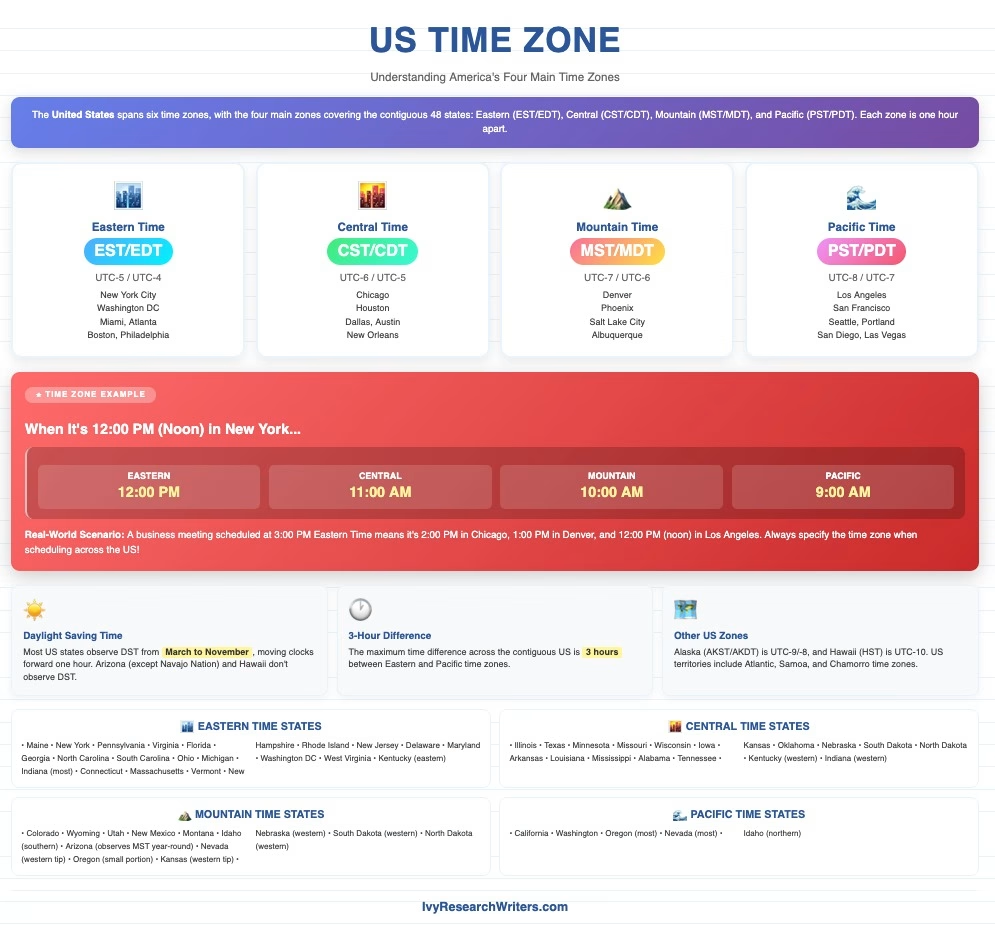
Understanding US time zones is essential for travel, business, broadcasting, and daily life across the country. Because the United States spans thousands of miles from the Atlantic coast to the Pacific Ocean—and even beyond to US territories—there are many time zones to account for.
In this comprehensive guide, we’ll explore the structure of the United States time system, explain how daylight saving time (DST) works, and break down the nation’s time zones, boundaries, and legal framework.
Time Zone Explained: What Is a US Time Zone?
A time zone is a geographic region that observes a uniform standard time. Time zones are used to simplify timekeeping across large areas of the globe.
The United States time system is based on its relation to UTC (Coordinated Universal Time)—the global standard for official time. UTC replaced Greenwich Mean Time (GMT) as the global reference point, though GMT is still commonly referenced.
Each US time zone is measured by its offset from UTC.
Standard Time and the Standard Time Act of 1918
The United States adopted official standard time zones under the Standard Time Act of 1918. This law established uniform time across the country and authorized federal oversight of time zone boundaries.
Later, the Uniform Time Act of 1966 standardized the observance of daylight-saving time and clarified federal authority over time regulations. Today, the Department of Transportation, in coordination with the National Institute of Standards and Technology (NIST), oversees official time and time zone boundaries.
United States Time: How Many Time Zones Exist?
There are a total of nine time zones across the United States and its territories.
The Six Primary Time Zones in the U.S.
Across the continental United States and non-contiguous states, there are six time zones:
- Eastern Time Zone (ET)
- Central Time Zone (CT)
- Mountain Time Zone (MT)
- Pacific Time Zone (PT)
- Alaska Standard Time (AKST)
- Hawaii-Aleutian Time Zone (HAST)
These six time zones cover the majority of the U.S.
| Time Zone Name | Abbreviation (Standard) | Abbreviation (Daylight Saving) | UTC Offset (Standard) | UTC Offset (DST) | Example States |
|---|---|---|---|---|---|
| Eastern Time | EST | EDT | UTC −5 | UTC −4 | New York, Florida, Georgia (Atlantic Coast States) |
| Central Time | CST | CDT | UTC −6 | UTC −5 | Texas (most), Illinois, Alabama |
| Mountain Time | MST | MDT | UTC −7 | UTC −6 | Colorado, Utah |
| Pacific Time | PST | PDT | UTC −8 | UTC −7 | California, Washington |
| Alaska Time | AKST | AKDT | UTC −9 | UTC −8 | Alaska |
| Hawaii-Aleutian Time | HAST | (No DST in Hawaii) | UTC −10 | N/A | Hawaii |
Additional Time Zones in US Territories
When including US territories, the nation’s time zones expand to nine:
- Atlantic Standard Time (AST) (Puerto Rico, U.S. Virgin Islands)
- Chamorro Time (Guam and Northern Mariana Islands)
- Samoa Standard Time (American Samoa)
Thus, there are nine time zones across the United States and its territories.
| Territory | Time Zone | UTC Offset | Observes DST? |
|---|---|---|---|
| Puerto Rico | Atlantic Standard Time (AST) | UTC −4 | No |
| U.S. Virgin Islands | Atlantic Standard Time (AST) | UTC −4 | No |
| Guam | Chamorro Standard Time (ChST) | UTC +10 | No |
| Northern Mariana Islands | Chamorro Standard Time (ChST) | UTC +10 | No |
| American Samoa | Samoa Standard Time (SST) | UTC −11 | No |
Time Zones in the Contiguous United States
The contiguous states (sometimes called the lower 48 states) are divided into four time zones:
- Eastern Zone
- Central Zone
- Mountain Zone
- Pacific Zone
These four zones cover the continental United States from the Atlantic coast to the westernmost Pacific coastline.
Need Expert Help With Your Research Paper?
Struggling with in-text citations, APA formatting, or structuring a strong academic argument?
Eastern Time: Eastern Standard Time and Eastern Daylight Time
The Eastern Time Zone includes major cities like:
- New York
- Washington, D.C.
- Atlanta
- Boston
During standard time, it is called Eastern Standard Time (EST).
During daylight saving time, it becomes Eastern Daylight Time (EDT).
Eastern time is UTC-5 during standard time and UTC-4 during DST.
Central Time Zone and Mountain Time Zone
The Central Time Zone operates as:
- Central Standard Time (CST) in winter
- Central Daylight Time (CDT) during DST
The Mountain Time Zone operates as:
- Mountain Standard Time (MST)
- Mountain Daylight Time (MDT)
These zones help manage time across large regions of the country, including major cities such as Chicago (Central) and Denver (Mountain).
Pacific Standard Time and the Westernmost Zone
The Pacific Time Zone includes California, Washington, and Oregon.
- Pacific Standard Time (PST) during winter
- Pacific Daylight Time (PDT) during DST
It is the westernmost time zone in the contiguous U.S.
Alaska Standard Time and Hawaii
Alaska operates on Alaska Standard Time (AKST), while Hawaii follows Hawaii-Aleutian Standard Time (HAST).
Important note:
- Hawaii and most of Arizona do not follow daylight saving time.
- DST is not observed in Hawaii.
- Arizona (except the Navajo Nation) does not follow daylight saving time.
Daylight Saving Time (DST) in the United States
Daylight saving time (DST) shifts clocks forward one hour to extend evening daylight.
DST begins on the second Sunday of March and ends on the first Sunday of November.
This means:
- Clocks “spring forward” in March.
- Clocks “fall back” in November.
Most states follow daylight saving time, except Hawaii and most of Arizona.
Zone Boundaries and the Time Zone Map
Time zone boundaries are not strictly straight lines; they often follow:
- State borders
- County lines
- Economic regions
A time zone map of the United States clearly shows how the zones covering the country are divided.
Zones in the contiguous US are structured to maintain economic and transportation efficiency.
US Territories and the International Date Line
Beyond the mainland, US territories operate in different time zones.
For example:
- American Samoa operates near the International Date Line.
- Guam follows Chamorro Time, which is significantly ahead of mainland US time.
These territories experience significant time differences relative to the continental United States.
Relation to UTC and GMT
All US time zones are defined by their relation to UTC (Coordinated Universal Time).
Examples:
- Eastern Standard Time = UTC – 5
- Pacific Standard Time = UTC – 8
- Alaska Standard Time = UTC – 9
Although GMT (Greenwich Mean Time) is sometimes referenced, UTC is the official modern standard.
Why Time Zones Are Used Across the United States
Time zones are used to:
- Standardize local time
- Coordinate transportation schedules
- Maintain consistent business hours
- Manage broadcasting
- Support interstate commerce
Given the vast size of the United States and its territories, different time zones are necessary.
Map of the United States and Official Time
A map of the United States shows clear zone names and abbreviations:
- ET (Eastern Time)
- CT (Central Time)
- MT (Mountain Time)
- PT (Pacific Time)
- AKST (Alaska Standard Time)
- HAST (Hawaii-Aleutian Standard Time)
Official time in the United States is maintained by federal agencies and synchronized with international standards.
Final Thoughts: Understanding US Time Zones
The nation’s time zones reflect the geographic breadth of the country. From the Atlantic coast and the eastern zone to the Pacific zone and Alaska, time across the United States is carefully regulated.
With a total of nine time zones across states and territories, including Chamorro Time and Samoa Standard Time, the United States operates one of the most complex time systems in the world.
Understanding US time zones, daylight saving time, and time zone boundaries is essential for travel, business, and academic knowledge.
Need Help With Geography, Time Systems, or Research Papers?
If you’re writing about:
- Time zones in the United States
- Daylight saving time history
- UTC and global time systems
- US territories and international date line
- Geographic map analysis
IvyResearchWriters.com provides:
✔ Expert geography and social science writers
✔ Accurate legal and historical analysis
✔ APA, MLA, Chicago formatting
✔ Undergraduate to PhD-level support
Order your custom research paper today and submit with confidence.
Frequently Asked Questions
What are the six US time zones?
The United States has six primary time zones that cover the states:
- Eastern Time (ET)
- Central Time (CT)
- Mountain Time (MT)
- Pacific Time (PT)
- Alaska Time (AKST)
- Hawaii-Aleutian Time (HAST)
These are the main time zones used across the country.
Key details:
- The states on the Atlantic coast operate on Eastern Time.
- The Central Time Zone covers much of the Midwest.
- Mountain and Pacific Time cover western states.
- Alaska and Hawaii each operate in separate zones.
It’s important to understand that most zones operate under standard time and daylight saving time, switching between the two during the year.
However:
- Arizona and Hawaii do not follow daylight savings time (with limited exceptions in Arizona).
If you need a breakdown including time offsets and regional coverage, IvyResearchWriters.com can provide a fully detailed academic explanation tailored to your assignment.
What is our time zone?
The answer depends on your location.
The United States spans multiple time zones, so “our time zone” varies by region.
For example:
- If you live in New York or Florida (states on the Atlantic coast), your time zone is Eastern Time.
- If you live in Texas, your time zone is Central Time.
- If you live in California, it is Pacific Time.
To determine your current time, you must know:
- Your geographic location
- Whether daylight savings time is in effect
Most of the country follows standard time and daylight saving, adjusting clocks twice per year. The exceptions remain Arizona and Hawaii, which do not observe daylight savings time.
For academic explanations of time systems including time transitions and federal regulations, IvyResearchWriters.com can help structure your answer clearly and professionally.
Which time zone has the USA?
The USA does not have just one time zone—it has multiple.
The main time zones used in the U.S. include six primary zones across the states, and additional zones in territories.
Within the mainland states alone, there are four major zones:
- Eastern
- Central
- Mountain
- Pacific
Adding Alaska and Hawaii brings the total to six.
Some states are even divided into two zones. For example:
- Florida has both Eastern and Central Time.
- Texas spans Central and Mountain Time.
This is because of geographic and economic considerations.
Understanding these divisions is especially important when calculating time differences, travel schedules, or business operations.
What is the central time zone in the US?
The Central Time Zone (CT) is one of the primary time zones in the United States.
During the year, it operates as:
- Central Standard Time (CST) in winter
- Central Daylight Time (CDT) during daylight savings time
Central Time covers states such as:
- Texas (partially)
- Illinois
- Missouri
- Alabama
- Louisiana
Like most zones, it follows standard time and daylight saving, except in areas where daylight saving adjustments are not observed.
To determine the current time in the Central Time Zone, you must know whether daylight savings time is currently active.

