

Trustworthiness and Qualitative Research: How to Prove Rigor, Credibility, and Quality (With Examples)
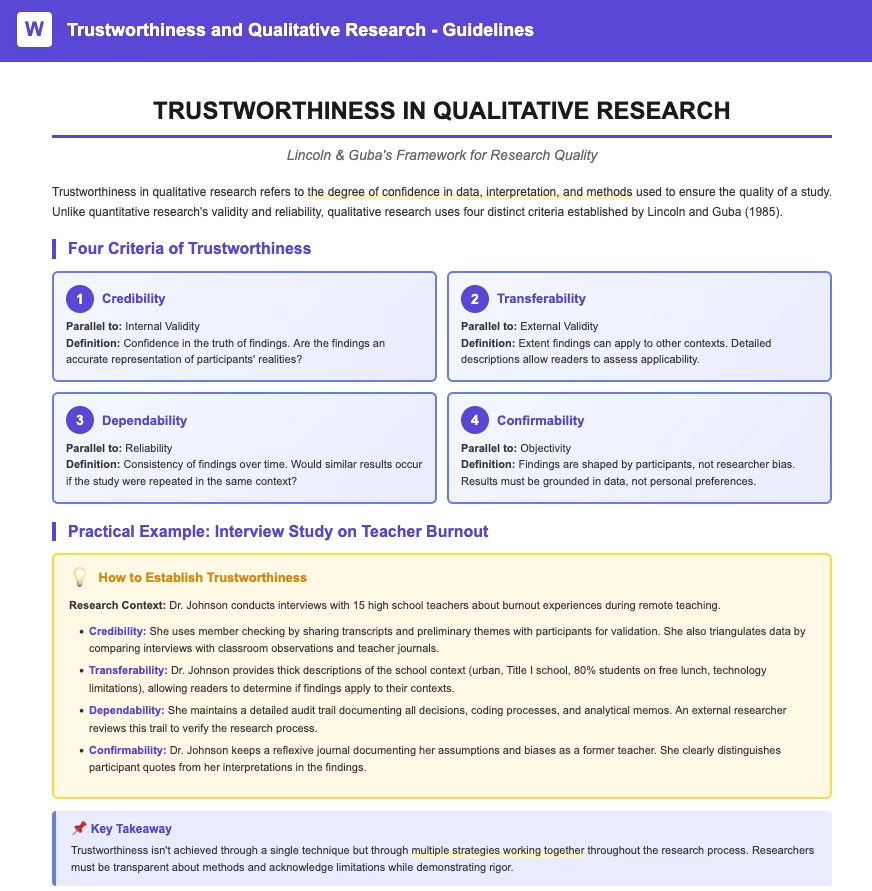
“Trustworthiness and qualitative research” is one of the most important topics you will write about in a dissertation, thesis, or journal-style assignment—especially when an assessor asks: How do we know your findings are reliable, valid, and not biased? In qualitative work, the answer is not a single statistic. Instead, trust is built through rigor, transparency, and a clear audit trail that shows how data were collected, analyzed, and interpreted.
This guide explains what trustworthiness means, how it differs from validity and reliability in quantitative research, and how to demonstrate the four criteria—credibility, transferability, dependability, and confirmability—using practical strategies like triangulation, reflexivity, member checking, and thick descriptions. You will also find ready-to-use examples you can adapt for your research topic, including qualitative health research and case study designs.
Why trustworthiness matters: the quality criteria for qualitative studies
Qualitative studies aim to understand meanings, experiences and perspectives, and the context surrounding a phenomenon of interest. Because qualitative research includes interpretation, reviewers often ask how you minimized researcher bias and ensured the quality of qualitative research.
In quantitative research, quality is often framed as validity and reliability:
- Validity in quantitative (including internal validity) is about whether you measured what you intended to measure and whether your conclusions are justified.
- Reliability in quantitative research is about stability and consistency—whether the same instrument would produce the same result under the same conditions.
- Generalizability is about whether results apply to broader populations.
In qualitative and quantitative research, both aim for rigor, but they use different quality criteria. The qualitative equivalent is commonly described as the trustworthiness of qualitative research, often presented as the four criteria (sometimes called the pillars of trustworthiness in qualitative research): credibility, transferability, dependability, and confirmability.
A clear definition: trustworthiness of qualitative research
Trustworthiness refers to how confident readers can be that your qualitative findings are well-grounded in the data, logically derived through a transparent research process, and presented with sufficient contextual information to support interpretation and applicability.
Put simply: trustworthiness asks whether your study is trustworthy qualitative work—whether your data analysis is credible, your interpretations are confirmable, your process is dependable, and your findings can transfer to similar contexts.
Many qualitative researchers link these criteria to the work of Guba (often discussed alongside Lincoln), who framed trustworthiness as a qualitative counterpart to internal validity, reliability, objectivity, and generalizability.
The four criteria: credibility, transferability, dependability, and confirmability
You do not “claim” trustworthiness—you demonstrate it through methods and documentation. Below are the four criteria, with definitions and practical examples.
Credibility: showing the findings are believable and well-supported
Credibility is the credibility of qualitative findings—whether interpretations accurately reflect participants’ accounts and the data collected.
Credibility is often compared to internal validity (and internal validity in quantitative research), but in qualitative work it is demonstrated through evidence that your interpretations make sense given your data.
How to strengthen credibility (with examples):
- Prolonged engagement: Spend enough time with participants and the field site to understand context and build trust.
Example: In a qualitative health study about medication adherence, prolonged engagement could involve multiple interviews over several weeks to capture shifting beliefs and barriers. - Persistent observation: Focus deeply on key elements of the phenomenon rather than surface-level contact.
Example: In a case study of hospital handoff communication, persistent observation means repeated shadowing of handoffs to capture patterns, breakdown points, and routines. - Triangulation: Use multiple data sources or methods to cross-check findings (data triangulation).
Example: Combine interviews, field notes, and policy documents (using multiple data sources) to validate recurring themes about internal processes. - Member checking: Share summaries or themes with participants to confirm accuracy.
Example: After coding interviews, you send participants a short theme summary and ask, “Does this reflect your experience?” - Peer debriefing: Discuss analysis decisions with another researcher to test assumptions and challenge bias.
Example: A second reviewer questions whether a theme is overgeneralized, improving methodological rigor.
What to write in your paper (credibility statement):
“Credibility was enhanced through triangulation using interviews and document review, member checking of summary themes, and peer debriefing to challenge assumptions and minimize researcher bias.”
Transferability: helping readers judge applicability beyond your sample
Transferability is about the extent to which your findings may apply to other contexts. Unlike generalizability, transferability does not claim universal application. Instead, it provides enough detail so readers can judge whether findings transfer to their setting.
Transferability is strengthened through:
- Thick and rich descriptions: Detailed explanations of context, participants, setting, and procedures.
- Sufficient contextual information: Who, where, when, and under what conditions the study occurred.
Example (transferability in practice):
If you studied communication breakdown in one emergency department, you describe staffing levels, workflow, patient volume, communication tools used, and organizational culture. These rich descriptions allow another hospital to decide whether the findings might apply.
What to write in your paper (transferability statement):
“Transferability was supported through thick descriptions of the study context, participants’ roles, and setting characteristics, enabling readers to assess applicability to similar contexts.”
Dependability: proving stability and consistency in the research process
Dependability is the qualitative counterpart to establishing reliability. It refers to stability and consistency: whether the research process is logical, traceable, and documented—so another researcher could follow the same steps and understand how conclusions were reached.
Dependability is strengthened by:
- A clearly described research design and study design
- Transparent data collection and analysis
- Consistent procedures for coding and theme development
- A detailed audit trail showing decisions made over time
Example (dependability in practice):
In a study on remote work communication, you document your interview guide versions, recruitment steps, data collection methods, coding iterations, and how you refined your codebook after early interviews.
What to write in your paper (dependability statement):
“Dependability was enhanced through a detailed audit trail documenting sampling decisions, changes to the interview guide, coding procedures, and theme development across the research process.”
Confirmability: showing findings are grounded in data, not researcher preference
Confirmability relates to objectivity—showing that findings come from the data, not personal values or uncontrolled subjectivity. While qualitative research acknowledges the presence of the researcher and interpretation, confirmability ensures that interpretations are evidence-based and transparent.
Confirmability is strengthened by:
- Reflexivity and reflexive journaling (documenting assumptions and decisions)
- Clear documentation of coding and theme development
- Storing analytic memos and decision logs in an audit trail
- Triangulation and peer review to reduce bias
Example (confirmability in practice):
You keep a reflexive journal noting how your background could influence interpretation (for example, professional experience in healthcare), and you record how you tested alternative explanations during analysis.
What to write in your paper (confirmability statement):
“Confirmability was supported through reflexive journaling, peer debriefing, and an audit trail linking codes and themes directly to verbatim excerpts from the qualitative data.”
Turn qualitative methods into defensible, high-scoring writing.
Let IvyResearchWriters.com strengthen your trustworthiness and rigor section so your work is as objective as possible, clearly justified, and easy to defend in a dissertation or research proposal.
Ensuring the quality and rigor: practical strategies you can apply immediately
Below is a compact checklist you can include in your methodology section to show quality and rigor and ensure trustworthiness:
Trustworthiness checklist for conducting qualitative research
- Use multiple data sources (interviews + documents + observations) when feasible
- Document data collection methods and any changes to tools
- Apply systematic coding with a codebook and memoing
- Use triangulation (data triangulation and/or method triangulation)
- Add member checking for key themes
- Conduct peer debriefing with another analyst
- Maintain a detailed audit trail (raw data → codes → themes → findings)
- Practice reflexivity (reflexive journaling) to minimize researcher bias
- Provide rich descriptions and sufficient contextual information for transferability
- Report decisions transparently when reporting qualitative studies
These strategies highlight the importance of trustworthiness, not as a theoretical concept, but as concrete research practices.
Trustworthiness vs validity and reliability in quantitative research
Students are often asked to compare qualitative trustworthiness with quantitative validity and reliability.
A practical way to write this comparison:
- Credibility parallels internal validity in quantitative research.
- Dependability parallels reliability in quantitative research (stability and consistency).
- Confirmability parallels objectivity in quantitative research (but qualitative acknowledges subjectivity and manages it transparently).
- Transferability parallels generalizability, but requires contextual detail rather than statistical inference.
This comparison is helpful in mixed-methods work (qualitative and quantitative) because it shows you understand both quality traditions.
Examples of trustworthiness in qualitative research: short write-ups you can copy
Example 1: Qualitative health research (interviews)
“In this qualitative health study, credibility was strengthened through member checking and triangulation using interview data and clinic education materials. Dependability was established through a detailed audit trail documenting the data collection and analysis steps and iterative coding decisions. Confirmability was supported through reflexive journaling and peer debriefing to minimize researcher bias, while transferability was enhanced through thick descriptions of participant demographics and the care setting, supporting applicability to similar clinics.”
Example 2: Case study (documents + interviews)
“In this case study, multiple data sources were used, including interviews, organizational records, and policy documents, enabling data triangulation to ensure trustworthiness of qualitative data. The research design, coding procedures, and theme development were documented in an audit trail to support dependability. Reflexivity and peer debriefing strengthened confirmability by making interpretive decisions transparent, and rich descriptions of the organizational context supported transferability.”
Common threats to trustworthiness (and how to fix them)
Threat 1: Researcher bias and unacknowledged subjectivity
Fix: reflexivity, reflexive journaling, peer debriefing, and transparent memoing.
Threat 2: Weak data collection and unclear procedures
Fix: document data collection methods, maintain consistency, and justify methodological choices.
Threat 3: Vague coding and theme claims without evidence
Fix: show the link between data collected, coding, and research findings; include exemplar quotes.
Threat 4: Poor contextual reporting
Fix: thick and rich descriptions and sufficient contextual information to support applicability.
Applicability: making your findings useful beyond your study
Applicability is often what supervisors and committees care about most: “How can these findings be used?” You can strengthen applicability by:
- relating themes to real-world decisions (policy, training, internal communication improvement)
- describing how findings might transfer to similar contexts (transferability)
- showing how conclusions were derived from data (confirmability)
When you connect trustworthiness to practical recommendations, you demonstrate the additional benefits they provide: your research is not only rigorous—it is usable.
Why IvyResearchWriters.com helps students write stronger trustworthiness sections
Many students understand trustworthiness conceptually but struggle to write it convincingly in academic language. IvyResearchWriters.com can help you:
- draft a trustworthiness section aligned to credibility, transferability, dependability, and confirmability
- build a defensible audit trail description and coding workflow
- integrate triangulation, reflexivity, member checking, and peer debriefing into your methodology
- tailor examples to your research topic and design (case study, qualitative health, interviews, focus groups)
If you share your research topic and method (for example, interviews, focus groups, case study), Ivy Research Writers can write a Word-ready “Trustworthiness” subsection (complete with strategies and a checklist) that fits directly into your dissertation Chapter 3.
Frequently Asked Questions
What is trustworthiness in qualitative research?
Trustworthiness in qualitative research is the set of key criteria used to judge whether a qualitative research project produces findings that are believable, well-supported by evidence, and transparently derived from the data. It is closely tied to validity in qualitative research because it explains why readers should trust your interpretations. In practice, trustworthiness shows that your study design and analysis allows the researcher to capture participants’ experiences accurately while being as objective as possible through documented procedures that reduce bias.
At IvyResearchWriters.com, we help students write trustworthiness sections that clearly link each criterion to specific methods—so assessors can see exactly how you ensure the trustworthiness of the study.
What are the strategies for ensuring trustworthiness in qualitative research?
To ensure the trustworthiness of a qualitative research project, use strategies that strengthen the four core criteria (credibility, transferability, dependability, confirmability). In mixed point-and-prose form:
- Triangulation (using multiple data sources) to support achieving data depth and cross-check findings
- Member checking to confirm interpretations match participants’ intent (supports validity in qualitative research)
- Peer debriefing to challenge assumptions and improve analytic discipline
- Audit trail (documents decisions, coding steps, and changes) to show dependability and confirmability
- Reflexivity / reflexive journaling to minimize researcher bias and stay as objective as possible
- Thick, rich description so readers can judge transferability to similar contexts
- Systematic coding with a codebook and analytic memos to show how themes were built from data
These strategies do more than satisfy a rubric—recognizing the additional benefits matters: they strengthen your credibility, reduce disputes about interpretation, and make your findings easier to defend in proposals, dissertations, and publications.
What is trustworthiness and rigor in qualitative research?
Trustworthiness and rigor in qualitative research are closely connected. Trustworthiness is the quality standard (the key criteria), while rigor is the discipline of execution—how carefully you apply methods across the research process.
In plain terms: rigor is how well you run your study; trustworthiness is how convincingly your paper demonstrates validity in qualitative research. Together, they show that the research project was conducted systematically, that the analysis was transparent, and that conclusions are grounded in evidence rather than opinion—helping the researcher remain as objective as possible within an interpretive approach.
Does trustworthiness in qualitative research refers to all of the following except?
In most academic settings, trustworthiness refers to the four criteria (credibility, transferability, dependability, confirmability). So, the “except” option is usually something from quantitative research quality language that does not belong to trustworthiness.
Typically, the “except” answer is:
- Statistical generalizability to a population (or “external validity” in the statistical sense)
Why: qualitative trustworthiness supports validity in qualitative research through context, transparency, and evidence. It does not claim statistical generalization; instead, it supports transferability through thick description so readers can judge applicability.

