

Triangular Prism Examples: Real-Life Objects, Properties, Surface Area, and Volume (With Solved Examples)
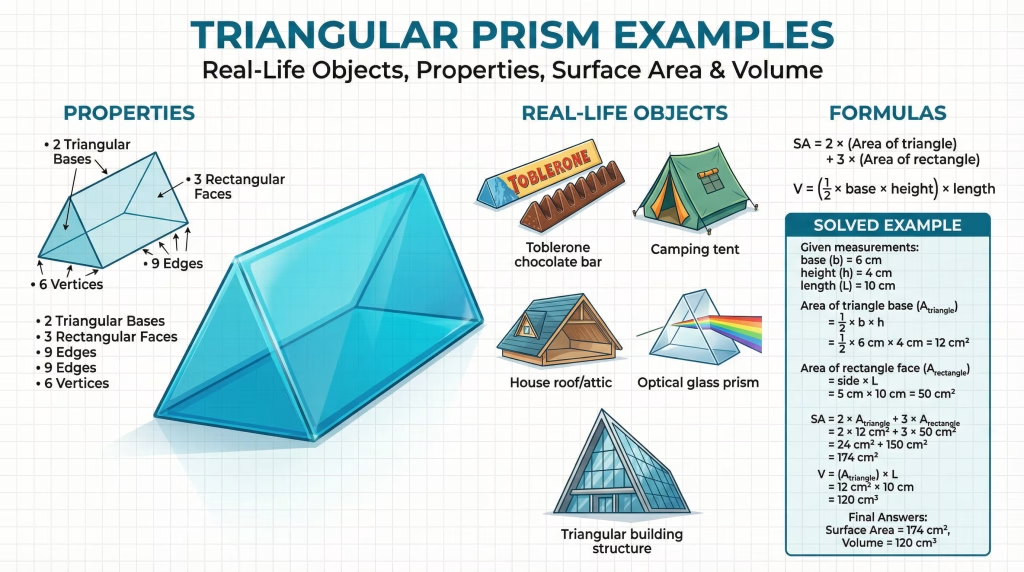
A triangular prism is one of the most common shapes you will see in geometry and in real life. From a camping tent to certain roof designs and packaging, the triangular prism shows up everywhere. In math, it is also a great shape for practicing how to calculate the volume and calculate the surface area of a three-dimensional figure.
This guide explains the triangular prism shape, gives clear triangular prism examples, breaks down edges and vertices, and walks you through the surface area and volume formulas with solved examples you can copy into homework, a lesson plan, or a study guide.
What a triangular prism is and how to recognize the prism shape
A triangular prism is a three-dimensional figure, meaning it is a 3D shape with length, width, and height. More precisely, a triangular prism is a polyhedron because it is a solid made of flat faces.
A triangular prism is called a triangular prism because:
- it has two triangular bases (also called the triangular ends)
- those bases are two identical triangles
- the bases are connected by three rectangular side faces (the lateral faces)
So the prism is a solid consisting of two triangular faces and three rectangles.
Key definition you can use
A triangular prism is a prism is a three-dimensional solid with two bases that are triangles, and the bases are connected by three rectangular faces.
The triangle-based structure: triangular base, triangular faces, and rectangular faces
To avoid confusion, it helps to label parts:
- Triangular base: the triangle at one end
- Two triangular bases: the pair of matching triangles on opposite ends
- Triangular faces: the triangle faces at the ends (these are the bases)
- Rectangular faces: the side faces that connect the triangles
- Lateral faces: another name for those side faces
- Length of the prism: the distance between the two triangular ends
- Height of the prism: depends on what you are measuring—some problems use height of the triangle, others use perpendicular height between bases; always check the diagram
In a right triangular prism, the lateral faces are rectangles and the connecting edges are perpendicular to the bases. In an oblique triangular prism, the sides “lean,” so the lateral faces can become a parallelogram instead of a rectangle.
Properties of a triangular prism: faces, edges, and vertices
A common exam question is to list the properties of a triangular prism.
A triangular prism has:
- triangular prism has 5 faces: faces and 2 triangular bases + three rectangular lateral faces
- 9 edges (three edges on each triangular base = 6, plus three connecting edges = 3; total 9)
- 6 vertices (three corners per triangle × two triangles = 6)
So if you see the prompt “edges and vertices,” you can quickly answer: 9 edges and 6 vertices.
Quick check: edges and vertices
- vertex: a corner point
- triangular prism: 6 vertices
- edges: line segments where two faces meet
- triangular prism: 9 edges
Right vs oblique: right triangular prism and oblique triangular prisms
Right triangular prism
A right triangular prism has:
- two triangular bases
- three rectangular faces
- connecting edges that are perpendicular to the bases
This is the most common type used in school geometry.
Oblique triangular prisms
Oblique triangular prisms have the same two triangular bases, but the prism “tilts.” The lateral faces are not necessarily rectangles; they can be parallelogram faces. The volume method still depends on base area × height, but surface area can be trickier because side faces may not be simple rectangles.
Triangular prism examples in real life: everyday examples and prism objects
Here are clear real-life examples and everyday examples that match the triangular prism shape:
- Tent: Many camping tents have a triangular cross-section, making them a practical example of a triangular prism.
- Roof sections: Some roof designs form a prism shape with triangular ends.
- Toblerone-style packaging: Some triangular chocolate boxes are prism objects (two triangular ends, rectangular sides).
- Doorstops: Many wedge-style doorstops approximate a triangular prism.
- Ramps: Small ramps can be modeled as triangular prisms in basic geometry problems.
These are also good examples of prisms because a prism has two bases and consistent cross-section along its length.
How a triangular prism compares to other 3D shapes: rectangular prism and triangular pyramid
Students often mix these up:
- Rectangular prism: has rectangular bases and all faces are rectangles (like a box).
- Triangular prism: has two triangular bases and three rectangular lateral faces.
- Triangular pyramid: has triangular faces that meet at a single point; it does not have two parallel triangular bases.
If a shape has two matching triangles at both ends, it is a triangular prism—not a triangular pyramid.
Area of a triangular prism: what “area” usually means in geometry
When people say area of a triangular prism, they usually mean one of two things:
- Area of the triangular base (the base area)
- Total surface area of triangular prisms (all faces added together)
So always confirm what is being asked:
- “Find area of the base” means area of the triangle.
- “Find the surface area of the triangular prism” means sum of all faces.
Formula to calculate: area of the triangle and base area
To compute base area, you need the area of the triangle:
Area of the triangle=12×base×triangle height\text{Area of the triangle} = \frac{1}{2} \times \text{base} \times \text{triangle height}Area of the triangle=21×base×triangle height
This becomes the base area (also called area of base).
If the base is an equilateral triangular base, you can also use:
A=34a2A = \frac{\sqrt{3}}{4}a^2A=43a2
where aaa is the side length.
Volume of a triangular prism: how to find the volume
The volume of a triangular prism is based on the idea that a prism has a constant cross-section:
Volume of triangular prism=area of base×height of the prism\text{Volume of triangular prism} = \text{area of base} \times \text{height of the prism}Volume of triangular prism=area of base×height of the prism
Here, “height of the prism” is the length of the prism (distance between the triangular ends).
So to find the volume:
- compute area of the triangular base
- multiply by length of the prism
Solved example: calculate the volume
Triangular prism is given:
- triangle base = 10 cm
- triangle height = 6 cm
- length of the prism = 12 cm
Step 1: area of the triangle (base area)
A=12×10×6=30 cm2A = \frac{1}{2}\times 10 \times 6 = 30\ \text{cm}^2A=21×10×6=30 cm2
Step 2: volume of a triangular prism
V=30×12=360 cm3V = 30 \times 12 = 360\ \text{cm}^3V=30×12=360 cm3
So the volume of a triangular prism is 360 cm³.
Surface area of a triangular prism: total surface area and lateral surface area
To compute surface area and volume, you need to separate:
- Lateral surface area: only the three rectangular (side) faces
- Total surface area: lateral area + both triangular bases
Total surface area of a triangular prism
A reliable formula to calculate total surface area is:
Total surface area=2(base area)+(perimeter of base)×(length of the prism)\text{Total surface area} = 2(\text{base area}) + (\text{perimeter of base})\times (\text{length of the prism})Total surface area=2(base area)+(perimeter of base)×(length of the prism)
Why this works:
- You have two triangular bases → 2×base area2 \times \text{base area}2×base area
- The side faces wrap around the triangle → perimeter × prism length
Solved example: calculate the surface area
Triangular prism is given:
- triangle sides = 5 cm, 7 cm, 8 cm
- triangle height to the 7 cm side = 4 cm
- length of the prism = 10 cm
Step 1: area of the triangular base
A=12×7×4=14 cm2A = \frac{1}{2}\times 7 \times 4 = 14\ \text{cm}^2A=21×7×4=14 cm2
Step 2: perimeter of triangle
P=5+7+8=20 cmP = 5 + 7 + 8 = 20\ \text{cm}P=5+7+8=20 cm
Step 3: lateral surface area
Lateral surface area=P×10=200 cm2\text{Lateral surface area} = P \times 10 = 200\ \text{cm}^2Lateral surface area=P×10=200 cm2
Step 4: total surface area
Total surface area=2(14)+200=28+200=228 cm2\text{Total surface area} = 2(14) + 200 = 28 + 200 = 228\ \text{cm}^2Total surface area=2(14)+200=28+200=228 cm2
So, the surface area of the triangular prism is 228 cm².
Need help with math homework, geometry explanations, or solved prism questions you can submit confidently?
At IvyResearchWriters.com, we provide clear step-by-step solutions, accurate formulas, and well-presented answers for assignments, quizzes, and study guides.
Find the surface area by adding faces directly (useful for beginners)
Another way to find the surface area is to add the faces of the prism:
- 2 triangular faces (the bases)
- 3 rectangular faces
If you know each rectangle’s dimensions, you can calculate each area and add them. This is especially helpful when the triangle is not “nice” but the rectangles are easy to compute.
Special triangular prisms used in geometry problems
Some problems mention special base triangles:
- equilateral triangular base
- right triangle base (for a right triangular prism)
- isosceles base for symmetry
Regardless of base type, the prism rules stay the same: prism has two identical triangular bases connected by three lateral faces.
Common mistakes students make with triangular prism calculations
- Mixing up height of the prism with the triangle’s height
- Forgetting there are two triangular bases in total surface area
- Using only one triangle edge for lateral area (instead of the full triangle perimeter)
- Confusing a triangular prism with a triangular pyramid
- Forgetting the prism has 9 edges and 6 vertices when asked for edges and vertices
Quick recap: what you should remember
- A triangular prism is a three-dimensional solid with two triangular bases and three rectangular lateral faces.
- It has 5 faces, 9 edges, and 6 vertices.
- Volume of a triangular prism = base area × length of the prism.
- Total surface area = 2(base area)+(perimeter of base)×(length)2(\text{base area}) + (\text{perimeter of base})\times (\text{length})2(base area)+(perimeter of base)×(length).
- Real-life triangular prism examples include a tent, packaging, doorstops, and some roof forms.
If you want, I can also generate a printable “cheat sheet” section you can paste into a study guide with the formulas, a labeled diagram description, and two more solved prism examples.
Frequently Asked Questions
What are three examples of a triangular prism?
Three clear examples of triangular prisms (everyday objects):
- A camping tent with a triangular cross-section (one of the most common examples of triangular prisms)
- A Toblerone-style chocolate box or triangular packaging (prism object with triangular ends)
- A wedge-shaped doorstop (often modeled as a triangular prism in geometry)
In prose: These are great examples of triangular solids because they match the shape of a triangular prism: two triangle ends connected along a length.
What is a real life example of a triangular prism?
A very simple real life example is a tent. The tent’s ends of the prism are triangle-shaped, and the sides are rectangular panels stretched along the length. This shows the use of triangular prisms in real structures because the shape is stable and practical.
Which shape is a triangular prism?
A triangular prism is a type of prism (and a polygon-based 3D solid) where the bases of the prism are triangles.
- The bases of a triangular prism are two triangles (the triangular ends).
- Those bases are connected by three side faces, usually rectangles in a right triangular prism.
So the shape of a triangular prism is: two triangular bases + three rectangular faces.
What are the three properties of a triangular prism?
Here are three key properties you can use in an answer (and they help with volume and surface area questions too):
- Bases: The bases of the prism are triangles; the bases of a triangular prism are two identical triangle ends (this is why “triangular prism are triangles” at the ends).
- Faces/structure: A triangular prism has 5 faces in total (2 triangular bases and 3 lateral faces).
- Measures: You can compute total area (surface area) and volume of triangular prism using formulas based on the triangle base area and the prism length.
To connect to calculation language: to find the area of the triangular base, use triangle area; then use that base area to calculate the volume of triangular prism and the total surface area.
Important note: A standard triangular prism does not have “4 triangular faces.” If a shape has four triangular faces, that is typically a triangular pyramid, not a triangular prism.

