

Strong Argument Example: How to Write a Good Argument (Deductive vs Inductive) and Avoid Fallacies
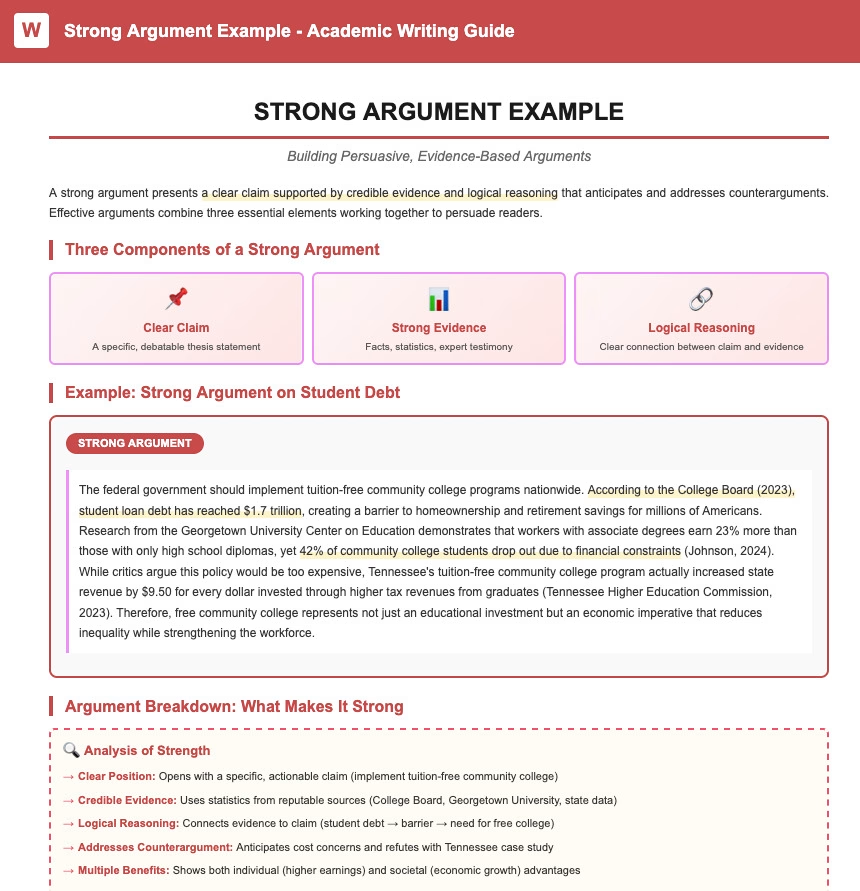
A “strong argument” is not the same thing as a loud opinion. In academic writing, debate, and scientific reasoning, a strong argument is one where the premises provide solid support for the conclusion, and the logical structure makes it rational to accept the conclusion. By contrast, a weak argument is one where the support is thin, the inference is shaky, or the argument relies on a fallacy.
This guide explains what makes a good argument, how deductive and inductive reasoning work, what “valid,” “invalid,” and “sound” mean, and how to strengthen arguments while you avoid logical fallacies. You will also get multiple strong argument examples you can copy, plus “weak argument” versions so you can see the difference clearly.
Argumentation basics: what an argument is and how arguments work
Argumentation is the practice of giving reasons for a claim. An argument is one set of statements where:
- the premises (reasons/evidence) are offered to support a claim, and
- the claim is the conclusion.
So every argument has:
- premises of the argument, and
- a conclusion.
Premises and the conclusion are linked by an inference—the reasoning step that says the premises lead to the conclusion.
A basic argument template:
- Premise 1
- Premise 2
- Therefore, Conclusion
A key idea: arguments are not “true” or “false.” Statements can be true or false, but an argument is evaluated by whether the premises support the conclusion.
What makes a strong argument vs a weak argument?
A strong argument is one that provides strong support for its conclusion. A weak argument is one that provides weak support for its conclusion. Strong or weak is typically used for inductive arguments, but you will also hear “stronger argument” informally for deductive cases.
A strong argument usually has:
- clear premises
- relevant evidence (premises actually connect to the conclusion)
- a valid or cogent logical structure
- no logical fallacies
- a conclusion that is either guaranteed (deductive) or likely to be true (inductive)
A weak argument often has:
- missing premises
- irrelevant or biased evidence
- questionable inference
- hidden assumptions
- a fallacy (for example, false dichotomy, straw man, ad hominem)
Deductive reasoning: valid argument, invalid arguments, and a sound argument
Deductive argument: definition and goal
A deductive argument aims for certainty. If it is deductively valid, then if the premises are true, the conclusion must be true. That is the hallmark of validity.
- A valid argument means: the conclusion follows from the premises. If the premises were true, the conclusion must be true.
- Invalid arguments mean: even if the premises are true, the conclusion might not follow. The inference fails.
Sound argument: when validity + true premises combine
A sound argument is a valid argument with true premises (premises are true; premises are actually true). In other words:
- valid structure + premises are true = sound argument
- A sound argument guarantees a true conclusion.
Strong argument example (deductive, valid, sound)
Following argument (Deductive):
- All research studies involving human subjects require informed consent. (premise)
- This study is research involving human subjects. (premise)
- Therefore, this study requires informed consent. (conclusion)
Why it works: the conclusion follows from the premises. If both premises are true, the conclusion is unavoidable. The argument is valid; and if the premises are actually true in your research context, it is also a sound argument.
Weak argument example (deductive, invalid)
- If a paper is well written, it will get an A. (premise)
- This paper got an A. (premise)
- Therefore, the paper is well written. (conclusion)
This is an invalid form (affirming the consequent). The conclusion might be true, but the premises do not guarantee it. The argument is invalid even if the premises look plausible.
Inductive reasoning: cogent arguments, strong or weak support, and “probably true”
Inductive argument: definition and goal
An inductive argument aims for probability rather than certainty. The conclusion is likely to be true, not guaranteed. Inductive reasoning is central to scientific reasoning, where we draw general conclusions from data and observations.
In inductive arguments:
- premises support the conclusion as probably true
- the conclusion is not forced, but it is rational to accept
- the strength depends on evidence quality and sample coverage
Cogent argument: the “sound argument” equivalent for induction
A cogent argument is a strong inductive argument with true premises. In other words:
- strong support + true premises = cogent
- If the premises are true and the inference is strong, then the conclusion is conclusion is likely.
So when someone says an argument is cogent, they mean:
- it is a strong inductive argument, and
- the premises are actually true.
Strong argument example (inductive, cogent)
- In three recent semesters, students who attended at least 80% of review sessions scored higher on the final exam than those who attended fewer sessions. (premise based on data)
- This semester’s class has similar course structure and assessment format. (premise)
- Therefore, students who attend at least 80% of review sessions this semester will probably score higher on the final exam. (conclusion likely to be true)
Why it works: it is a strong use of inductive reasoning because the premises provide solid support, and the conclusion is framed with appropriate probability (“probably true”).
Weak argument example (inductive, weak support)
- I attended one review session and scored well. (premise)
- Therefore, attending review sessions causes high exam scores for everyone. (conclusion)
This is weak because the evidence base is tiny, and it overgeneralizes. The conclusion is too strong for the support offered.
Valid and invalid: the most common confusion
A quick rule:
- Validity is about structure (logical form), not truth.
- The truth of the premises is a separate issue.
So:
- An argument may be valid even if its premises are false.
- An argument may have true premises and still be invalid.
Example: valid but not sound
- All birds are mammals. (false premise)
- All mammals are warm-blooded. (premise)
- Therefore, all birds are warm-blooded. (conclusion)
This is valid (the structure works), but not sound because the first premise is false. This shows why premises are actually true matters.
How to make an argument stronger: premises, inference, and support for its conclusion
To strengthen arguments, focus on three things:
1) Improve the premises
- Replace vague claims with specific, testable statements.
- Use credible data or authoritative evidence.
- Ensure premises are true (or at least well-supported in academic contexts).
2) Tighten the inference
- Make sure the premises logically connect.
- Remove leaps in reasoning.
- Add missing assumptions explicitly.
3) Match the conclusion to the support
- Deductive: if you claim certainty, you must be deductively valid.
- Inductive: use probability language (likely, probably true, tends to).
A strong writer checks whether the argument is valid or cogent, whether the premises are actually true, and whether the conclusion matches the level of support.
Logical fallacies: how bad arguments look convincing
A fallacy is an error in reasoning that can make bad arguments feel persuasive. Fallacies often sneak into everyday writing when someone tries to win rather than reason.
Here are quick examples of logical fallacies that weaken arguments:
- False dichotomy: presenting two options when options beyond those exist
- Hasty generalization: drawing a broad conclusion from little evidence
- Ad hominem: attacking the person instead of the reasoning
- Straw man: misrepresenting an opponent’s view
- Post hoc: assuming one thing caused another just because it happened first
If you want a stronger argument, you must avoid logical fallacies and keep the reasoning transparent.
Turn your topic into a high-scoring argumentative paper.
Let IvyResearchWriters.com refine your thesis, sharpen your premises, eliminate fallacies, and align your conclusion with what the evidence actually supports.
Strong argument examples you can use in essays, debates, and research papers
Example 1: Strong argument (deductive)
- If a source is peer-reviewed, it has undergone scholarly evaluation. (premise)
- This article is peer-reviewed. (premise)
- Therefore, this article has undergone scholarly evaluation. (conclusion follows)
This is a valid argument. If premises are true, the conclusion must be true.
Example 2: Strong argument (inductive, scientific reasoning)
- Multiple randomized controlled trials show that intervention X reduces symptom Y compared to placebo. (premise)
- The current patient population matches the trial eligibility criteria. (premise)
- Therefore, intervention X will likely reduce symptom Y in this population. (conclusion is likely)
This is scientific reasoning using inductive logic.
Example 3: Weak argument (fallacy-based)
- Either we ban phones in class or students will never learn. (premise framing)
- Therefore, we must ban phones. (conclusion)
This is a false dichotomy fallacy. It ignores middle options (structured phone use, policies, learning design).
A quick self-check: checklist for a good argument
Use this checklist before submitting any research paper:
- Do I have clear premises and a clear conclusion?
- Do the premises provide relevant support?
- Is the argument is valid (if deductive) or strong/cogent (if inductive)?
- Are the premises actually true or well-supported?
- Does the conclusion match the strength of evidence (must be true vs likely)?
- Have I avoided logical fallacies?
- Would a reasonable reader accept the conclusion based on the reasoning?
If you can answer “yes” to these, your argument is not just persuasive—it is logically strong.
Why IvyResearchWriters.com helps students build strong arguments quickly
Many students have good ideas but lose marks because their argumentation is unclear, premises are weak, or fallacies creep in. IvyResearchWriters.com helps you:
- turn opinions into defensible premises
- build deductive or inductive structures correctly
- avoid fallacies and strengthen arguments with credible evidence
- write clear, academic paragraphs where the conclusion follows logically
If you share your topic and thesis statement, Ivy Research Writers can rewrite your argument into a stronger version with clearer premises and a tighter logical structure (Word-ready).
Frequently Asked Questions
What is a strong argument example?
A strong argument example depends on the type of argument (deductive vs inductive), but in every case the argument is strong when its logical reasoning makes the conclusion acceptable based on the premises.
Example (deductive; valid):
- Premise 1: All research involving human subjects requires informed consent.
- Premise 2: This study involves human subjects.
- Conclusion: Therefore, this study requires informed consent.
Here the argument is valid or invalid based on structure, and this one is valid because the conclusion follows from the premises. If the premises are accurate, the conclusion is true.
At IvyResearchWriters.com, we help you turn your claim into a structured argument with clean premises so the logic is easy to defend in academic writing.
How do you describe a strong argument?
You describe a strong argument by showing that:
- the premises support the conclusion through clear logical reasoning, and
- the conclusion fits the strength of the evidence (not overstated).
In prose: an argument is strong when the premises provide enough support that a rational reader argument would accept the conclusion, and the reasoning avoids gaps and fallacies. In deductive form, “strong” often means the argument is valid and, when the premises match reality, it becomes sound. In inductive form, “strong” means the conclusion is highly supported even if it is not guaranteed.
Importantly, a strong argument is not the same as the truth of the conclusion alone—an argument can have a true conclusion for the wrong reasons.
What are some strong argumentative topics?
Here are topic ideas where arguments are good because they naturally allow clear premises, evidence, and a defensible conclusion:
- Should social media platforms be regulated to reduce misinformation?
- Should colleges require a financial literacy course for graduation?
- Should employers adopt permanent hybrid work policies?
- Should public health agencies mandate certain vaccinations in high-risk settings?
- Should Artificial Intelligence tools be allowed in academic writing with disclosure?
- Should governments ban or restrict targeted advertising to minors?
- Should universities implement test-optional admissions permanently?
- Should schools limit smartphone use during instructional time?
IvyResearchWriters.com can help you pick a topic, craft a thesis, and build a structured argument where each premise clearly supports the conclusion.
What are strong and weak arguments?
Strong and weak arguments differ by how well the premises support the conclusion and whether the reasoning is valid.
Strong arguments
- clear premises + strong evidence + solid logical reasoning
- the structure is not flawed (not valid or invalid confusion)
- when premises match reality, the conclusion is reliable
- ideally, you can show premises and a true conclusion in a coherent chain
Weak arguments
- missing, vague, or irrelevant premises
- leaps in reasoning or fallacies
- conclusions that overreach the evidence
- the argument may be invalid even if the writer feels confident
Key clarification: argument are true is not the right way to judge logic—statements can be true or false, but an argument is evaluated as valid or invalid, and as strong or weak. You can even have a case where the conclusion is false while the reasoning is valid (because validity is about structure, not truth). IvyResearchWriters.com helps students avoid these common mistakes by tightening premises, improving evidence, and aligning the conclusion with what the support actually justifies.

