

Straw Man Fallacy Examples: How to Identify and Avoid a Straw Man Argument
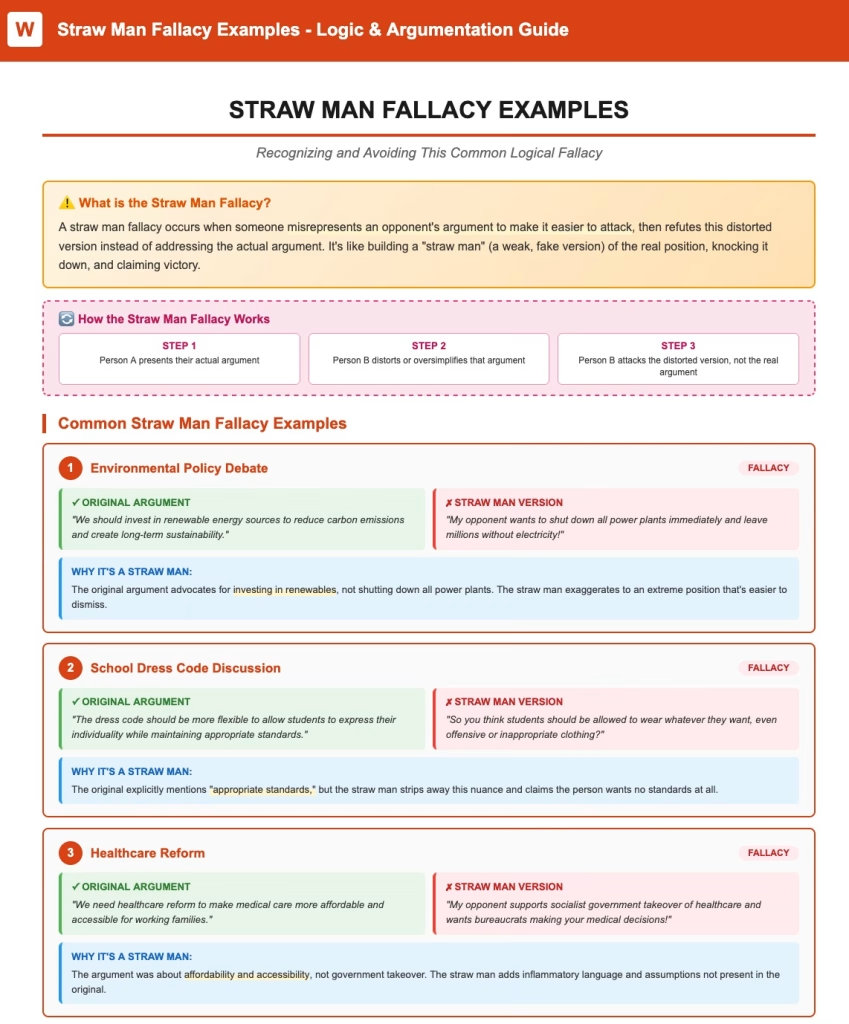
The straw man fallacy is one of the most common and misleading types of logical fallacies found in debate, politics, media, and everyday conversation. Often used to distort, exaggerate, or misrepresent an opponent’s position, this fallacy weakens critical thinking and undermines productive dialogue.
In this post for Ivy Research Writers, we’ll explore the straw man fallacy in depth, including definitions, real-world examples, and how to identify and avoid it in argumentation.
What Is a Fallacy?
A fallacy is a flaw in reasoning that renders an argument invalid, illogical, or misleading. Fallacies often appear persuasive but collapse under scrutiny.
Among the many types of logical fallacies, the straw man fallacy is particularly deceptive because it gives the illusion of refuting an argument — while never actually engaging with the real argument at all.
What Are Straw Men?
The term straw men refers metaphorically to military training dummies — lifeless figures that are easy to knock down. In argumentation, a “straw man” is a weakened, exaggerated, or fabricated version of someone else’s argument — made only so it can be easily dismissed.
This sets the stage for a false victory in a debate, where the arguer wins by attacking an imaginary or distorted version of the opponent’s claim.
What Is the Straw Man Fallacy?
The straw man fallacy occurs when someone misrepresents another person’s argument to make it easier to attack or refute. Rather than addressing the opponent’s actual position, the speaker constructs a caricature of it — a “man of straw” — and proceeds to tear it down.
Definition: A straw man fallacy is a fallacy of relevance where the arguer substitutes a distorted, exaggerated, or misrepresented version of an opposing argument, refutes that version, and concludes the real argument has been defeated.
What Is a Straw Man Argument?
A straw man argument is the product of the straw man fallacy. Instead of engaging with a constructive or pragmatic critique of an opposing viewpoint, the speaker distorts or oversimplifies it, creating an easier target.
This often occurs in:
- Political campaigns
- Media commentary
- Live debates
- Online disagreements
Straw Man Fallacy Examples
Let’s explore some classic and contemporary straw man fallacy examples to understand how this fallacy is used in practice.
Example 1: Environmental Policy
Person A: We should have stronger regulations on industrial pollution to protect the environment.
Person B: So you want to shut down every factory and put thousands of people out of work?
Analysis: Person B has created a distorted version of Person A’s argument — no one said anything about shutting down all factories. This is a textbook straw man argument.
Example 2: Gun Control Debate
Person A: I support background checks for gun buyers.
Person B: My opponent wants to take away your guns and destroy the Second Amendment.
Analysis: This is a common straw man fallacy used in American politics, where a moderate viewpoint is exaggerated to sound extreme.
Example 3: Nutrition Advice
Person A: I think we should reduce sugar in school lunches.
Person B: Oh great, now you want to starve children.
Analysis: This takes a constructive suggestion and turns it into an unpopular, exaggerated position, which is much easier to refute than the actual argument.
Straw Man Argument Examples in Politics
The straw man fallacy is often used by both liberal and conservative figures. Consider this fictional campaign line:
“My opponent believes the government should help people find jobs. That’s just code for more socialism and laziness.”
Here, the opponent’s position (job assistance) is turned into an unpopular and inaccurate caricature — making it easier to oppose without addressing the real argument.
Logical Fallacies: How the Straw Man Fits In
The straw man fallacy is part of a broader family of logical fallacies, including:
- Ad hominem – attacking the person rather than the argument
- Red herring fallacy – distracting with irrelevant information
- False dilemma – presenting only two options when more exist
Each fallacy undermines rational discourse and shifts focus away from constructive disagreement.
How to Identify a Straw Man Argument
To identify a straw man argument, ask:
- Does the response misrepresent the original claim?
- Is the opponent’s argument simplified or exaggerated?
- Is the new version of the argument easier to attack?
- Does the speaker refute a position that wasn’t actually stated?
If so, you’ve likely encountered a straw man fallacy.
Why People Use Straw Man Arguments
Using a straw man is often strategic:
- It avoids refuting an argument that’s too strong to oppose directly
- It creates a sense of moral or intellectual superiority
- It can persuade audiences emotionally by appealing to fear or outrage
In short, straw man arguments are often about winning a debate, not finding truth.
How to Avoid the Straw Man Fallacy
If you want to avoid using straw man arguments:
- Represent your opponent’s position fairly and accurately
- Restate their view in their own words
- Ask clarifying questions before criticizing
- Focus on constructive criticism, not dismissal
- Avoid oversimplifying complex issues
This builds inclusive, respectful, and stronger arguments — essential in academic writing, research, and public discourse.
How the Straw Man Argument Is Used in Research
While the straw man argument is typically associated with debate and informal discourse, it can and does appear—intentionally or unintentionally—in academic research papers, opinion pieces, and critical reviews. When used in research, it can undermine scholarly credibility and mislead readers. Here’s how:
1. Straw Man Arguments in Literature Reviews
In literature reviews, a researcher might misrepresent an opposing scholar’s argument to make it easier to criticize.
Example:
Original position (Scholar A): “Qualitative research can provide valuable insight into small-scale social phenomena.”
Straw man (Scholar B): “Scholar A argues that quantitative methods are useless.”
This distorted version creates a non-existent viewpoint that is easier to dismiss, instead of addressing the real, more nuanced position.
2. Straw Man in Theoretical Critique
Some researchers construct a straw man to refute a theory or model by oversimplifying its assumptions.
Example:
Dismissing evolutionary psychology by saying it “reduces all human behavior to biology” is often a straw man. The field acknowledges environmental, cultural, and psychological factors.
Here, the opposing position is presented as overly rigid to be more easily refuted, even if the actual theory is more balanced.
3. Policy Research and Political Framing
In public policy research, especially on topics like climate change, education, or health care, straw man arguments are used to weaken opposing policy stances.
Example:
A paper advocating for universal basic income might claim: “Opponents believe people should live in poverty to stay motivated.”
This caricature is an inaccurate misrepresentation of the actual argument against UBI and constitutes a straw man.
4. Peer Review and Academic Criticism
Even peer-reviewed critiques sometimes use straw man reasoning to strengthen their rebuttal by portraying the other side as simplistic or extreme.
This is dangerous in academic discourse, as it damages the integrity of scholarly exchange and may be flagged during peer review or rebuttal responses.
How to Avoid Using Straw Man Arguments in Research
- Always quote or paraphrase opposing views accurately
- Cite original sources to avoid summarizing others’ work inaccurately
- Engage with the strongest version of an opposing argument (steelman approach)
- Avoid reducing complex positions to easily-dismissed extremes
The straw man fallacy used in research often hides behind sophisticated language, but it remains a logical fallacy that can undermine academic integrity. At IvyResearchWriters.com, we help ensure your papers are built on sound reasoning, accurately represent all viewpoints, and stand up to critical scrutiny.
Need help strengthening your research without logical fallacies?
Visit IvyResearchWriters.com for expert guidance on research writing, argumentation, and critical analysis.
Conclusion: Why Straw Man Fallacies Matter
The straw man fallacy might seem like a harmless rhetorical trick, but it causes serious damage to dialogue, disagreement, and critical thinking. Whether in a live debate, a research paper, or a political campaign, it’s crucial to engage with the actual argument, not a scarecrow version of it.
By learning to identify a straw man argument, we can have more pragmatic, productive, and truthful conversations — and that’s something every writer, debater, and thinker should strive for.
Strengthen your research paper with expert academic guidance.
Visit IvyResearchWriters.com today and get professional assistance tailored to your discipline, deadline, and academic level.
Frequently Asked Questions
What is an example of a straw man fallacy?
An example of a straw man fallacy occurs when someone responds to an opposing point of view by attacking a misrepresentation of it rather than the real claim.
Example:
- Original argument: “Universities should provide more mental health support for students.”
- Response: “My opponent thinks students are too weak to handle real life.”
In this case, the responder invents a non-existent and exaggerated opposing position that was never stated. Instead of engaging with the actual argument, they refute a distorted version.
At IvyResearchWriters.com, writers are trained to identify and avoid this kind of flawed reasoning by accurately engaging with the real argument, not a fabricated one.
What is a real-life example of a strawman?
A real-life strawman often appears in workplace discussions, media debates, or classrooms.
Real-life example:
- A manager suggests flexible working hours.
- A colleague responds: “So you’re saying people shouldn’t be accountable anymore.”
Here, the colleague replaces the opposing point of view with a misrepresentation that is easier to criticize. The original suggestion is turned into a non-existent extreme position, making the response misleading and intellectually weak.
Academic writers supported by IvyResearchWriters.com are taught to recognize such tactics and respond to the actual opposing position, strengthening the credibility of their work.
What best describes a straw man fallacy?
The best description of a straw man fallacy is:
A logical error in which someone distorts, exaggerates, or fabricates an opposing position, creating a misrepresentation that is easier to attack than the real argument.
In essence:
- The real argument is ignored
- A weaker, sometimes non-existent, version is substituted
- That false version is then criticized or dismissed
This is why the straw man fallacy is considered intellectually dishonest and academically unsound — a key point emphasized in research and writing guidance at IvyResearchWriters.com.
What are some real-life examples of fallacies?
Straw man arguments are just one of many fallacies encountered in real life. Common examples include:
- Straw man fallacy: Attacking a misrepresentation of an opposing point of view
- Ad hominem: Attacking the person instead of the opposing position
- Red herring: Introducing irrelevant information to distract from the real issue
- False dilemma: Presenting only two options when others exist
Real-life contexts where these appear:
- Political debates
- Social media arguments
- Marketing claims
- Academic essays written without proper reasoning skills
This is precisely why students and professionals rely on IvyResearchWriters.com — to ensure arguments are logically sound, accurately represent opposing viewpoints, and meet high academic standards.

