

Pull factor examples: What attracts migrants and why people move
Migration decisions rarely happen for one single reason. Most of the time, a person weighs what is happening in their home countries (pressure, danger, or limited prospects) against what they believe they can gain in another country (safety, stability, and a better life). That is why understanding pull factor examples matters: pull factors highlight the positive aspects that make a destination appealing and help explain why people migrate.
Below is an in-depth guide you can use for essays, assignments, or general understanding—packed with definitions, real-world illustrations, and clear “why it matters” explanations.
Pull factor
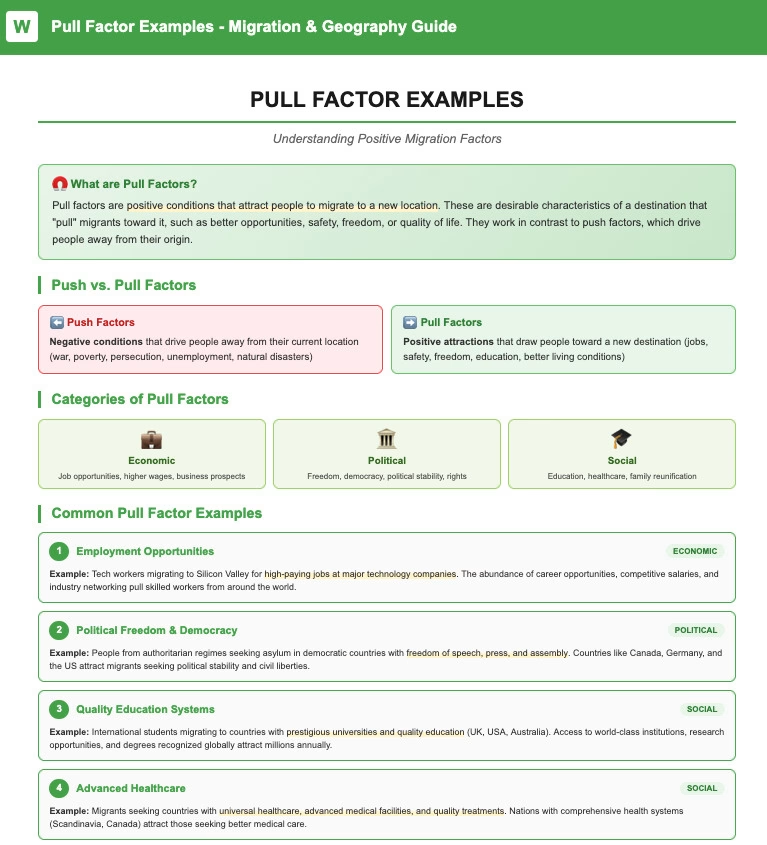
A pull factor is any condition that attracts a person toward a new location. In simple terms, pull factors are positive because they describe benefits that make people want to move somewhere else. These are the “rewards” on the destination side—things that pull a person in.
Many pull factor examples are linked to opportunity and quality of life. Pull factors are often connected to:
- job opportunities and stable incomes
- economic opportunities and stronger labor markets
- higher standard of living (better housing, services, safety, and infrastructure)
- better education and career opportunities
- reliable public systems and social support
- personal freedom, including protection from religious or political harm
In other words, factors attract because they offer “more” of what people want: security, growth, and possibility. When opportunities are significantly better elsewhere, a person may decide it is worth migrating to a new location.
A key point: pull factors are not always about moving to a totally different nation. Sometimes they attract populations to a new city, state, or portion of the country where work, services, or safety is better. That still counts as migration, just at a different scale.
Push factor
A push factor is a condition that pressures people to leave a place. A push factor does not “invite” someone somewhere else—it creates hardship, danger, or instability that makes staying difficult. Many people leave their homes because the conditions in the country of origin become unbearable.
Push factors are often things like:
- unemployment and rising living costs
- economic hardship and shrinking wages
- famine and food insecurity
- famine or drought that destroys crops and income
- violence, war, and insecurity
- religious persecution or political repression
- a sub-standard level of living with few essential services
These are conditions that drive people to move because they limit survival, safety, or the ability to build a future. In practical terms, push factors drive people away from a community and drive people to leave a place.
When push factors become severe, they can essentially force a population to relocate. Some crises force a population or person from one location to another—not because they want to explore, but because they must survive.
That is why many people are affected by push factors even when they do not want to move. A single push factor in a country (like widespread unemployment) can pressure a group of people leave in search of stability.
Push and pull factors
Most migration stories are not “push only” or “pull only.” Usually, push and pull factors combine. That is how push and pull factors work in real life:
- Push factors create strong reasons to leave (pressure).
- Pull factors create strong reasons to choose a destination (reward).
In short, push and pull factors work like a two-part decision system: hardship makes leaving likely, opportunity makes a specific destination attractive. In many cases, pull factors work together rather than acting alone. For example, a country might offer job opportunities, a safer environment, and a higher standard of living—and those benefits combine into a powerful “pull.”
Here is a simple way to picture it:
- Push factors in a country: low wages, instability, lack of opportunities, insecurity
- Pull factors elsewhere: better opportunities, safer communities, stronger public services, education, healthcare
So when you write about migration, do not treat push and pull as isolated. Push and pull factors often operate side-by-side, shaping why people leave and where they go.
Migrate
To migrate means to move from one place to another, often with the intention of staying for a long time. People can migrate within the same country (internal migration) or across borders (international migration). Either way, people move because they believe relocation will improve survival, safety, or life chances.
Two key terms matter here:
- emigration: leaving one’s home country
- immigrate: entering and settling in a new country
So, when people leave a country, they are emigrating. When they arrive and settle, they immigrate.
A person who moves is a migrant. Migrants may move voluntarily (for work or education) or under pressure (conflict, famine, persecution). Some migrants seek refuge in another country when danger becomes extreme—especially when a person from one country faces threats that make staying unsafe.
This is where the “refuge” language matters. In the most serious cases, a person’s only realistic option is to seek refuge in another country because push factors have become life-threatening. Sometimes the risks are so severe that people are often faced with genocide-like conditions. These genocide-like conditions in their country can include targeted violence, mass persecution, or systematic killing.
For example, consider germany during the nazi era. Many people fled because they faced imprisonment or violent death if they remained. In that scenario, the pressure was not mild—it was survival. The person may have been forced from a location because the environment essentially force a population to move.
Migration also includes economic movement. A young adult who cannot find stable work, who cannot find a lucrative job, may leave because the local economy offers limited upward mobility. That person might be in search of better prospects and decide to move toward places with stronger labor markets.
This is also why many migrants aim for developed countries, where they believe economic opportunities are more available and systems are more stable.
Examples of pull factors
Now to the core of this post: practical pull factor examples you can use in writing and discussion. The best way to describe them is to show how they factors attract populations and why they motivate relocation.
1) Job access and income growth
One of the most common pull factor examples is job opportunities. When wages are higher, hiring is steady, and workers can advance, factors attract people who want stability.
- Pull factor: better-paying employment
- Why it matters: it allows people to seek a better life and support family
This is also why many migrants relocate for seeking jobs. If opportunities are significantly better elsewhere, it becomes rational to move.
2) Career mobility and professional development
Another strong pull factor is career opportunities. Some locations have industries, training pathways, or professional networks that do not exist in a person’s country of origin.
- Pull factor: promotions, credentials, experience
- Why it matters: it helps people pursue a better life compared to what they could achieve at home
3) Higher standard of living
The promise of a higher standard of living is among the most persuasive pull factor examples. This includes safe neighborhoods, reliable healthcare, quality education, infrastructure, and stable public services.
- Pull factor: “life works better” (services, safety, stability)
- Why it matters: people move toward the positive aspects of daily life
4) Safety, rights, and protection from persecution
Sometimes pull factors involve rights and safety. If a destination protects minority groups or offers freedom from religious or political harm, that becomes a major pull.
- Pull factor: safety and civil protections
- Why it matters: it can help a person or population survive and rebuild
5) Abundance of food and basic security
Food security can be a powerful pull factor. Abundance of food in a destination matters most when a person’s home region is experiencing famine or drought.
- Pull factor: reliable food supplies and stable prices
- Why it matters: it supports survival and family stability
6) Education and long-term family prospects
Education access is a pull factor when schools are strong, affordable, and recognized globally. This can strongly encourage people to immigrate, especially families planning long-term futures.
- Pull factor: better schools, training, scholarships
- Why it matters: it improves lifetime earnings and social mobility
7) Community networks and familiarity
Family members, cultural communities, and existing support networks can also attract migrants. Even if two destinations have similar wages, the one with community support can feel safer.
- Pull factor: support, housing help, job referrals
- Why it matters: it reduces risk when considering migrating to a new place
A sentence you can reuse in essays
If you need a clean line for academic writing, try:
Pull factors are positive conditions that factors attract populations by offering better opportunities and a higher standard of living, which can encourage people to immigrate.
And here is another essay-friendly line:
In many cases, pull factors are often economic and social benefits that attract populations to a new region where opportunities are significantly better elsewhere.
Also, to match common classroom language: encourage people, examples of pull factors include job access, safety, education, and quality healthcare.
Factors of immigration
When instructors ask about the factors of immigration, they usually want a structured explanation of what motivates people to enter and settle in a country. The clearest approach is to classify causes into push and pull categories and show how they interact.
What “factors of immigration” typically include
In many assignments, you can explain that factors include:
- economic causes (wages, unemployment, economic opportunities)
- safety causes (war, crime, religious persecution)
- survival causes (famine, disaster, health crises)
- opportunity causes (education, career opportunities, business growth)
- family and social causes (networks and reunification)
You can also write: factors are often multi-layered—economic, social, and political at the same time. And factors also vary depending on age, skills, and family responsibilities.
Ready to turn your “push–pull factors” topic into a high-grade essay or research paper?
Message IvyResearchWriters.com with your topic + word count + deadline, and we’ll draft a polished outline (or full paper) fast—so you submit with confidence.
How history shows push and pull in action
A classic example is the great potato famine. The potato famine of the mid-19th is often referenced alongside the famine of the mid-19th century because it shows how push and pull can combine.
- Push factor: starvation risk, collapse of local food systems, poverty
- Pull factor: the chance of food security and work elsewhere
As a result, thousands of irish families chose to move and immigrate to the united states—many going to the united states to avoid starvation. This is a clear case where survival pressures made people to leave, and the promise of stability elsewhere made relocation feel possible.
Forced migration under extreme threat
Some of the most severe push factors involve persecution. People may be often faced with genocide-like conditions where their only way to survive is to flee. When a government or armed group targets communities, it creates genocide-like conditions in their country and can lead people to escape quickly.
Again, germany during the nazi era is frequently used as a historical illustration of persecution and flight. For many, staying could mean imprisonment or violent death if they remained. In such cases, it is not simply “choice”—the conditions can essentially force a population to move.
This is where it helps to write clearly: these factors can force a population or person from one place to another, meaning a population or person from one area is pushed outward until they can find safety. That is often the pathway by which a person from one country may attempt to seek refuge in another country.
A practical framework for decision-making
In real life, migration decisions often come down to whether relocating will improve outcomes. These conditions can help a person or population determine whether leaving is justified. More formally, a person or population may weigh:
- risk of staying versus potential gain of leaving
- the safety of the destination
- whether a country to settle offers legal pathways, employment, and stability
- whether relocating to a new area would provide a measurable improvement
In essay-ready form, you can say: population determine whether relocating will provide safety, employment, and long-term stability. Or: people evaluate whether a move would provide a significant benefit.
Everyday modern examples
Not every story is famine or war. Sometimes the drivers are economic:
- A young adult who cannot find work locally, who cannot find a lucrative job, may decide to leave a country because they see limited upward mobility.
- If the local economy has lack of opportunities and persistent unemployment, those are push pressures that drive people to leave.
- When they compare options and see stronger systems in developed countries, the pull becomes stronger.
This is the heart of many modern migration stories: people choose to leave their country or region because daily life feels stuck, and they want better opportunities in a place where they believe they can seek a better life.
Bringing it all together: how to write about pull factor examples clearly
When you summarize migration for a blog post or essay, keep these ideas tight:
- Push factors explain why people leave and what drive people to leave.
- Pull factors explain why factors attract and why migrants select a specific destination.
- Most of the time, push and pull operate together—push and pull factors work as a combined system.
If you need one final sentence to conclude a paragraph, use this:
Push factors create conditions that drive people to leave their home countries, while pull factors highlight the positive aspects of a different place—such as job opportunities, safety, and higher standard of living—that encourage people to immigrate when they believe opportunities are significantly better elsewhere.
Frequently Asked Questions
What are 5 examples of pull factors?
Pull factors are often the positive aspects of a destination that give people strong reasons to want to move. Common examples include:
- Job opportunities (higher pay, more hiring, better job security)
- Higher standard of living (safer neighborhoods, better housing, reliable services)
- Better education and training (schools, universities, scholarships, skills programs)
- Stronger healthcare access (quality hospitals, affordable care, better outcomes)
- Safety and rights protections (especially for people leaving conflict or discrimination)
At IvyResearchWriters.com, we often help students frame these as the benefits that attract populations to a new place, especially when opportunities are clearly better than at home.
What are three examples of a pull factor?
Three clear pull factor examples are:
- Job opportunities and career growth
- Better standard of living and safer communities
- Access to education and professional development
These are often the positive aspects that create strong reasons to want to relocate, whether for a single person or larger groups—meaning they can attract populations to a new place.
What are 5 examples of push factors?
Push factors are the difficult conditions that pressure people to leave their home region. Five common examples are:
- Unemployment and lack of work
- Economic hardship (low wages, high costs, unstable income)
- Famine or food insecurity
- War, violence, or widespread insecurity
- Persecution (religious or political threats)
When push factors become severe, people may leave one country to seek refuge elsewhere. In academic writing, IvyResearchWriters.com can help you explain how push factors create urgency, while pull factors shape the destination choice.
What is a pull factor?
A pull factor is a condition that attracts people to a new location—these are often the positive aspects of another place that offer strong reasons to want to move. Pull factors can influence individuals and also attract populations to a new place.
For instance, migrants may immigrate to the united states because they believe they can find better work, safety, and long-term stability. In other situations, people may leave one country to seek refuge if safety and protection are the strongest pull compared to staying in danger.
If you are turning these definitions into an essay, discussion post, or research paper, IvyResearchWriters.com can help you present them clearly, with strong examples and clean academic structure.

