

What To Know
- According to various claims, it is a supposed program designed to simulate a large-scale event—such as a fake alien invasion or a staged second coming—to manipulate the public and establish a totalitarian global system.
- The supposed goal is to create a unified global reaction to a staged event, leading to centralized control.
Project Blue Beam: Origins, Claims, and Critical Analysis
Introduction
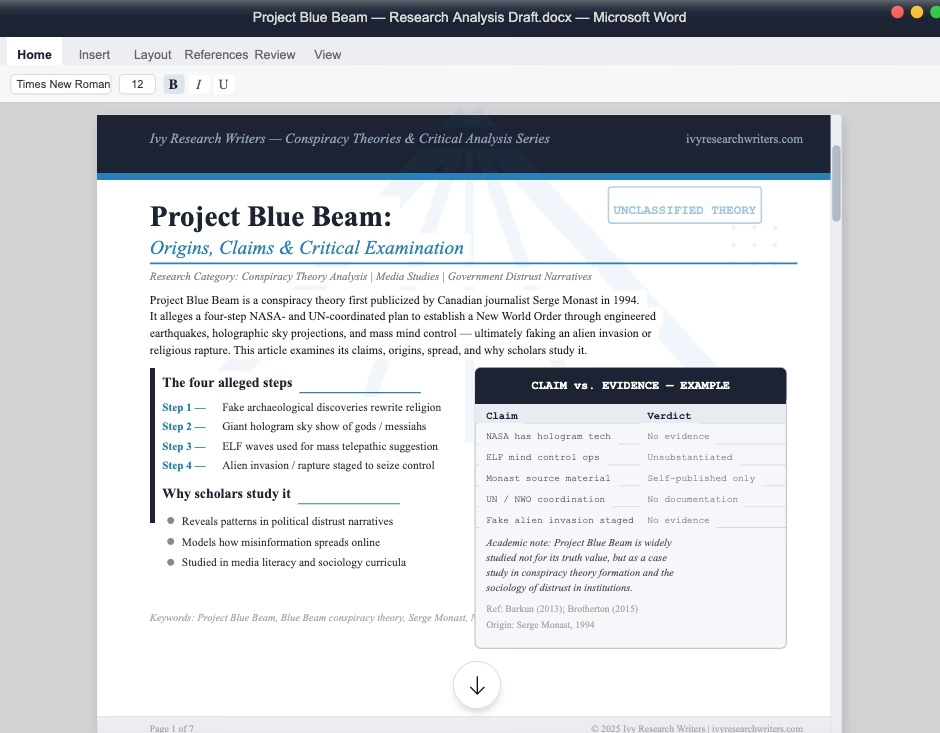
Project Blue Beam is one of the most widely discussed modern conspiracy theories, often linked to ideas about global control, staged events, and technological deception. According to various claims, it is a supposed program designed to simulate a large-scale event—such as a fake alien invasion or a staged second coming—to manipulate the public and establish a totalitarian global system.
This article explores the history, claims, and critical perspectives surrounding Project Blue Beam, separating fact from speculation while providing a balanced overview.
Video
Much of the popularity of Project Blue Beam comes from online video content.
- Viral videos claim to show evidence of holographic projections in the sky
- Some videos link unusual atmospheric phenomena to secret government operation
- Others present alleged insider testimony
However, most of these videos lack verifiable source material and are often edited or taken out of context.
Project
The term Project Blue Beam refers to a hypothetical covert project allegedly orchestrated by powerful institutions.
Claims suggest the project involves:
- Advanced holographic technology
- Psychological manipulation
- Use of information systems to influence belief
The supposed goal is to create a unified global reaction to a staged event, leading to centralized control.
Bluebeam
The name bluebeam originates from a book written by Serge Monast, a Canadian journalist who popularized the theory.
- The book described a four-step plan involving deception
- It included claims about the CIA, the United Nations, and other international organizations
- Monast argued that these groups were part of a coordinated global plot
Despite its influence, there is no verified evidence supporting these claims.
Source
When evaluating Project Blue Beam, it is crucial to examine the source of the information.
- Most claims originate from a single primary source (Serge Monast’s writings)
- There is no official documentation confirming the existence of such a program
- Academic and scientific communities do not recognize the theory as credible
Critical thinking and source verification are essential when analyzing conspiracy-related content.
Public
The role of the public is central to the theory.
- The theory assumes mass manipulation of global society
- It suggests that belief systems—especially Abrahamic religions—could be targeted
- The alleged goal is to influence perception of truth and reality
In reality, large-scale coordination of this kind would require immense transparency and cooperation, making it highly unlikely.
Origins and History
The history of Project Blue Beam dates back to the 1990s.
- Introduced by Serge Monast
- Spread through early internet forums and alternative media
- Gained traction with the rise of social media and online conspiracy communities
The theory often overlaps with other ideas, including UFO sightings and secret government operation narratives.
Common Claims and Examples
Proponents of the theory often cite several examples:
- A staged UFO invasion to unite humanity under a single authority
- A simulated second coming to influence religious populations
- Use of advanced technology to project images in the sky
These claims are often presented without verifiable evidence and rely heavily on speculation.
Critical Analysis
From a scientific and analytical perspective:
- There is no credible evidence of technology capable of global holographic deception at the scale described
- Claims involving organizations like the CIA or United Nations lack substantiation
- The theory reflects broader fears about control, surveillance, and misinformation
Experts emphasize the importance of distinguishing between verified information and unsupported claims.
Why the Theory Persists
Project Blue Beam continues to circulate due to:
- Public interest in secret government activities
- The influence of viral video content
- Growing distrust in institutions
It also reflects deeper societal concerns about globalization and the potential for centralized power.
Common Assignments Related to Project Blue Beam
Students studying topics like Project Blue Beam often encounter a variety of academic assignments across disciplines such as sociology, media studies, political science, and religious studies. Below are common assignment types:
1. Research Essays
- Analyze the origins and history of Project Blue Beam
- Evaluate the credibility of its primary source
- Compare it with other conspiracy theories
Example: Discuss whether Project Blue Beam reflects genuine concern or misinformation in modern society.
2. Critical Analysis Papers
- Examine the role of video and online media in spreading conspiracy theories
- Analyze how information is framed to influence the public
Example: Critically assess how digital platforms amplify conspiracy narratives.
3. Case Study Assignments
- Focus on Project Blue Beam as a case of mass belief formation
- Explore its connection to institutions like the alleged CIA or United Nations
Example: Evaluate how conspiracy theories impact trust in international organizations.
4. Argumentative Essays
- Argue for or against the plausibility of Project Blue Beam
- Discuss its implications for society and governance
Example: Could a global staged event realistically occur in today’s world?
5. Media Analysis Projects
- Analyze viral video content related to Project Blue Beam
- Identify bias, editing techniques, and lack of credible source material
6. Presentation Assignments
- Present the history and evolution of the theory
- Discuss its links to UFO narratives and global control ideas
7. Comparative Religion Essays
- Explore how the theory references the second coming
- Analyze its relationship with Abrahamic religions
8. Sociology or Psychology Papers
- Study why people believe in conspiracy theories
- Examine fear, uncertainty, and trust in authority
9. Debate Topics
- “Is Project Blue Beam a harmless conspiracy or a dangerous plot?”
- “Do conspiracy theories contribute to misinformation in modern society?”
10. Dissertation or Thesis Topics
- The role of conspiracy theories in shaping public perception
- Media influence on belief systems
- The rise of digital misinformation and global narratives
Struggling with research essays, critical analysis, or APA formatting?
IvyResearchWriters.com provides expert academic writing support tailored to your assignment requirements.
APA Research Essay Example: Project Blue Beam—Origins, Claims, and Critical Evaluation
Title Page
Project Blue Beam: Origins, Claims, and Critical Evaluation of a Modern Conspiracy Theory
Student Name
Institution
Course
Instructor
Date
Abstract
Project Blue Beam is a widely circulated conspiracy theory alleging the existence of a covert international program designed to simulate global events—such as a fabricated UFO invasion or a staged second coming—to manipulate the public and establish centralized control. This research essay examines the theory’s origins, primary sources, and claims, and evaluates them using principles of media literacy, political science, and sociology. By contrasting anecdotal evidence with verifiable information, the paper argues that Project Blue Beam persists due to information ecosystems, distrust in institutions, and the persuasive power of narrative, rather than empirical support.
Introduction
Conspiracy theories have long shaped public discourse, particularly during periods of uncertainty. Among them, Project Blue Beam stands out for its sweeping claims about global manipulation involving advanced technology, religious symbolism, and international coordination. Popularized in the 1990s by Serge Monast, the theory alleges a secret operation orchestrated by entities such as the CIA and the United Nations to influence global society.
This essay investigates the history of Project Blue Beam, outlines its core claims, and evaluates the credibility of its sources. It further explores why such theories gain traction and how they influence perceptions of truth in the modern information environment.
Origins and Primary Source Analysis
The principal source of Project Blue Beam is Serge Monast’s book and related publications. These materials describe a multi-stage plan involving technological deception, psychological conditioning, and manipulation of religious beliefs, particularly within Abrahamic religions.
However, critical analysis reveals key limitations:
- Lack of corroborating evidence from independent or official sources
- Reliance on anonymous or unverifiable claims
- Absence of technical feasibility studies supporting large-scale holographic projections
From a methodological standpoint, the theory does not meet standards of empirical verification, which undermines its credibility.
Core Claims of the Theory
Proponents of Project Blue Beam commonly assert the following:
- A staged UFO event to create a perceived external threat
- A simulated second coming to influence religious populations
- The use of advanced projection or communication technologies to deceive the public
- The establishment of a totalitarian global governance system
These claims are often disseminated through video content and online forums, where repetition and visual framing can enhance perceived legitimacy despite limited evidence.
Media, Information, and Public Perception
The persistence of Project Blue Beam can be understood through the lens of media studies.
- Digital platforms enable rapid dissemination of information regardless of accuracy
- Visual media (e.g., video clips) can create strong emotional responses
- Algorithms may reinforce exposure to similar content, creating echo chambers
As a result, the public may encounter the theory in contexts that blur the line between verified information and speculation.
Sociological and Psychological Perspectives
From a sociological perspective, conspiracy theories often emerge in response to uncertainty, institutional distrust, and perceived loss of control. Project Blue Beam reflects these dynamics by offering a comprehensive narrative that explains complex global phenomena through a single coordinated plot.
Psychologically, such theories can provide:
- A sense of order in chaotic environments
- Simplified explanations for complex events
- Reinforcement of existing beliefs or biases
These factors contribute to the theory’s endurance despite lack of empirical support.
Critical Evaluation of Feasibility
Evaluating the feasibility of Project Blue Beam requires consideration of technological, political, and logistical constraints.
- No known technology can convincingly simulate global-scale holographic events across diverse environments
- Coordinating a secret operation across multiple international institutions would require unprecedented secrecy
- The diversity of global cultures and belief systems would make uniform manipulation unlikely
These challenges suggest that the theory is not practically viable under current scientific and geopolitical conditions.
Discussion
Project Blue Beam illustrates how narratives can shape perceptions of reality. While the theory lacks credible evidence, it highlights broader issues such as misinformation, media influence, and the role of critical thinking in evaluating claims.
Rather than dismissing such theories outright, it is important to analyze why they resonate with audiences. Doing so provides insight into public concerns about authority, technology, and truth in a rapidly changing world.
Conclusion
Project Blue Beam remains an influential but unsubstantiated conspiracy theory. Its origins in a single source, lack of empirical evidence, and reliance on speculative claims limit its credibility. However, its persistence underscores the importance of media literacy and critical analysis in the digital age.
Understanding how and why such theories spread is essential for addressing misinformation and fostering informed public discourse.
References
Monast, S. (Year). Project Blue Beam (Book).
Sunstein, C. R., & Vermeule, A. (Year). Conspiracy theories: Causes and cures. Journal of Political Philosophy.
Lewandowsky, S., et al. (Year). Misinformation and its correction. Psychological Science.
Conclusion
Project Blue Beam remains a compelling but unproven conspiracy theory. While it raises interesting questions about technology, media, and influence, there is no reliable evidence to support its existence as a real program.
Understanding such theories requires critical thinking, careful evaluation of sources, and awareness of how information spreads in the digital age.
FAQs About Project Blue Beam
What is Project Blue Beam?
Project Blue Beam is a widely discussed conspiracy theory that claims a secret program exists to stage large-scale global events—such as a fake UFO invasion or a simulated second coming—to influence the public and reshape global society.
- Originates mainly from a single source (Serge Monast’s book)
- Often linked to organizations like the CIA or United Nations in theory (without verified evidence)
Is there any real evidence for Project Blue Beam?
No, there is no verified evidence supporting Project Blue Beam.
- Claims are mostly based on speculation and online video content
- No official documents or credible investigations confirm the theory
In context: Most experts consider it part of broader conspiracy theories rather than a real operation.
Why do people believe in Project Blue Beam?
Several factors contribute to belief in the theory:
- Distrust of governments and international institutions
- Viral spread of video content online
- Interest in topics like UFO phenomena and hidden agendas
What is the main goal claimed by the theory?
According to the theory, the goal is to establish a totalitarian global system.
- It allegedly involves manipulating religious beliefs, including Abrahamic religions
- Uses staged events to influence perception of truth
In summary: These claims describe a coordinated global plot, but they remain unproven and widely disputed.

