

Porter’s Five Forces: A Complete Guide to Industry Analysis and Competitive Strategy
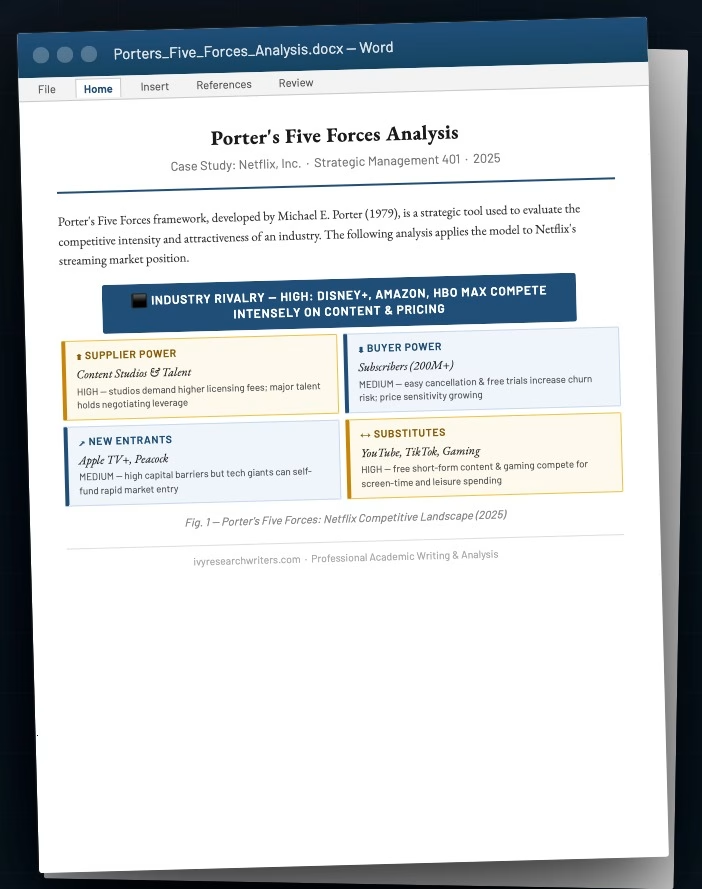
Understanding Porters Five Forces is essential for anyone studying strategic management, competitive analysis, or business strategy. Developed by Harvard Business School professor Michael Porter, this powerful framework helps organizations analyze a market or industry and determine its competitiveness and profitability.
In this comprehensive guide from IvyResearchWriters.com, we’ll explore:
- The five forces model
- The forces that shape industry structure
- How the forces work together
- The relationship between Porter’s framework and SWOT analysis
- Real-world examples
- How businesses use the model for strategy formulation
Who Is Michael Porter? (Harvard Business School & Strategic Management)
Michael Porter, a renowned Harvard Business professor, introduced the Five Forces framework in 1979 in the Harvard Business Review. His work fundamentally changed how businesses conduct competitive analysis.
Porter’s model focuses on the competitive forces that shape strategy and determine:
- Industry attractiveness
- Industry profitability
- The intensity of competition and potential returns
- Where power lies in their sector
Michael Porter’s Five Forces remains one of the most influential tools used to analyze a market or industry.
What Is Porter’s Five Forces Model?
The Five Forces Model is a framework that helps businesses analyze the competitive landscape within an industry.
According to Porter’s framework, five forces collectively determine:
- Threat of New Entrants
- Bargaining Power of Suppliers
- Bargaining Power of Buyers
- Threat of Substitute Products
- Rivalry Among Existing Competitors
These five competitive forces shape strategy and determine the competitive environment of a business.
The Five Competitive Forces That Shape Industry Structure
Let’s examine each force in detail.
1️⃣ Threat of New Entrants
The threat of new entrants refers to how easily new competitors can enter an industry.
Factors that influence this force:
- Barriers to entry
- Access to distribution channels
- Brand loyalty
- Switching costs
- Capital requirements
- Government regulation
If barriers to entry are low, new entrants may enter the market easily, increasing competition and lowering industry profitability.
Example:
In the tech startup industry, lowers barriers to entry (e.g., cloud infrastructure) allow startups to compete quickly. However, strong brand loyalty in industries like automobiles helps deter new entrants.
2️⃣ Bargaining Power of Suppliers (Supplier Power)
Power of suppliers refers to how much influence suppliers have over pricing and terms.
Supplier power increases when:
- There are few suppliers
- Substitute products or services are limited
- Switching costs are high
- Suppliers offer differentiated products
Strong bargaining power of suppliers can reduce profitability.
Example:
A smartphone manufacturer relying on a single chip supplier faces high supplier power.
3️⃣ Bargaining Power of Buyers (Buyer Power)
Buyer power or power of customers determines how much influence customers have over pricing.
Buyer power increases when:
- There are many substitute products
- Customers can easily switch
- Product differentiation is weak
- Customers purchase in large volumes
High buyer power can drive down prices and affect competitiveness.
4️⃣ Threat of Substitute Products
The threat of substitutes refers to alternative products that can replace existing offerings.
Substitute products or services limit industry profitability when:
- Switching costs are low
- Substitute products are readily available
- Price-performance alternatives exist
Example:
Streaming platforms are substitutes for traditional cable television.
The threat of substitute products can significantly influence industry attractiveness.
5️⃣ Rivalry Among Existing Competitors
Rivalry among existing competitors is often the strongest force.
It increases when:
- There are many competitors
- Exit barriers are high
- Industry growth is slow
- Products lack differentiation
Competitive rivalry intensifies when businesses fight for market share.
Example:
The airline industry experiences intense rivalry due to low differentiation and high fixed costs.
How the Five Forces Work Together
The forces at play within an industry collectively determine:
- Competitive advantage
- Strategic position
- Industry profitability
- Business models
The five forces analysis allows companies to better understand where power lies and how competitive forces shape strategy.
Porter’s model emphasizes that competition and potential profitability depend not just on direct rivals but on the entire industry structure.
Common Assignments Related to Porter’s Five Forces
Porter’s Five Forces is one of the most frequently assigned frameworks in business schools worldwide. Professors use it to assess students’ understanding of industry structure, competition, and strategic analysis.
Below are the most common assignment types.
1️⃣ Industry Analysis Paper (Five Forces Analysis Essay)
Most common assignment format
Students are required to:
- Select a specific industry (e.g., airline, technology, fast food, pharmaceuticals)
- Apply all five forces
- Evaluate industry attractiveness
- Assess overall profitability potential
Typical requirements:
- 1500–3000 words
- Academic sources (Harvard Business Review, journals, case studies)
- Strategic recommendations
2️⃣ Company Case Study Using Porter’s Model
In this assignment, students:
- Analyze a specific company (e.g., Apple, Tesla, Amazon)
- Evaluate how competitive forces shape its strategy
- Identify strengths and vulnerabilities
- Propose strategic positioning
Often used in:
- MBA programs
- Strategic management courses
- Capstone projects
3️⃣ SWOT vs Porter’s Five Forces Comparison
Professors often ask students to:
- Compare SWOT analysis with Porter’s Five Forces
- Explain differences in scope (firm-level vs industry-level)
- Evaluate when each framework is appropriate
This assignment tests:
- Conceptual clarity
- Strategic thinking
- Application skills
4️⃣ Harvard Business Review Case Analysis
Students may be given a case study from:
- Harvard Business School
- Harvard Business Review
- A school of management case database
They must:
- Identify the five forces at play
- Discuss industry structure
- Evaluate competitive rivalry
- Recommend strategic actions
5️⃣ Market Entry Analysis
Students analyze:
- Whether new entrants can gain market share
- Barriers to entry
- Distribution channels
- Capital requirements
- Brand loyalty
Often framed as:
“Should Company X enter Industry Y?”
This assignment requires examining:
- Threat of new entrants
- Number of competitors
- Competitive intensity
6️⃣ Strategic Positioning & Competitive Advantage Paper
This type of assignment requires students to:
- Use Porter’s framework to understand where power lies
- Identify how competitive forces shape strategy
- Propose differentiation strategies
- Evaluate long-term sustainability
7️⃣ Presentation Assignment (PowerPoint)
Students must:
- Create a 10–15 slide presentation
- Visually explain the five forces
- Analyze a real industry
- Present findings to the class
Graded on:
- Clarity
- Application accuracy
- Strategic recommendations
8️⃣ Research Paper on Michael Porter’s Theory
In more advanced courses, students are asked to:
- Analyze the origins of the Five Forces framework
- Discuss Harvard Business professor Michael Porter’s influence
- Critique limitations of the model
- Explore modern adaptations (sixth force, digital disruption)
9️⃣ Comparative Industry Analysis
Students compare:
- Two industries
- Or two companies within the same industry
They evaluate:
- Which industry is more attractive
- How the business landscape differs
- Which has higher long-term profitability
🔟 MBA-Level Strategic Analysis Project
In graduate-level programs, students may:
- Combine Porter’s model with SWOT
- Integrate PESTEL analysis
- Conduct full strategic audits
- Evaluate business models
- Provide executive recommendations
Porter’s Five Forces vs SWOT Analysis
Many students confuse Porter’s Five Forces with SWOT analysis, but they are different tools.
Porter’s Five Forces:
- External focus
- Analyzes industry structure
- Evaluates competitiveness
- Used for strategic analysis
SWOT Analysis:
- Evaluates Strengths, Weaknesses, Opportunities, Threats
- Internal and external factors
- Broader business strategies
Five forces can help analyze external pressures, while SWOT identifies both internal and external positioning.
Both tools are valuable in strategic management and strategy formulation.
Need Help with Porter’s Five Forces Assignments?
Order your custom Five Forces analysis today and elevate your strategic management performance with professional academic support.
Real-World Example of Five Forces Analysis
Let’s analyze the fast-food industry:
1. Threat of New Entrants:
Moderate — Requires capital and brand recognition.
2. Supplier Power:
Low — Many food suppliers available.
3. Buyer Power:
High — Customers can switch easily.
4. Threat of Substitutes:
High — Home cooking and meal kits are substitutes.
5. Rivalry Among Competitors:
Very high — McDonald’s, Burger King, Wendy’s compete aggressively.
This forces analysis shows high competitiveness and moderate profitability.
Why Porter’s Model Matters for Business Strategy
Porter’s 5 Forces is a tool used to analyze a market or industry and determine the competitive environment.
Businesses use it to:
✔ Identify key forces affecting profitability
✔ Determine strategic position
✔ Deter new entrants
✔ Improve product differentiation
✔ Build competitive advantage
✔ Understand distribution channels
✔ Develop effective business models
Michael Porter’s Five Forces remains foundational in business schools worldwide.
Limitations of Porter’s Five Forces
While powerful, Porter’s model has limitations:
- It focuses primarily on industry structure
- It may not account for rapid technological change
- It assumes relatively stable market conditions
However, it remains a central tool in strategic analysis.
Key Takeaways
Porter’s Five Forces:
- Explains forces that shape industry structure
- Helps determine the competitive landscape
- Assesses industry profitability
- Identifies power dynamics
- Supports strategy formulation
The five forces framework allows businesses to analyze a market or industry and determine its competitiveness.
Need Help with a Five Forces Analysis Assignment?
At IvyResearchWriters.com, we help students with:
✔ Five Forces analysis essays
✔ Strategic management assignments
✔ SWOT vs Five Forces comparisons
✔ Competitive analysis reports
✔ Harvard Business Review case study analyses
✔ MBA-level business strategies papers
✔ Strategic position assessments
Our experts understand Porter’s framework deeply and deliver well-researched, plagiarism-free academic papers.
👉 Order your custom Five Forces analysis today at IvyResearchWriters.com and gain a strategic advantage in your coursework.
Frequently Asked Questions
What are the 5 forces of Porter’s model?
The five forces that determine industry competitiveness were developed by Harvard Business professor Michael Porter at the Harvard Business School, one of the world’s leading institutions in strategic management and the school of management tradition.
Porter identified five key competitive pressures that shape the business landscape:
- Threat of New Entrants
- Examines whether new entrants to gain market share can easily enter an industry.
- Influenced by barriers to entry, capital requirements, and brand loyalty.
- Bargaining Power of Suppliers
- Determines how much influence suppliers have over pricing and costs.
- Bargaining Power of Buyers
- Assesses how customers can pressure firms to lower prices or improve quality.
- Threat of Substitute Products or Services
- Evaluates alternatives that could replace existing offerings.
- Rivalry Among Existing Competitors
- Analyzes the number of competitors and the intensity of competition within an industry.
Together, these five forces determine the structure of competition and overall industry profitability. They help organizations understand how competitive pressures operate in the broader business landscape.
At IvyResearchWriters.com, we guide students in applying Porter’s model accurately in strategic analysis essays, MBA case studies, and competitive evaluation reports.
What is the difference between SWOT and Porter’s 5 forces?
Although both tools are used in business strategy, they serve different purposes.
Porter’s 5 Forces:
- Focuses externally on the industry
- Analyzes competitive pressures
- Helps organizations evaluate the forces to understand how power operates within the market
- Examines how new entrants to gain access might influence competition
SWOT Analysis:
- Evaluates Strengths, Weaknesses, Opportunities, and Threats
- Includes both internal and external factors
- Focuses on a specific firm’s capabilities
In short:
- Porter’s model analyzes the business landscape and industry structure
- SWOT evaluates a company’s internal position and external environment
Students often confuse these frameworks. IvyResearchWriters.com provides expertly structured comparisons that clarify how each tool fits into strategic management coursework.
What are the 6 Porter forces?
Originally, Harvard Business professor Michael Porter proposed five forces. However, some scholars and modern business analysts introduce a sixth force.
The extended model sometimes includes:
- Complementors or Government Influence
- Factors such as regulation, partnerships, or complementary products that influence competition.
While the classic five forces that determine industry attractiveness remain foundational, adding a sixth force reflects how the modern business landscape has evolved.
In academic settings, it is important to clearly distinguish between:
- The original five-force framework developed at Harvard Business School
- Later interpretations that expand the model
At IvyResearchWriters.com, we help students explain both versions correctly in research papers and strategic analysis assignments.
Why do businesses use Porter’s 5 forces?
Businesses use Porter’s framework because it provides a structured way to:
✔ Analyze industry structure
✔ Evaluate the number of competitors and intensity of rivalry
✔ Assess whether new entrants to gain market access pose a threat
✔ Identify competitive pressures affecting profitability
✔ Understand the forces to understand where power lies
✔ Determine long-term industry attractiveness
The model helps firms in strategy formulation by examining how the five forces that determine competitiveness influence:
- Pricing power
- Cost structure
- Market entry conditions
- Competitive positioning
By applying Porter’s model, businesses gain insight into how the business landscape operates and whether the industry is likely to generate sustainable returns.
For students studying in any school of management program, understanding this framework is essential. That’s why IvyResearchWriters.com specializes in delivering in-depth, academically rigorous Five Forces analyses tailored to undergraduate, MBA, and executive-level coursework.

