

Perceptual Region Example: The Best Human Geography Guide With Clear Definitions and Real-World Cases
If you are searching perceptual region example, you are probably studying geography, preparing for a human geography exam, or trying to answer common questions about perceptual regions. Perceptual regions show up constantly in introductory and advanced human geography because they explain something maps alone cannot: how people think about places.
A perceptual region is not “wrong” because it lacks precise borders. It is valuable because it captures cultural identity, shared meaning, and community-based spatial labels that people use every day. In this blog post, you will learn what a perceptual region is, how it differs from a formal region and a functional region, and you will get multiple perceptual region examples you can confidently use in essays and exams.
Regions in geography: why geographers use types of regions to understand space
In the study of geography, a region is an area identified and grouped based on shared traits. A geographer uses regions because regions allows us to organize large amounts of information into meaningful categories. Regions also support comparison: it is easier to analyze patterns when places are grouped by common features.
In regions in geography, regions can be created from:
- cultural or physical characteristics
- physical characteristics such as climate, landforms, or vegetation
- economic and social patterns such as industry, employment, or income
- political boundaries and government jurisdictions
- shared identity and historical experience
That is why regions are essential in both physical geography (where you study physical features and environments) and human geography (where you study people, culture, and society).
Understanding perceptual regions by comparing formal region and functional region
To master this topic, you need to know the major types of regions and how each one is created. The three main region types in human geography are formal, functional, and perceptual (vernacular).
Formal region: an area defined using measurable features and often formal boundaries
A formal region is an area defined by one or more specific traits. It is a defined region where the region is defined using consistent criteria. Often, a formal region is formally defined by data or official classification.
Formal regions may have:
- clearly defined borders
- formal boundaries that match political boundaries
- traits that can be measured (language, religion, climate, population density)
Examples of formal regions include:
- Countries and provinces with official borders
- Climate zones (a physical region)
- Language regions measured by census data, such as the French-speaking region of Canada
These are also strong examples of formal regions because they are created through consistent rules.
Functional region: a region based on interactions and connections around a node
A functional region is a region based on movement, services, and flows. Instead of being defined by shared culture or a single measurable trait, it is defined by how places connect to a central node.
A following is an example of a functional region:
- a city and its commuter zone
- a hospital’s service area
- a metropolitan transit network
- a delivery company’s coverage area
If your exam asks for an example of a functional region, you can say: “A metropolitan area where surrounding towns are linked to the city through commuting patterns.” This is a classic example of a functional region.
Concept of perceptual region: what makes a region “vernacular” in human geography
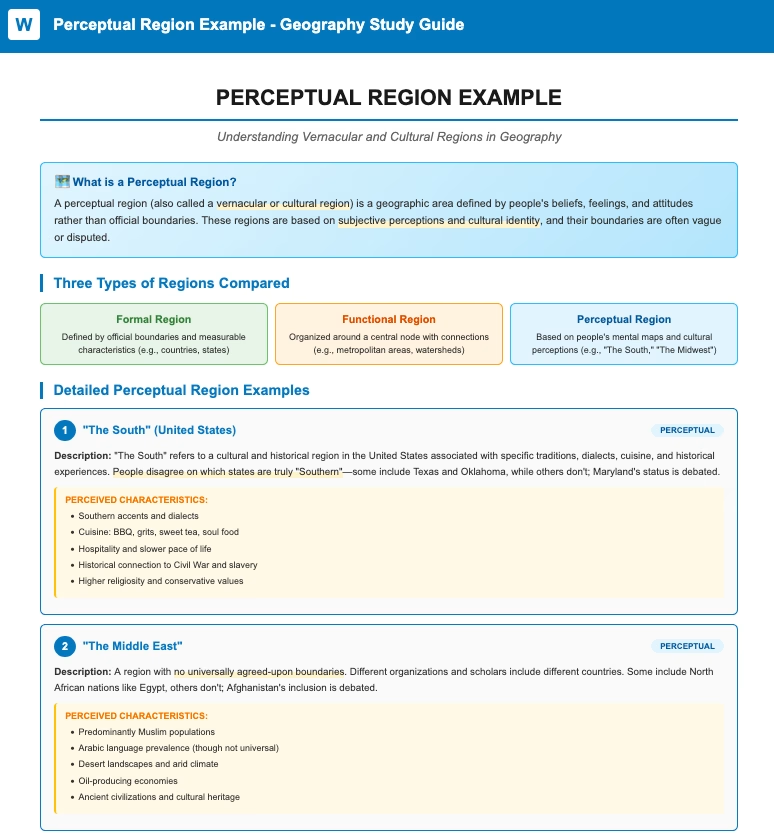
A perceptual region is also called a vernacular region. The word vernacular means “everyday language.” A perceptual region is a term used to describe an area that exists because of how people talk about it, identify with it, and imagine it.
This is the key point: perceptual regions are shaped by perception rather than strict measurement. They are formed by:
- feelings and attitudes
- shared feelings and cultural images
- attitudes about an area
- shared cultural identity and meaning
- narratives and shared history
Because they are based on perception, perceptual regions may have borders that are unclear or debated. A perceptual region can be hard to define because where it begins or ends is not agreed upon. These regions often differ from person to person, which is exactly why they are called perceptual.
In other words, perceptual regions are not built from official political lines. They are based on how people people perceive, people refer to, and emotionally label a place—often rather than official boundaries.
Perceptual regions differ from formal: what to write in an exam answer (fast and correct)
A high-scoring way to explain the difference is to show what each region depends on.
- A formal region is created using measurable traits and often has clearly defined borders and official borders.
- A functional region is defined by a node and connections (commuting, services, transportation).
- A perceptual region (a vernacular region) is based on shared perception, identity, and the feelings and attitudes people associate with a place.
That is why perceptual regions differ from formal: perceptual regions rely on perceptions rather than strict rules or geographical boundaries, and they may vary depending on who is asked.
Perceptual region example: “The South,” the American South, and the Deep South
When exam questions ask for an example of a perceptual region?, the most common answer is “the south” in the United States. The “South” is widely recognized, but its boundaries are debated. People may disagree on which states count as Southern, and even within states there are northern and southern differences in identity.
The American South
The American South is a perceptual region shaped by shared history, cultural narratives, dialect, cuisine, and social patterns. The region is not strictly fixed by state lines; it is created by what people believe the South “is.”
Deep South
The deep south is an even narrower perceptual region within the broader South. It is often connected to strong cultural symbolism and historical memory. Again, where it begins and ends is debated—some people include particular states, while others include parts of states.
These are excellent examples of perceptual regions because they are based on cultural identity and perception, not strict mapping rules.
Bible Belt as an example of a perceptual region based on culture and traditional values
The bible belt is another classic perceptual region, especially in a human geography exam. The Bible Belt is a region that is strongly based on culture, especially the influence of religion on public life and community norms.
It is associated with:
- traditional values
- church-centered community life
- recognizable cultural symbols and norms
However, its borders are not official. People disagree about where it begins or ends, which makes it a perceptual region rather than a strictly defined formal region.
Rust Belt refers to an economic and social perceptual region, not a clearly defined one
Rust belt refers to areas associated with deindustrialization and industrial decline. It is a strong example of an economic and social perceptual region. People commonly “know” what the Rust Belt means, but there is no single map line that defines it everywhere.
It is:
- widely referenced in media and politics
- associated with industry, factories, and employment shifts
- shaped by shared history and economic identity
Because it is not fixed by official borders, it is perceptual.
Silicon Valley: perception rather than strict geographical boundaries shaped by tech industry identity
Silicon valley is a powerful case because it shows how cultural-economic identity creates a perceptual region. People associate Silicon Valley with innovation, venture capital, start-ups, and major tech companies in the tech industry.
The region is often understood through:
- reputation and identity (“tech hub”)
- networks of firms, talent, and investment
- surrounding areas that become “part of Silicon Valley” as the tech economy expands
This is perception rather than strict, official mapping. Different people draw Silicon Valley differently, which supports the idea that perceptual regions differ from person to person.
Rural areas and perceptual regions: why some regions are hard to define but still real in human geography
“Rural areas” can be defined statistically, but in everyday life people use “rural” as a perceptual label tied to:
- lifestyle assumptions
- cultural imagery
- identity and political narratives
- shared feelings about community, land use, and tradition
In human geography, this matters because it shows how people’s perceptions shape how they group space—even when the borders are vague.
How to recognize a perceptual region on an exam: the “begins and ends” test
A simple exam trick is this:
If you can say, “People debate where it begins and ends,” it is likely a perceptual region.
Perceptual regions usually have:
- no official boundaries
- strong cultural meaning
- names used in everyday speech
- identity markers and certain characteristics tied to culture more than data
That is why they are “vernacular”—people name them and keep them alive in conversation.
Need an A-grade AP Human Geography response set that matches exam phrasing?
You will get a polished, exam-ready answer bank you can study from or paste directly into your assignment.
Quick human geography exam templates: answering questions about perceptual regions
Here are exam-ready formats you can use immediately.
Template 1: Define + example
“A perceptual (vernacular) region is a region people recognize based on shared perception, identity, and feelings rather than official boundaries. An example of a perceptual region is the Bible Belt, because its borders are debated and based on culture and values.”
Template 2: Compare types of regions
“A formal region is defined by measurable traits and often has clear boundaries, such as a country or a language region. A functional region is organized around a node and interactions, such as a metropolitan commuter area. A perceptual region is based on how people perceive an area, such as the American South.”
These formats work well for questions about perceptual regions and region types.
Final takeaway: perceptual regions help explain identity, culture, and how people make meaning from place
Perceptual regions matter because human geography is not only about maps—it is about how people interpret space. A perceptual region is a region shaped by shared identity, cultural meaning, and community perception. Its borders are fuzzy, but its influence is real.
Need a full AP Human Geography answer set or essay draft?
If you are preparing for a human geography exam or writing a paper on regions in geography, IvyResearchWriters.com can help you turn these concepts into high-scoring work.
Visit IvyResearchWriters.com and message: “PERCEPTUAL REGION ESSAY.”
You will receive a polished draft with definitions, comparisons, and multiple perceptual region examples written in clear, exam-ready language.
Frequently Asked Questions
1) What are two examples of a functional region?
A functional region is organized around a central node and the flows that connect surrounding areas to it.
Two strong examples:
- A metropolitan commuter area (example would be a city and the surrounding suburbs that depend on it for jobs and transportation).
- A delivery or service zone (example would be a hospital’s catchment area or a package company’s service area tied to a central hub).
These work well on exams because the region exists due to interactions, not because of shared culture or fixed political borders.
2) Why is the Midwest an example of a perceptual region?
The Midwest is commonly treated as a perceptual (vernacular) region because its boundaries are not precise or officially fixed. It is recognized through identity, reputation, and shared imagery rather than strict measurement.
In many human geography classes, it is discussed among geographers as a region people “know” when they hear it, even though different people draw it differently. That makes it unlike formal regions that are clearly defined by official criteria. The Midwest is often described through certain cultural traits (for example, shared speech patterns, farming and small-town imagery, or “heartland” identity), which supports its perceptual status.
3) How is Silicon Valley a perceptual region?
Silicon Valley is a perceptual region because people define it through shared understanding and reputation more than official borders.
- It is unlike formal regions because there is no single legal boundary that everyone agrees on.
- It is associated with certain cultural and economic characteristics—innovation, start-ups, venture capital, and tech identity.
- It is widely recognized among geographers and in everyday language, but where it “starts” and “ends” changes depending on who you ask.
So, Silicon Valley exists strongly as a “place in people’s minds,” which is exactly what makes it perceptual.
4) Which of the following best describes a perceptual region?
The best description is:
A region defined by people’s shared perceptions, identity, and cultural meaning, with boundaries that can vary from person to person.
In other words, a perceptual region is unlike formal regions because it is not based on fixed criteria or official borders. Classic examples include “the south,” the Bible Belt, and the Midwest—recognized widely among geographers, but not sharply bounded on a map.

