

Oligopoly Examples: Understanding Market Power in Modern Economies
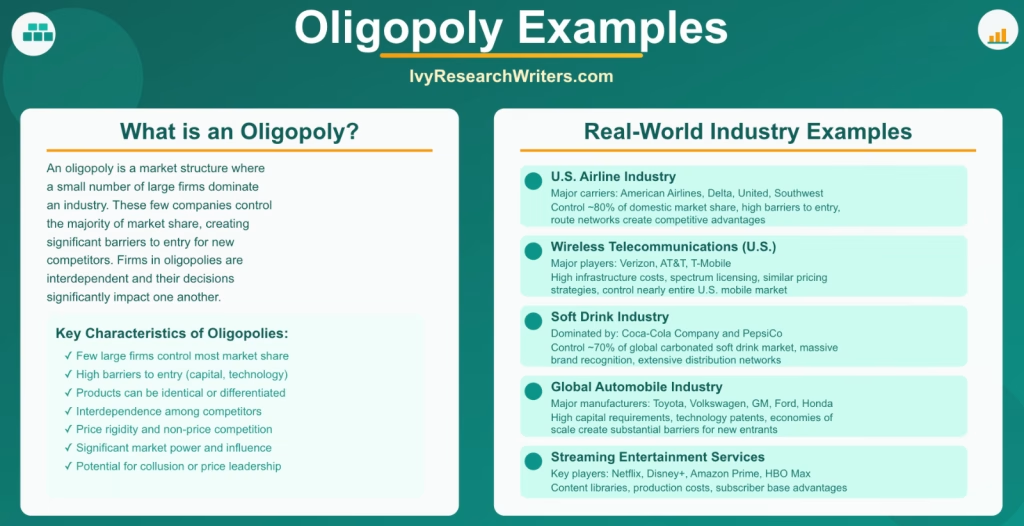
In today’s global economy, a handful of powerful firms dominate entire industries, shaping prices, production, and innovation. This phenomenon is called an oligopoly — a market structure where a few large companies control most of the market share, often leading to cooperation, competition, and occasional price wars.
This article explores the definition of oligopoly, its characteristics, examples of oligopolies in various sectors, and how it differs from monopoly and monopolistic competition. We’ll also examine why barriers to entry play a key role in sustaining these oligopolistic markets.
Oligopoly: Definition and Meaning
An oligopoly is an economic market structure dominated by a small number of firms that produce similar or differentiated products or services. These firms, known as oligopolists, possess significant market power, allowing them to influence prices and output decisions.
According to economists, an oligopoly is a market structure where the combined market share of the largest firms in an industry exceeds 60–80%. Because there are only a few dominant players, each firm’s decision directly impacts the others, leading to interdependence and strategic behavior — often modeled through game theory.
Oligopoly meaning:
It represents a balance between perfect competition (many small firms, no market power) and monopoly (one dominant firm). The presence of high barriers to entry—such as economies of scale, capital requirements, and brand loyalty—prevents smaller firms or new entrants from easily competing.
Examples include:
- Airlines (Delta, American Airlines, United)
- Auto manufacturers (Ford, General Motors, Toyota)
- Technology giants (Apple, Microsoft, Google)
- Telecommunications (AT&T, Verizon, T-Mobile)
Examples of Oligopolies in the Modern Economy
1. The Airline Industry: A Classic Oligopoly Example
The airline industry in the U.S. is arguably an oligopoly dominated by a small number of firms—Delta Air Lines, American Airlines, United Airlines, and Southwest. Together, they control nearly 80% of the total market, making them the main participants in the market.
When one airline sets prices or introduces a new route, the others follow suit, illustrating how the actions of one firm affect all others. These airlines benefit from economies of scale (large fleets, global networks) and significant barriers to entry (airport slots, fuel costs, and regulations) that prevent new players from entering the market.
2. Auto Manufacturers in the United States
The auto industry is another oligopolistic market where a few large companies dominate production. In the United States, Ford, General Motors, and Stellantis (Chrysler) control a major share of domestic sales.
Globally, automakers like Toyota, Volkswagen, and Honda hold similar dominance. The industry is dominated by a few companies, each capable of influencing market prices and innovation trends. These oligopolistic firms rely heavily on brand differentiation, research and development, and long-term supply contracts to maintain their power.
3. The Technology Sector
The modern tech industry is a powerful oligopolistic industry. Firms like Apple, Google (Alphabet), Microsoft, and Amazon dominate digital markets, cloud computing, and consumer technology.
This market structure is sustained by high barriers to entry—including advanced technology, intellectual property rights, and massive user networks. These firms often cooperate indirectly through cross-licensing agreements while competing fiercely for user attention, advertising revenue, and innovation leadership.
4. Telecommunications
The telecommunications industry is an oligopoly where a small number of firms—such as Verizon, AT&T, and T-Mobile—control most of the U.S. mobile market.
Because of the capital-intensive infrastructure, network licensing, and regulatory barriers, new entrants face immense challenges. As a result, prices for consumers often remain higher than in perfectly competitive markets, and innovation tends to move at a pace determined by these dominant players.
Oligopolistic Market: Key Characteristics
An oligopolistic market exhibits several defining features:
- Few Large Firms:
The market consists of two or three firms holding a majority market share, often referred to as the “rule of the few.” - Interdependence:
Each firm’s decisions regarding pricing, output, or marketing directly affect others. Game theory explains this strategic behavior. - Barriers to Entry:
High start-up costs, brand loyalty, and economies of scale deter new competitors. These significant barriers to entry preserve the dominance of existing players. - Non-price Competition:
Firms often compete through advertising, customer service, or product differentiation rather than price, to avoid destructive price wars. - Potential for Collusion:
When oligopoly firms cooperate to set prices or limit production, it’s known as collusion—which may result in higher consumer prices and reduced competition.
Ready to Excel in Your Economics Paper?
At IvyResearchWriters.com, we help students and professionals craft well-researched, plagiarism-free papers on topics like Oligopoly, Monopoly, and Market Competition — tailored to your field and deadline.
Oligopolistic Industry: Types of Oligopoly
There are different types of oligopoly, each defined by the level of cooperation and product differentiation among the firms:
- Collusive Oligopoly:
Firms act together or form a cartel to control prices and production (e.g., OPEC—the Organization of Petroleum Exporting Countries). - Non-collusive Oligopoly:
Firms compete independently while still being influenced by rivals’ strategies. The airline industry is a prime example. - Pure Oligopoly:
Products are identical or nearly so—like steel or oil markets. - Differentiated Oligopoly:
Firms produce varied products under strong brand identities, as seen in automotive and tech industries.
Monopoly vs. Oligopoly
| Aspect | Monopoly | Oligopoly |
|---|---|---|
| Number of Firms | Single firm dominates | Few large firms dominate |
| Competition | No competition | Limited competition, interdependent firms |
| Product Differentiation | None (unique product) | May exist (differentiated or identical) |
| Barriers to Entry | Extremely high | High, but not insurmountable |
| Price Control | Full control | Partial control, affected by rivals |
| Examples | Local utility companies | Airlines, Auto manufacturers, Telecoms |
Unlike a monopoly, where one company controls the entire market, oligopolies exist in sectors where two or three firms dominate but must consider the actions of competitors before changing prices or production levels.
Oligopoly and the Economy
Oligopolies have both positive and negative effects on the economy:
- Advantages:
- Stability in pricing and supply
- Encouragement of innovation due to competition among few giants
- Economies of scale reduce production costs
- Disadvantages:
- Risk of collusion or price-fixing
- Limited consumer choice
- Higher prices compared to competitive markets
Economists argue that while oligopolies often form naturally due to market efficiency, regulatory oversight is necessary to prevent abuse of market power.
Examples of Price Wars and Collusion
In oligopoly markets, companies sometimes engage in price wars, reducing prices to outcompete rivals—only to eventually stabilize them when profits fall.
For instance, in the airline industry, fare reductions by American Airlines often trigger similar responses from Delta or United. In the soft drink industry, Coca-Cola and PepsiCo have alternated between competition and informal collusion, influencing global pricing trends.
Barriers to Entry in Oligopolistic Markets
High barriers to entry are a cornerstone of oligopolies. These include:
- Capital investment requirements (aircraft fleets, manufacturing plants)
- Economies of scale that allow large firms to lower costs
- Brand loyalty and advertising dominance
- Government regulation and licensing
Such barriers ensure that new competitors rarely disrupt established oligopolistic industries, allowing incumbents to maintain long-term dominance.
Research Paper Example on Oligopoly
Market Power and Competition: An Analysis of Oligopoly Structures in the Global Economy
Student Name
Institutional Affiliation
Course Title
Date
Abstract
This research paper examines the market structure of oligopoly and its influence on pricing, production, and innovation within modern economies. An oligopoly is a market dominated by a few large firms whose actions are interdependent. Using industries such as airlines, automobiles, and technology as examples, this paper explores the mechanisms of price-setting, collusion, and strategic behavior. The study integrates theoretical frameworks such as game theory and the kinked demand curve model to explain market dynamics. Findings suggest that oligopolies can enhance innovation through economies of scale but also risk reducing competition and consumer welfare.
Introduction
In economic theory, an oligopoly is one of the most prevalent market structures in modern industries. It describes a scenario in which a small number of firms dominate an entire market, influencing price, output, and innovation. Oligopolies differ from monopolies—where one firm controls the market—and perfect competition—where many firms operate with no power over prices. This paper explores the defining characteristics, types, and examples of oligopolies, with attention to how they shape global economic performance.
Defining Oligopoly and Its Characteristics
An oligopoly exists when a market is dominated by a few powerful firms, each aware of the other’s actions. The interdependence among these firms means that decisions regarding price or production are strategically planned with competitors’ responses in mind. High barriers to entry—such as significant startup costs, economies of scale, and brand loyalty—prevent smaller firms from entering. Other characteristics include non-price competition, mutual interdependence, and potential for collusion among major firms.
Types of Oligopoly
Oligopolies can take different forms depending on product type and firm behavior. A collusive oligopoly involves firms cooperating to fix prices or divide markets, as seen in cartels like OPEC. A non-collusive oligopoly involves independent behavior where firms react strategically to competitors’ actions. There are also pure oligopolies—where products are homogeneous (e.g., steel, oil)—and differentiated oligopolies, featuring branded products like automobiles or smartphones.
Theoretical Models Explaining Oligopoly Behavior
Game Theory
Game theory explains strategic decision-making among oligopolistic firms. It highlights how companies anticipate rivals’ reactions before making pricing or output decisions. The Prisoner’s Dilemma is often used to show how rational self-interest may lead to less-than-optimal outcomes even when cooperation could increase collective profits.
The Kinked Demand Curve Model
The kinked demand curve model describes how prices tend to be rigid in oligopolistic markets. If one firm raises prices, others do not follow, causing a loss of customers. If one lowers prices, others match the reduction, leading to a fall in profits for all firms.
Examples of Oligopolies in Global Markets
- 1. Airline Industry: Major carriers such as Delta Air Lines, United Airlines, and American Airlines dominate U.S. air travel, setting ticket prices and flight routes that rival firms quickly replicate.
- 2. Automobile Industry: Ford, Toyota, and Volkswagen control much of the world’s automobile production, influencing technology trends and pricing strategies globally.
- 3. Technology Sector: Apple, Microsoft, and Google form a powerful oligopoly, setting global standards for operating systems, mobile devices, and cloud computing services.
- 4. Telecommunications: AT&T, Verizon, and T-Mobile dominate the U.S. market, where infrastructure costs and government licensing create high barriers to entry.
Advantages and Disadvantages of Oligopolies
Oligopolies offer both benefits and challenges. On the positive side, large firms achieve economies of scale, reducing production costs and enabling investment in research and development. Oligopolistic competition often leads to innovation, as firms seek to differentiate products and attract customers. However, when firms collude, they may fix prices or limit production, reducing consumer choice and raising prices above competitive levels. Price wars may also occur, destabilizing markets and hurting smaller competitors.
Regulation of Oligopolistic Markets
Governments regulate oligopolistic markets to promote fair competition and protect consumers. Antitrust laws—such as the Sherman Act and the Clayton Act in the United States—prohibit collusion and predatory pricing. Regulatory bodies monitor mergers and acquisitions to prevent excessive concentration of market power that could harm the economy.
Conclusion
Oligopoly remains a defining feature of global markets, from airlines to technology firms. While it fosters stability and innovation, unchecked dominance by a few firms can lead to inefficiencies and exploitation. Effective regulatory frameworks and competitive policies are essential to ensure that oligopolistic industries operate in ways that benefit consumers, investors, and the broader economy.
References
- Krugman, P., & Wells, R. (2022). Microeconomics. Worth Publishers.
- Stiglitz, J. (2020). Market Structure and Inequality. Columbia University Press.
- Porter, M. E. (1980). Competitive Strategy: Techniques for Analyzing Industries and Competitors. Free Press.
- Tirole, J. (1988). The Theory of Industrial Organization. MIT Press.
- Samuelson, P. A., & Nordhaus, W. D. (2021). Economics. McGraw-Hill Education.
Conclusion: The Influence of Oligopolies in Modern Society
From airlines and automobiles to telecommunications and technology, oligopolistic markets shape much of the modern global economy. These industries demonstrate the interdependence of large firms, strategic decision-making, and the balancing act between competition and cooperation.
Understanding oligopoly examples helps policymakers and consumers recognize how market power affects prices, innovation, and accessibility.
At IvyResearchWriters.com, our expert economists and academic writers can help you analyze complex market structures and craft custom research papers that demonstrate critical thinking, theoretical depth, and clear economic reasoning.
Frequently Asked Questions
1. What are 5 examples of an oligopoly?
An oligopoly is a market structure where a small number of firms dominate an entire particular market, influencing prices, output, and competition.
Unlike monopolistically competitive markets (many small players) or a monopoly (a single company), oligopoly consists of a group of firms whose actions directly affect each other.
Five real-world examples of oligopolists include:
- Airline Industry – Delta Air Lines, American Airlines, and United Airlines together control most U.S. air travel, setting fares and routes that rival firms often match.
- Automobile Industry – Companies like Ford, Toyota, and Volkswagen dominate global car production, shaping design, technology, and fuel efficiency trends.
- Telecommunications – AT&T, Verizon, and T-Mobile represent a three-oligopoly that controls the majority of mobile network services in the U.S.
- Soft Drink Industry – Coca-Cola and PepsiCo are the two firms that define this oligopoly model, often engaged in advertising battles and pricing strategies.
- Technology Sector – Apple, Microsoft, and Google dominate software, devices, and cloud services, making them the leading players that have resulted in industry consolidation.
At IvyResearchWriters.com, we provide in-depth analysis on how these firms in an oligopoly interact, compete, and maintain dominance — perfect for research papers, case studies, or dissertations.
2. Is Coca-Cola an oligopoly?
Yes — Coca-Cola operates within an oligopoly.
It competes primarily with PepsiCo, forming a duopoly (a type of oligopoly with two dominant companies) in the soft drink market.
Both companies produce similar beverages, advertise heavily, and adjust pricing based on each other’s actions. Although hundreds of smaller brands exist, their market share is low enough that the actions of Coca-Cola or Pepsi determine the direction of the entire industry.
While not a monopoly (no single company controls everything), this oligopoly acts like a monopoly in terms of influence. These firms maintain market power through branding, economies of scale, and consumer loyalty.
At IvyResearchWriters.com, our business writers can explore Coca-Cola’s oligopolistic pricing, market share, and its strategic responses using economic models like game theory and price elasticity of demand.
3. Is Netflix an oligopoly?
Yes — in the streaming industry, Netflix operates within an oligopolistic market.
The number of companies dominating global streaming is limited to a few: Netflix, Disney+, Amazon Prime Video, and HBO Max.
These firms collectively dominate the industry, each offering exclusive content and subscription models. When one platform changes pricing, others follow suit or adjust content strategies to maintain competitiveness.
Unlike a free market with countless small producers, these oligopoly firms control most viewership and revenue, resulting in high barriers to entry for newcomers.
The industry consolidation seen over the last decade has transformed streaming into a three-to-five player oligopoly, where price increases or exclusive content releases ripple across the market.
Need an analysis of Netflix’s market structure or its oligopoly model for your economics assignment?
Our experts at IvyResearchWriters.com can deliver a custom-written paper examining content dominance, competitive behavior, and consumer welfare impacts.
4. What is oligopoly competition?
Oligopoly competition occurs when a small number of large firms compete within the same market structure, influencing each other’s pricing, marketing, and output decisions.
In such markets, each firm recognizes that its actions (like a price increase or new product launch) will affect — and be affected by — the decisions of rival firms.
Unlike monopolistically competitive firms, where each player has limited influence, firms in an oligopoly are highly interdependent. They often avoid aggressive price competition to prevent going out of business, preferring to compete through advertising, branding, and innovation.
An oligopoly and a monopoly both limit competition, but in an oligopoly, multiple players produce the monopoly-like effects by cooperating or tacitly colluding.
For example, when Delta Air Lines adjusts its fares, other carriers follow suit to avoid losing customers, reflecting strategic interdependence—a core principle of the oligopoly model.
At IvyResearchWriters.com, we can help you analyze oligopolistic competition through case studies, mathematical modeling, and real-world examples for your term paper or thesis.

