

Geometry Formulas: The Ultimate Guide to Important Geometry Formulas in Mathematics
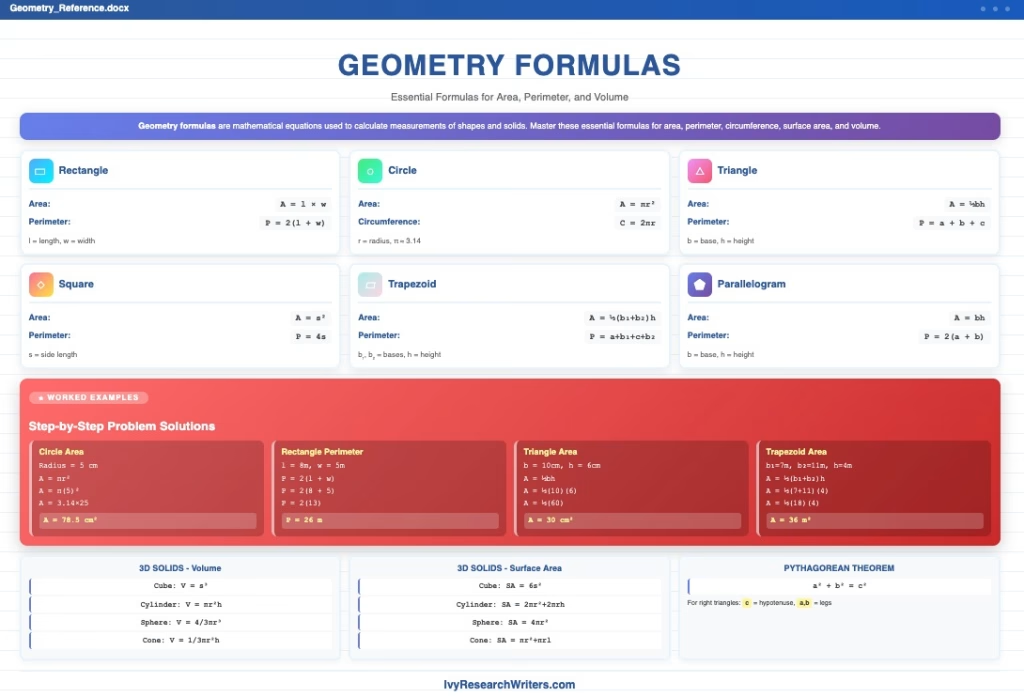
Understanding geometry formulas is essential for mastering both basic geometry and advanced mathematics. From calculating the area of a circle to applying the Pythagorean theorem in coordinate geometry, formulas help us measure, analyze, and solve problems involving shapes, angles, and three-dimensional objects.
In this comprehensive guide, IvyResearchWriters.com explains the most important geometry formulas, defines key concepts, and provides clear examples to help students succeed.
What Is a Geometry Formula in Mathematics?
A formula in mathematics is an equation that expresses a relationship between quantities. In geometry, formulas are used to calculate properties such as:
- Area
- Perimeter
- Surface area
- Volume
- Length
- Angle measurement
Geometry focuses on shapes in both two-dimensional (2D) and three-dimensional (3D) space. These shapes exist on a mathematical plane or as solids occupying space.
Using geometry formulas correctly allows students to solve problems efficiently and accurately.
Basic Geometry: Two-Dimensional Shapes and Area Formulas
In basic geometry, we study flat shapes such as triangles, rectangles, squares, and circles. These are called two-dimensional shapes because they have length and width but no depth.
Triangle Formulas and Key Geometry Concepts
A triangle is a polygon with three sides and three angles. Important triangle types include:
- Equilateral triangle (all sides equal)
- Isosceles triangle (two sides equal)
- Right triangle (contains a 90° angle)
Area of a Triangle
Area=12×base×height\text{Area} = \frac{1}{2} \times \text{base} \times \text{height}Area=21×base×height
Perimeter of a Triangle
P=a+b+cP = a + b + cP=a+b+c
Pythagorean Theorem (Right Triangle Only)
a2+b2=c2a^2 + b^2 = c^2a2+b2=c2
This theorem is one of the most important geometry formulas used to calculate the length of a line segment in right triangles.
Sum of the Angles in a Triangle
Sum of the angles=180∘\text{Sum of the angles} = 180^\circSum of the angles=180∘
Struggling with area formulas, coordinate geometry, 3D shapes, or proofs?
Order your custom math assignment today at IvyResearchWriters.com and boost your confidence in geometry and mathematics.
Circle Geometry Formula: Radius, Diameter, and Pi
A circle is a shape where all points are equidistant from a central point.
Key Terms:
- Radius (r) – distance from center to edge
- Diameter (d) – twice the radius
- Chord – a line segment connecting two points on the circle
- Tangent – a line touching the circle at one point
- Pi (π) – ratio of circumference to diameter (≈ 3.1416)
Circumference of a Circle
C=2πrC = 2\pi rC=2πr
Area of a Circle
A=πr2A = \pi r^2A=πr2
Understanding the ratio involving pi is fundamental in geometry.
Quadrilateral and Parallelogram Formulas
A quadrilateral is a polygon with four sides. Examples include rectangles, squares, and parallelograms.
Rectangle
Area=length×width\text{Area} = \text{length} \times \text{width}Area=length×width Perimeter=2(length+width)\text{Perimeter} = 2(\text{length} + \text{width})Perimeter=2(length+width)
Square
Area=side2\text{Area} = \text{side}^2Area=side2
Parallelogram
Area=base×height\text{Area} = \text{base} \times \text{height}Area=base×height
Properties:
- Opposite sides are parallel.
- Opposite angles are equal.
Angles and Lines: Key Geometry Relationships
In geometry, angles and lines are foundational concepts.
Types of Angles:
- Supplementary angles (sum = 180°)
- Right angle (90°)
- Acute and obtuse angles
Line Relationships:
- Parallel lines
- Perpendicular lines
- Lines that intersect
Understanding congruence and transformation helps analyze how shapes relate to each other in the plane.
Coordinate Geometry: Using Geometry Formulas on the Plane
Coordinate geometry combines algebra and geometry.
Key concepts include:
Slope Formula
m=y2−y1x2−x1m = \frac{y_2 – y_1}{x_2 – x_1}m=x2−x1y2−y1
Slope-Intercept Equation
y=mx+by = mx + by=mx+b
This equation represents a straight line on the coordinate plane.
Using geometry formulas in coordinate geometry allows students to calculate distance, slope, and intersection points.
Three-Dimensional Shapes and 3D Geometry
Unlike two-dimensional shapes, three-dimensional shapes (3D shapes) have length, width, and height.
Examples of 3-dimensional solids include:
- Cube
- Sphere
- Cylinder
- Cone
Cube
Volume=s3\text{Volume} = s^3Volume=s3 Surface area=6s2\text{Surface area} = 6s^2Surface area=6s2
Rectangular Prism
Volume=length×width×height\text{Volume} = \text{length} \times \text{width} \times \text{height}Volume=length×width×height
Sphere
Volume=43πr3\text{Volume} = \frac{4}{3}\pi r^3Volume=34πr3 Surface area=4πr2\text{Surface area} = 4\pi r^2Surface area=4πr2
Cylinder
Volume=πr2h\text{Volume} = \pi r^2 hVolume=πr2h
Cone
Volume=13πr2h\text{Volume} = \frac{1}{3}\pi r^2 hVolume=31πr2h
Understanding surface area and volume is essential in 3D geometry.
Important Geometry Formulas Chart (Quick Reference)
| Shape | Area | Perimeter / Circumference |
|---|---|---|
| Triangle | ½bh | a+b+c |
| Circle | πr² | 2πr |
| Rectangle | lw | 2(l+w) |
| Square | s² | 4s |
| Parallelogram | bh | 2(a+b) |
This type of chart helps students memorize key geometry formulas efficiently.
50 geometry practice questions with solutions
1) Square perimeter
Q: A square has side length 7 cm. Find its perimeter.
A: P=4s=4(7)=28 cm.
2) Square area
Q: A square has side length 9 m. Find its area.
A: A=s2=92=81 m².
3) Rectangle perimeter
Q: A rectangle is 12 in by 5 in. Find its perimeter.
A: P=2(l+w)=2(12+5)=34 in.
4) Rectangle area
Q: A rectangle is 14 cm by 3 cm. Find its area.
A: A=lw=14⋅3=42 cm².
5) Triangle area
Q: A triangle has base 10 cm and height 6 cm. Find its area.
A: A=21bh=21(10)(6)=30 cm².
6) Triangle perimeter
Q: A triangle has sides 8, 11, and 13. Find its perimeter.
A: P=8+11+13=32.
7) Right triangle (Pythagorean)
Q: Legs are 9 and 12. Find hypotenuse.
A: c=92+122=81+144=225=15.
8) Right triangle missing leg
Q: Hypotenuse 13, one leg 5. Find the other leg.
A: b=132−52=169−25=144=12.
9) Isosceles triangle perimeter
Q: An isosceles triangle has equal sides 10 and base 12. Perimeter?
A: P=10+10+12=32.
10) Circle circumference
Q: Radius is 7 cm. Find circumference (use π).
A: C=2πr=2π(7)=14π cm.
11) Circle area
Q: Radius is 4 m. Find area.
A: A=πr2=π(16)=16π m².
12) Diameter to circumference
Q: Diameter is 10 in. Find circumference.
A: C=πd=π(10)=10π in.
13) Circle area from diameter
Q: Diameter is 18 cm. Find area.
A: r=9. A=π(92)=81π cm².
14) Arc length (simple)
Q: Radius 6, central angle 60°. Find arc length.
A: s=36060⋅2πr=61⋅2π(6)=2π.
15) Sector area
Q: Radius 10, central angle 90°. Sector area?
A: A=36090πr2=41π(100)=25π.
16) Parallelogram area
Q: Base 15 cm, height 8 cm. Area?
A: A=bh=15⋅8=120 cm².
17) Parallelogram perimeter
Q: Sides are 9 cm and 14 cm. Perimeter?
A: P=2(a+b)=2(9+14)=46 cm.
18) Trapezoid area
Q: Bases 12 and 20, height 5. Find area.
A: A=21h(b1+b2)=21(5)(32)=80.
19) Rhombus area
Q: Diagonals are 10 and 14. Area?
A: A=21d1d2=21(10)(14)=70.
20) Triangle angle sum
Q: Two angles are 35° and 65°. Find the third.
A: 180−(35+65)=80∘.
21) Supplementary angles
Q: One angle is 112°. Find its supplementary angle.
A: 180−112=68∘.
22) Complementary angles
Q: One angle is 27°. Find its complement.
A: 90−27=63∘.
23) Vertical angles
Q: Two vertical angles are formed. One is 48°. What is the other vertical angle?
A: Vertical angles are equal → 48∘.
24) Linear pair
Q: An angle forms a linear pair with a 139° angle. Find it.
A: 180−139=41∘.
25) Parallel lines (alternate interior)
Q: If alternate interior angle is 73°, what is its pair?
A: Alternate interior angles are congruent → 73∘.
26) Exterior angle of triangle
Q: A triangle has remote interior angles 40° and 55°. Find the exterior angle.
A: Exterior = sum of remote interior → 40+55=95∘.
27) Regular polygon interior angle
Q: Find each interior angle of a regular hexagon.
A: n(n−2)180=6(6−2)180=6720=120∘.
28) Sum of interior angles
Q: Find the sum of interior angles of a decagon (10 sides).
A: (n−2)180=(10−2)180=1440∘.
29) Exterior angles sum
Q: What is the sum of exterior angles of any convex polygon?
A: 360∘.
30) Regular polygon exterior angle
Q: Each exterior angle is 24°. How many sides?
A: n=24360=15 sides.
31) Coordinate distance
Q: Distance between (2, 3) and (8, 15).
A: d=(8−2)2+(15−3)2=62+122=36+144=180=65.
32) Midpoint
Q: Midpoint of (−4, 6) and (10, −2).
A: (2−4+10,26+(−2))=(3,2).
33) Slope
Q: Slope through (1, 5) and (7, 2).
A: m=7−12−5=6−3=−21.
34) Line equation (slope-intercept)
Q: Line with slope 3 passing through (0, −4).
A: y=mx+b. Since x=0 gives y=b → b=−4. So y=3x−4.
35) Perpendicular slopes
Q: A line has slope 4. What is the slope of a perpendicular line?
A: Negative reciprocal → −41.
36) Parallel slopes
Q: A line has equation y=−2x+7. Slope of a parallel line?
A: Same slope → −2.
37) Circle equation basics
Q: Circle center (2, −1), radius 5. Write equation.
A: (x−2)2+(y+1)2=25.
38) Area of composite (rectangle minus square)
Q: A 10×8 rectangle with a 3×3 square cut out. Area remaining?
A: 10⋅8−32=80−9=71.
39) Similar triangles scale factor
Q: Two similar triangles have scale factor (small→large) 3. Small area is 12. Large area?
A: Area scales by 32=9. 12⋅9=108.
40) Similar triangles side length
Q: Similar triangles: small side 6 corresponds to large side 15. Scale factor?
A: k=615=2.5.
41) Volume of a cube
Q: Cube side 4 cm. Volume?
A: V=s3=43=64 cm³.
42) Surface area of a cube
Q: Cube side 7. Surface area?
A: SA=6s2=6(49)=294.
43) Rectangular prism volume
Q: Prism 9×4×3. Volume?
A: V=lwh=9⋅4⋅3=108.
44) Rectangular prism surface area
Q: Prism 5×2×3. Surface area?
A: SA=2(lw+lh+wh)=2(10+15+6)=2(31)=62.
45) Cylinder volume
Q: Cylinder radius 3, height 10. Volume?
A: V=πr2h=π(9)(10)=90π.
46) Cylinder surface area
Q: Cylinder radius 4, height 6. Total surface area?
A: SA=2πr2+2πrh=2π(16)+2π(4)(6)=32π+48π=80π.
47) Cone volume
Q: Cone radius 6, height 9. Volume?
A: V=31πr2h=31π(36)(9)=108π.
48) Sphere volume
Q: Sphere radius 5. Volume?
A: V=34πr3=34π(125)=3500π.
49) Sphere surface area
Q: Sphere radius 8. Surface area?
A: SA=4πr2=4π(64)=256π.
50) Transformation: reflection
Q: Reflect point (−3, 7) across the x-axis.
A: (x,y)→(x,−y) → (−3,−7).
Using Geometry Formulas Effectively
When using geometry formulas:
- Identify the shape.
- Determine what is being asked (area, volume, perimeter).
- Substitute known measurements into the equation.
- Solve carefully.
Always check:
- Units of measurement
- Correct formula selection
- Proper substitution
Why Geometry Formulas Matter
Geometry is not just abstract mathematics—it applies to:
- Architecture
- Engineering
- Physics
- Design
- Computer graphics
Understanding geometric formulas strengthens mathematical reasoning and spatial awareness.
Final Thoughts: Mastering Geometry Formulas
From triangles and circles to three-dimensional solids, geometry formulas provide the foundation for solving spatial problems. Whether calculating the surface of a sphere or applying the Pythagorean theorem, mastering these equations is essential for academic success.
If you need help with:
- Geometry assignments
- Proofs and theorems
- Coordinate geometry problems
- Exam preparation guides
- Research papers in mathematics
IvyResearchWriters.com offers:
✔ Expert math writers
✔ Step-by-step solutions
✔ Clear explanations
✔ Customized assignments
✔ Undergraduate to advanced-level support
👉 Order your custom math paper today and build confidence in geometry and mathematics.
Frequently Asked Questions
What are the basic geometry formulas?
Basic geometry formulas are mathematical equations used to calculate measurements such as area, perimeter, circumference, surface area, volume, length, and angle relationships in both two-dimensional and three-dimensional shapes.
These formulas form the foundation of basic geometry and are essential for solving problems involving common shapes like triangles, rectangles, circles, and polygons.
🔷 2D Geometry Formulas (Two-Dimensional Shapes)
These apply to flat shapes drawn on a plane.
🔹 Square
- Area: A=s2A = s^2A=s2
- Perimeter: P=4sP = 4sP=4s
🔹 Rectangle
- Area: A=lwA = lwA=lw
- Perimeter: P=2l+2wP = 2l + 2wP=2l+2w
🔹 Triangle
- Area: A=12bhA = \frac{1}{2}bhA=21bh
- Perimeter: a+b+ca + b + ca+b+c
For a right triangle:
- Pythagorean Theorem: a2+b2=c2a^2 + b^2 = c^2a2+b2=c2
Also remember:
- Sum of the angles in a triangle = 180°
🔹 Circle
- Area of a circle: A=πr2A = \pi r^2A=πr2
- Circumference of a circle: C=2πrC = 2\pi rC=2πr or πd\pi dπd
Where:
- rrr = radius
- ddd = diameter
- π≈3.14\pi \approx 3.14π≈3.14
🔹 Parallelogram
- Area: A=bhA = bhA=bh
- Perimeter: 2a+2b2a + 2b2a+2b
🔹 Trapezoid
- Area: A=12h(b1+b2)A = \frac{1}{2}h(b_1 + b_2)A=21h(b1+b2)
These are some of the most important geometry formulas students must memorize.
🔷 3D Geometry Formulas (Three-Dimensional Shapes)
These apply to solid shapes or 3-dimensional objects.
🔹 Rectangular Prism
- Volume: V=lwhV = lwhV=lwh
🔹 Cylinder
- Volume: V=πr2hV = \pi r^2 hV=πr2h
- Surface Area: SA=2πr(r+h)SA = 2\pi r(r+h)SA=2πr(r+h)
🔹 Sphere
- Volume: V=43πr3V = \frac{4}{3}\pi r^3V=34πr3
- Surface Area: SA=4πr2SA = 4\pi r^2SA=4πr2
🔹 Cone
- Volume: V=13πr2hV = \frac{1}{3}\pi r^2 hV=31πr2h
These formulas are essential in 3D geometry for calculating volume and surface measurements.
🔷 Coordinate Geometry Formulas
In coordinate geometry, algebra meets geometry.
🔹 Distance Formula
d=(x2−x1)2+(y2−y1)2d = \sqrt{(x_2 – x_1)^2 + (y_2 – y_1)^2}d=(x2−x1)2+(y2−y1)2
🔹 Slope Formula
m=y2−y1x2−x1m = \frac{y_2 – y_1}{x_2 – x_1}m=x2−x1y2−y1
🔹 Slope-Intercept Equation
y=mx+by = mx + by=mx+b
These formulas help calculate how lines intersect and measure distance on the coordinate plane.
What are the 20 formulas in math?
Here are 20 essential formulas covering geometry, algebra, and coordinate geometry:
🔷 Geometry
- Area of rectangle: A=lwA = lwA=lw
- Area of triangle: A=12bhA = \frac{1}{2}bhA=21bh
- Area of circle: A=πr2A = \pi r^2A=πr2
- Circumference: C=2πrC = 2\pi rC=2πr
- Volume of sphere: V=43πr3V = \frac{4}{3}\pi r^3V=34πr3
- Volume of cylinder: V=πr2hV = \pi r^2 hV=πr2h
- Surface area of sphere: SA=4πr2SA = 4\pi r^2SA=4πr2
- Pythagorean theorem: a2+b2=c2a^2 + b^2 = c^2a2+b2=c2
🔷 Coordinate Geometry
- Distance formula
- Midpoint formula
- Slope formula
- Slope-intercept form
🔷 Algebra
- Quadratic formula
- Difference of squares
- Square of a sum
- Sum of cubes
- Factor theorem
🔷 Trigonometry
- sinθ=oppositehypotenuse\sin \theta = \frac{opposite}{hypotenuse}sinθ=hypotenuseopposite
- cosθ=adjacenthypotenuse\cos \theta = \frac{adjacent}{hypotenuse}cosθ=hypotenuseadjacent
- tanθ=oppositeadjacent\tan \theta = \frac{opposite}{adjacent}tanθ=adjacentopposite
These formulas are foundational in mathematics from high school to college.
What are the 7 basic geometric forms?
Depending on the context, the seven basic geometric forms often include:
🔷 2D Forms:
- Circle
- Triangle
- Square
- Rectangle
- Pentagon
- Hexagon
- Heptagon
OR in foundational geometry:
- Point
- Line
- Plane
- Circle
- Sphere
- Cylinder
- Cone
These shapes form the building blocks of all geometric study.
What are the 12 algebraic formulas?
Common algebraic formulas students must know include:
- (a+b)2=a2+2ab+b2(a+b)^2 = a^2 + 2ab + b^2(a+b)2=a2+2ab+b2
- (a−b)2=a2−2ab+b2(a-b)^2 = a^2 – 2ab + b^2(a−b)2=a2−2ab+b2
- a2−b2=(a+b)(a−b)a^2 – b^2 = (a+b)(a-b)a2−b2=(a+b)(a−b)
- (x+a)(x+b)=x2+(a+b)x+ab(x+a)(x+b) = x^2 + (a+b)x + ab(x+a)(x+b)=x2+(a+b)x+ab
- (a+b+c)2=a2+b2+c2+2ab+2bc+2ca(a+b+c)^2 = a^2 + b^2 + c^2 + 2ab + 2bc + 2ca(a+b+c)2=a2+b2+c2+2ab+2bc+2ca
- (a+b)3=a3+b3+3ab(a+b)(a+b)^3 = a^3 + b^3 + 3ab(a+b)(a+b)3=a3+b3+3ab(a+b)
- (a−b)3=a3−b3−3ab(a−b)(a-b)^3 = a^3 – b^3 – 3ab(a-b)(a−b)3=a3−b3−3ab(a−b)
- Quadratic formula
- Arithmetic mean formula
- Probability formula
- Equation of a circle
- Linear equation form
These algebraic formulas complement geometric formulas in coordinate geometry.
Why Students Choose IvyResearchWriters.com for Math Support
At IvyResearchWriters.com, we help students:
✔ Understand geometry formulas step-by-step
✔ Memorize key geometry concepts
✔ Solve coordinate geometry problems
✔ Master algebra and trigonometry
✔ Prepare for exams like SAT, ACT, and college math
✔ Get plagiarism-free custom assignments
Whether you need a geometry formula sheet, worked examples, or a research paper in mathematics, our experts provide accurate, structured solutions.

