

Examples of Weaknesses for a SWOT Analysis: The Complete Guide With Templates, Definitions, and Real Business Examples
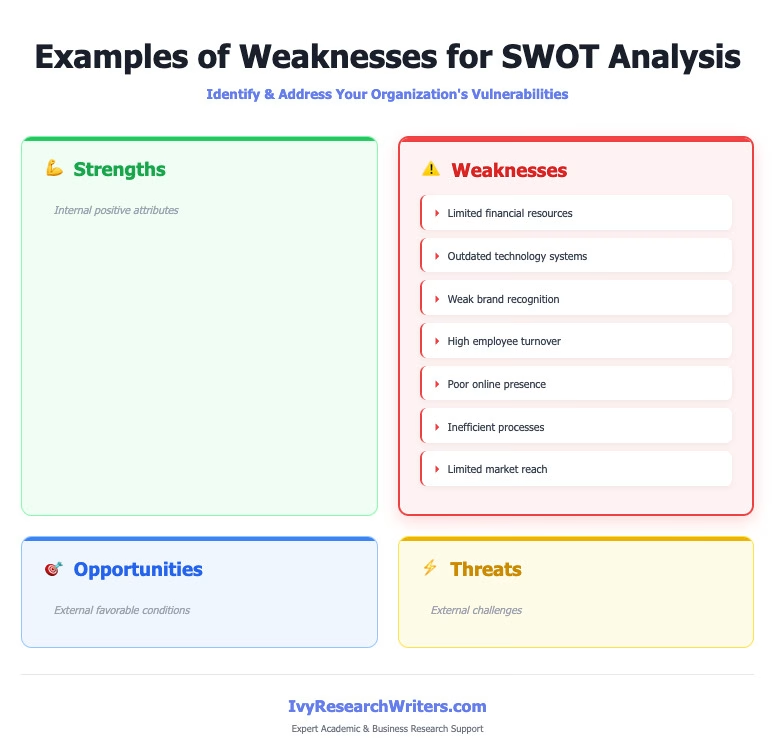
Every business has weaknesses. The difference between companies that grow and companies that struggle is not the presence of weaknesses—it is whether they identify them early and respond with clear strategy. That is why examples of weaknesses for a SWOT analysis matter so much. When weaknesses stay hidden, they quietly hinder growth, damage customer loyalty, reduce efficiency, and make it easier for competitors to win your market.
A SWOT analysis is a strategic framework used to assess both internal and external conditions that shape performance. It looks at strengths and weaknesses inside the organization, and opportunities and threats outside the organization. This method is widely linked to the work of Albert Humphrey, who helped popularize the approach for structured planning and decision-making. In this blog post, you will learn exactly what weaknesses mean in SWOT, how to write them correctly, and how to use them for stronger strategic planning and competitive analysis.
What SWOT stands for, and why weaknesses are the most useful part
SWOT stands for strengths (S), weaknesses (W), opportunities (O), and threats (T). Many people enjoy writing strengths and opportunities because they feel positive. However, weaknesses are often the most valuable quadrant because they identify what is limiting success right now.
- Strengths are internal advantages that your business controls.
- Weaknesses are internal limitations that your business can improve.
- Opportunities are external factors that you can take advantage of.
- Threats are external risks you cannot fully control but must prepare for.
Because SWOT evaluates internal factors and external factors, it gives you a complete picture of performance. It helps you see where your company stands today and what should change to grow tomorrow.
Why a SWOT analysis is important for growth and decision-making
A SWOT analysis is important because it turns scattered observations into organized strategy. Instead of guessing what to improve, you get a structured view of the business and can prioritize the changes that matter most.
A well-done SWOT analysis helps you:
- improve your product or service
- strengthen brand image
- boost customer retention rates
- protect or expand market share
- build long-term competitive advantage
- allocate time and resources more effectively
- create stronger business strategies based on reality
Most importantly, the analysis becomes a practical strategic planning tool when you turn weaknesses into clear actions. That is when SWOT stops being academic and becomes profitable.
Using an analysis template to keep your SWOT clear and professional
An analysis template makes SWOT easier because it guides your thinking and prevents vague lists. The biggest mistake people make is mixing internal and external points or writing weaknesses that are too general, such as “bad marketing” without proof.
A strong SWOT should be specific, measurable, and linked to outcomes.
A simple structure is:
- Strengths (internal strengths you control)
- Weaknesses (internal weaknesses you must improve)
- Opportunities (external openings you can pursue)
- Threats (external risks you must manage)
Using a template ensures the SWOT is not just random brainstorming, but structured evaluation that supports planning.
How a SWOT analysis template works in practice
A strong SWOT analysis template helps you separate internal from external and connect your insights to strategy.
Here is a practical template you can copy:
Strengths (Internal)
- What do we do better than competitors?
- What assets or capabilities support success?
- What makes customers choose us?
Weaknesses (Internal)
- What needs improvement right now?
- What processes are inefficient?
- What limits growth or revenue?
Opportunities (External)
- What market trends can we seize?
- What unmet needs exist in the market?
- What partnerships or technology changes can help us grow?
Threats (External)
- What competitor actions could hurt us?
- What economic, legal, or supply risks exist?
- What could cause us to fall behind?
This template ensures you analyze internal strengths and weaknesses alongside external conditions, instead of treating SWOT like four unrelated lists.
What weaknesses really mean in a SWOT analysis (definitions that help you write better)
Weaknesses are not “bad things” about your business. They are internal weaknesses that reduce performance, slow growth, increase cost, or weaken customer loyalty.
A weakness is internal when it comes from inside the organization, such as:
- limited skills or capacity
- weak systems or inefficient workflows
- poor customer experience
- inconsistent quality control
- weak financial structure, such as lack of financial resources
In other words, weaknesses are internal factors that your organization can change with training, investment, leadership, or better systems.
Examples of weaknesses for a SWOT analysis that you can use immediately
Below are detailed, realistic examples of weaknesses you can use for a business SWOT. These are written in professional style and grouped by category so you can quickly adapt them to your own company or assignment.
Financial weaknesses (very common in small businesses)
Financial problems often appear first, especially when a business wants to grow.
Common weakness examples for businesses:
- Lack of financial resources to expand operations or marketing
- Weak cash flow management affecting daily operations
- High operating costs reducing profit margins
- Limited ability to invest in technology or talent
Why it can hinder growth:
Even a strong product or service can fail if the business cannot consistently fund inventory, staff, or promotion.
Brand and marketing weaknesses (poor visibility = slow growth)
Marketing weaknesses reduce reach and limit customer acquisition.
Common examples:
- Poor brand awareness in the target market
- Weak brand image due to inconsistent messaging
- Low online visibility and weak search performance
- Limited marketing channels beyond word-of-mouth
Why it matters:
When customers do not trust your brand or do not recognize it, growth slows and competitors gain attention.
Customer experience weaknesses (the silent cause of low loyalty)
Weak customer experience shows up in retention, reviews, and repeat sales.
Common examples:
- Declining customer retention rates
- Slow response times for customer support
- Inconsistent customer experience across staff
- Weak after-sales service and follow-up
Business impact:
When retention drops, your customer base shrinks and your costs rise because you must constantly replace lost customers.
Operational weaknesses (systems that waste time and money)
Operations are where businesses lose money quietly.
Common examples:
- Inventory management issues causing stockouts
- Poor workflow and slow service delivery
- Overdependence on manual processes
- Delays caused by weak scheduling or planning
Why it matters:
Operational weakness wastes time and resources, increases customer dissatisfaction, and makes scaling difficult.
People and skills weaknesses (training gaps reduce performance)
Many businesses have great ideas but weak team execution.
Common examples:
- Staff need training in customer service, sales, or technology
- Skill gaps leading to inconsistent results
- High employee turnover affecting continuity
- Poor internal communication and unclear roles
Impact:
When teams lack training and structure, efficiency falls and the business cannot execute strategy consistently.
Product or service weaknesses (what you offer must compete)
Your offering must be competitive and consistent.
Common examples:
- Product quality inconsistency
- Limited product variety compared to competitors
- Weak differentiation in the market
- Pricing challenges due to rising costs
Why it matters:
Customers compare alternatives. If your product or service is not competitive, you lose market share.
Weaknesses in a SWOT analysis should be measurable, not emotional
A SWOT weakness should sound professional, not personal. The goal is not blame—it is clarity.
Instead of writing:
“We are bad at marketing.”
Write:
“Limited online visibility and inconsistent branding reduce customer acquisition.”
Instead of:
“Our customer service is poor.”
Write:
“Slow customer response times contribute to declining customer retention rates.”
Weaknesses should point to what needs improvement, and ideally include evidence from sales patterns, customer feedback, staff performance, or operational outcomes.
Need help with your SWOT analysis or research project?
Let IvyResearchWriters.com craft a high-quality, ready-to-submit paper for you — fast, accurate, and plagiarism-free.
A complete example SWOT showing weaknesses clearly
Here is an example SWOT you can use as a model. This demonstrates how weaknesses should be written and connected to outcomes.
Example SWOT: Local skincare business
Strengths (Internal):
- High-quality natural ingredients
- Strong customer loyalty in one region
- Fast local delivery service
- Strong product reviews
Weaknesses (Internal):
- Lack of financial resources to expand production capacity
- Limited marketing strategy and inconsistent brand image online
- Small customer base beyond the local market
- Staff need training to handle growing customer support volume
- Inventory shortages during peak seasons lowering sales
Opportunities (External):
- Rising consumer demand for clean beauty products
- Growth of online shopping trends
- Partnerships with local influencers and salons
- Expansion into regional e-commerce platforms
Threats (External):
- Increased competition with bigger brands
- Supplier price increases impacting profit margins
- Changing market trends in skincare preferences
- Online reputation risks from negative reviews
This SWOT shows strengths and weaknesses alongside external opportunities and threats, which is the most practical way to use the framework.
How to conduct a SWOT analysis the right way (so weaknesses are accurate)
To conduct a SWOT analysis, you must avoid guessing. Use data and observation to confirm what is truly happening.
A reliable process looks like this:
- Identify the strengths using performance evidence
- List internal weaknesses that create real business problems
- Review the market for opportunities based on trends
- Identify threats from competitors and external shifts
- Convert the analysis into actionable priorities
When you do this well, SWOT becomes more than a document—it becomes a planning system that improves results.
Identifying weaknesses quickly using practical business questions
Identifying weaknesses becomes easier when you ask direct questions.
Try these:
- Where are we losing customers, and why?
- What complaints show up repeatedly?
- What delays happen often?
- What is blocking growth right now?
- What internal weaknesses reduce quality or speed?
- What skills do employees need training in?
- What part of the business “breaks” under pressure?
These questions help you assess internal factors and identify weaknesses that are real, not imaginary.
Weakness examples for businesses (copy-and-paste list)
If you need quick weakness examples for businesses, here is a practical list:
- Lack of financial resources for expansion
- Weak cash flow stability
- Poor brand awareness and weak brand image
- Limited marketing channels
- Low customer retention rates
- Slow customer service response times
- Inconsistent product quality
- Weak inventory management
- Staff need training in key skills
- Poor internal communication
- Limited scalability due to manual systems
- Weak differentiation versus competitors
- Overdependence on one supplier or one market
- Inefficient workflow and wasted time and resources
- Low digital presence causing the business to fall behind
Use these as a starting point, but always adapt them to fit your business reality.
Strategic planning: turning weaknesses into competitive advantage
A SWOT is not complete until it drives strategic planning. Weaknesses should lead to action, not just awareness.
Here is how to move from weaknesses to strategy:
- If the weakness is “poor brand image,” the action is a brand consistency plan and messaging update.
- If the weakness is “lack of financial resources,” the action is budgeting, lean operations, or funding strategy.
- If the weakness is “staff need training,” the action is a structured training program and performance review.
- If the weakness is “low customer retention rates,” the action is improving support, loyalty rewards, and customer experience.
This is how you turn analysis into actionable business strategies that improve real outcomes.
How to use SWOT analysis to grow market share and reduce risk
When you use SWOT analysis, you are doing more than listing problems. You are aligning internal improvements with external opportunities.
A strong SWOT helps you:
- strengthen the customer base
- create smarter marketing and positioning
- improve operational performance
- seize opportunities from market trends
- protect profits against threats
- build and defend competitive advantage
- increase market share over time
To use the SWOT effectively, update it regularly—not once a year. Markets change, competitors evolve, and customer expectations shift quickly.
Competitive analysis: why weaknesses matter more than you think
Weaknesses are even more dangerous when competitors are strong in those areas. That is why SWOT connects directly to competitive analysis.
For example:
- If competitors have strong branding and you have a poor brand image, they win customers faster.
- If competitors respond faster and you have slow customer support, your customer retention rates fall.
- If competitors are well-funded and you lack financial resources, you may fall behind in marketing and expansion.
Competitive analysis helps you see where your weaknesses can cost you market share, so you can act early.
Final takeaway: weaknesses are internal, fixable, and strategic
The best businesses do not pretend they have no weaknesses. They identify weaknesses early, prioritize improvements, and build stronger systems. Weaknesses are internal, which means they can be changed with better planning, training, resources, and execution.
A SWOT analysis is important because it helps you identify strengths, clarify weaknesses, understand external opportunities, and prepare for threats. When strengths are internal and threats are external, the real power of SWOT is how it connects internal strengths and weaknesses alongside external realities so your strategic planning becomes smarter and faster.
If you want a professionally written SWOT report, a polished SWOT analysis template, or a complete example SWOT tailored to your product or service, IvyResearchWriters.com can help you produce a high-quality SWOT that supports real business strategies and competitive advantage.
Frequently Asked Questions
What are 5 examples of weaknesses in SWOT analysis?
Here are 5 strong examples of weaknesses in a SWOT analysis (these are weaknesses are internal issues that can hinder growth):
- Lack of financial resources to expand operations or marketing
- Poor brand image or low brand awareness in the target market
- Declining customer retention rates (repeat customers are reducing)
- Staff need training to improve service quality or productivity
- Weak inventory/operations systems causing delays and stockouts
What are 5 examples of weaknesses?
Below are 5 general weakness examples for businesses you can use in an SWOT:
- Limited cash flow and budgeting control
- Slow customer support response time
- Inconsistent product or service quality
- Weak online visibility and marketing reach
- Inefficient internal processes wasting time and resources
Pro tip: A weakness should always point to something inside the business that “needs improvement.” If it comes from outside the company (like competitor pricing), that is not a weakness—it is usually a threat.
What are 5 examples of threats in SWOT analysis?
Here are 5 examples of threats (remember, threats are external risks that can affect your business performance):
- Strong competitors gaining market share through better pricing or branding
- Rapid market trends changes that reduce demand for your product or service
- Economic downturn or inflation increasing operating costs
- Supplier delays or shortage of stock affecting delivery and customer satisfaction
- Negative online reviews or reputation issues harming your brand image
What would be considered a weakness when conducting a SWOT analysis?
A weakness is any internal factor that reduces performance, limits growth, or weakens competitiveness. In short, when conducting a SWOT analysis, a weakness is something inside your business that you can fix through better systems, training, budgeting, or strategy.
Weaknesses usually include:
- poor customer experience (low customer retention rates)
- skill gaps (staff need training)
- operational inefficiencies (delays, poor inventory tracking)
- weak marketing/brand image
- lack of financial resources

