

Critical Thinking Exercises: An In-Depth Guide to Training Your Brain, Enhancing Analytical Skills, and Making Better Decisions
In an era defined by information overload, the ability to think critically is one of the most valuable competencies a student or professional can possess. From academic research to workplace problem-solving, critical thinking skills empower individuals to analyze information, question assumptions, and make informed decisions based on evidence rather than guesswork.
At IvyResearchWriters.com, we recognize that critical thinking is not just a skill—it is a powerful tool that underpins academic success, professional growth, and effective decision-making in real-life situations. This comprehensive guide explores the best critical thinking exercises, explains key concepts, and provides actionable strategies to train your brain and strengthen your thinking abilities.
🧠 Critical Thinking: Foundations of Analytical and Reflective Thinking
Critical thinking is the disciplined process of actively and skillfully conceptualizing, applying, analyzing, and evaluating information to reach a conclusion.
Key components of critical thinking:
- Analytical thinking – breaking down complex ideas
- Logical thinking – using structured reasoning
- Reflective thinking – evaluating your own thought process
- Strategic thinking – planning and anticipating outcomes
💡 Example:
Instead of accepting a claim in a research paper, a critical thinker examines the strength of evidence, questions assumptions, and evaluates whether the argument is supported by claims with evidence.
This ability to analyze and evaluate information is essential for solving academic problems and navigating various situations in life.
🧩 Critical Thinking Exercise: Definition, Purpose, and Impact
A critical thinking exercise is a structured activity designed to improve your cognitive abilities, problem-solving skills, and analytical skills.
Why these exercises matter:
- They help you solve problems systematically
- They improve your ability to identify biases
- They strengthen your ability to make informed decisions
These exercises are especially important for students who must evaluate sources, construct arguments, and effectively address complex academic challenges.
👉 At IvyResearchWriters.com, we integrate effective critical thinking exercises into academic support, helping students build strong reasoning skills for assignments and research.
🎯 Critical Thinking Activities: Practical and Engaging Methods
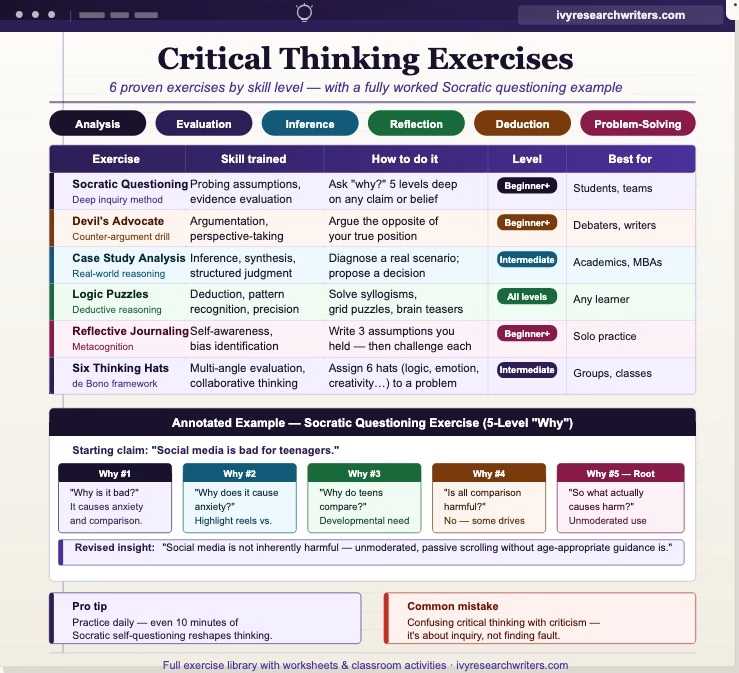
1. The Five Whys Technique (Root Cause Analysis)
The five whys technique is a powerful exercise that involves asking “why” repeatedly to uncover the root cause of a problem.
How it works:
- Identify a problem
- Ask “why” five times
- Analyze each answer to uncover deeper causes
💡 Example:
A student performs poorly on an exam.
- Why? → Lack of preparation
- Why? → Poor time management
- Why? → Overcommitment to activities
This method helps students effectively address issues rather than just treating symptoms.
2. Reverse Brainstorming: Creative Problem-Solving
Unlike traditional brainstorming, reverse brainstorming asks: How can we make this problem worse?
- Encourages creative thinking
- Promotes lateral thinking
- Reveals hidden risks
💡 Example: Instead of asking how to improve productivity, ask how to make productivity worse—then reverse those ideas.
3. Mind Mapping: Visualizing Thought Processes
Mind mapping helps you visualize connections between different ideas.
- Enhances analytical thinking
- Encourages brainstorm sessions
- Generates new insights
This technique is especially useful for structuring essays, research papers, and coursework.
4. Argument Mapping: Evaluating Evidence and Reasoning
An argument map breaks down arguments into:
- Claims
- Supporting evidence
- Counterarguments
This improves your ability to:
- Evaluate the strength of evidence
- Understand complex arguments
- Make decisions based on evidence
5. Socratic Questioning: Deep Inquiry and Reflection
Inspired by Socrates, this method uses thoughtful questioning to challenge assumptions.
Questions to ask:
- What evidence supports this claim?
- Are there alternative explanations?
- What biases might be present?
Using Socratic questioning helps you:
- See things from multiple perspectives
- Evaluate different viewpoints
- Develop deeper understanding
💡 Critical Thinking Skills: Core Competencies for Success
Developing critical thinking skills enhances your ability to:
- Solve problems effectively
- Make informed decisions
- Communicate ideas clearly
- Approach challenges with situations with clarity
These critical skills are essential for academic success and professional growth.
🧠 Thinking Abilities: Strengthening Cognitive and Analytical Capacity
Your thinking abilities include:
- Cognitive abilities (memory, reasoning)
- Problem-solving abilities
- Analytical skills
Engaging in exercises that will help improve these abilities ensures you are better prepared to handle solving complex problems.
🔍 Critical Thinking Abilities: Applying Skills in Real-Life Situations
Strong critical thinking abilities enable you to:
- Evaluate situations objectively
- Consider various perspectives
- Make decisions based on evidence
💡 Example:
A team leader resolving workplace conflict must evaluate different viewpoints and choose the best solution without making the problem worse.
🧩 Thinking Puzzles: Engaging Ways to Train Your Brain
Thinking puzzles are among the best critical thinking games.
Examples:
- Logic puzzles
- Mathematical puzzle challenges
- The Tower of Hanoi (a puzzle that involves moving disks strategically)
These puzzles:
- Improve logical thinking
- Enhance problem-solving abilities
- Encourage you to solve the puzzle without relying on guesswork
🧠 Train Your Brain: Daily Practices for Growth
To consistently train your brain, incorporate:
- Daily solve puzzles routines
- Creative problem-solving exercises
- Reflection using reflective thinking
- Exposure to various situations requiring decision-making
These habits help you become able to think critically in any context.
🏆 Best Critical Thinking Exercises for Students and Professionals
Some of the best critical thinking exercises include:
- Case study analysis
- Debate and discussion sessions
- Scenario-based simulations
- Group team-building activity exercises
These activities:
- Improve communication skills
- Encourage collaboration
- Strengthen analytical thinking
🎩 Six Thinking Hats: A Structured Framework for Analysis
The six thinking hats technique encourages examining problems from multiple angles:
- Logical (facts)
- Emotional (feelings)
- Creative (ideas)
- Critical (risks)
- Optimistic (benefits)
- Process (organization)
This approach ensures you:
- Consider various perspectives
- Avoid bias
- Make balanced decisions
🌍 Using Critical Thinking in Academic and Real-Life Situations
Using critical thinking helps you:
- Avoid poor decisions based on a guess
- Evaluate claims using evidence and logical reasoning
- Solve problems in academic and professional contexts
💡 Example:
When writing a research paper, you must analyze and evaluate sources, ensuring credibility and relevance.
🎓 How IvyResearchWriters.com Helps You Develop Critical Thinking Skills
At IvyResearchWriters.com, we don’t just provide writing services—we help students become better critical thinkers.
Our support includes:
- Guidance on applying critical thinking exercises in assignments
- Assistance with analyzing complex topics
- Help in structuring arguments using evidence and logical reasoning
- Training students to highlight skills and present ideas clearly
We ensure students are:
- Able to understand complex concepts
- Equipped to handle academic challenges
- Confident in their problem-solving skills
Ready to Strengthen Your Critical Thinking and Excel Academically?
Mastering critical thinking exercises is the key to unlocking better grades, sharper reasoning, and stronger academic performance—but you don’t have to do it alone.
At IvyResearchWriters.com, we help you go beyond basic understanding and truly encourage deeper thinking through expert guidance and personalized support.
Related Assignments
If you’re studying critical thinking exercises, there are several academic assignments designed to help you encourage deeper thinking and apply reasoning skills in real-world and academic contexts. At IvyResearchWriters.com, we help students approach these assignments using innovative ways that improve both understanding and performance.
🧠 1. Critical Thinking Essay
This assignment focuses on analyzing an issue using logic and evidence.
- Example topic: “The Role of Critical Thinking in Academic Success”
- Requirements:
- Break down arguments using analysis and evaluation
- Support claims with evidence
- Demonstrate how each technique works in practice
💡 This type of essay is one of the best critical ways to assess your reasoning and writing skills.
📊 2. Case Study Analysis
Students are given real or hypothetical scenarios to analyze.
- Task:
- Identify the problem
- Evaluate possible solutions
- Recommend the best course of action
This assignment helps students apply critical thinking to real-life situations and develop structured reasoning.
🧩 3. Problem-Solving Assignment
Focuses on applying logic to solve challenges.
- Example:
- Analyze a business or social problem
- Use frameworks like the Five Whys or argument mapping
- Goal:
- Show how each technique works to arrive at a solution
🗣️ 4. Debate or Argumentative Paper
Students must present and defend a position.
- Include:
- Strong arguments and counterarguments
- Evidence-based reasoning
- Clear structure
This type of assignment helps encourage deeper thinking by requiring students to consider multiple perspectives.
📘 5. Reflective Thinking Assignment
Students analyze their own thought processes.
- Focus:
- What you learned from applying critical thinking
- How your reasoning improved
- Outcome:
- Greater awareness of your thinking abilities
🛠️ 6. Instructional Guide on Critical Thinking
Students create guides explaining critical thinking techniques.
- Example topic: “Effective Critical Thinking Exercises for Students”
- Include:
- Practical exercises
- Explanations of how each technique works
- Real-life applications
👥 7. Team-Based Problem-Solving Project
A collaborative assignment that develops both reasoning and communication.
- Activities:
- Group discussions
- Scenario analysis
- Decision-making tasks
This is one of the best critical assignments for building teamwork and analytical skills.
🎯 Why These Assignments Matter
These assignments help you:
- Develop structured reasoning
- Apply critical thinking in academic and real-world contexts
- Strengthen problem-solving and communication skills
They also prepare you for advanced research and professional challenges.
✍️ Need Help With Critical Thinking Assignments?
At IvyResearchWriters.com, we provide expert assistance with:
- Critical thinking essays and case studies
- Problem-solving assignments
- Reflective and analytical writing
👉 Whether you’re learning how to apply a new concept or struggling to structure your ideas, we help you use innovative ways to think critically, write clearly, and achieve top results.
🚀 Conclusion: Master Critical Thinking for Lifelong Success
Mastering critical thinking exercises is essential for success in academics, careers, and everyday life. By engaging in thinking puzzles, practicing structured techniques like Socratic questioning, and applying analytical thinking, you can significantly enhance your thinking abilities.
👉 With consistent practice—and expert guidance from IvyResearchWriters.com—you can become a confident, analytical thinker capable of making sound decisions and solving complex problems with ease.
Frequently Asked Questions (FAQs)
What are the 7 critical thinking skills?
The seven core critical thinking skills are widely recognized as essential for academic and professional success. These include:
- Analysis
- Interpretation
- Evaluation
- Inference
- Explanation
- Self-regulation
- Problem-solving
Prose insight:
These skills work together to help you analyze information, question assumptions, and make sound judgments. For example, evaluation and inference allow you to assess the strength of evidence, while explanation helps you communicate your reasoning clearly.
👉 At IvyResearchWriters.com, we help students master these skills through structured guidance and innovative ways of approaching assignments—ensuring you not only understand concepts but also apply them effectively.
What are 5 critical thinking techniques?
There are several proven techniques that help encourage deeper thinking and improve reasoning abilities.
Five effective techniques include:
- Socratic questioning – asking deeper, probing questions
- Mind mapping – visualizing connections between ideas
- The Five Whys – identifying root causes
- Reverse brainstorming – exploring problems from the opposite angle
- Argument mapping – breaking down claims and evidence
Prose insight:
Each technique works differently, but they all aim to strengthen your ability to evaluate and solve problems. For instance, Socratic questioning is one of the best critical thinking methods because it forces you to challenge assumptions and explore multiple perspectives.
👉 At IvyResearchWriters.com, we incorporate these techniques into academic support to help students think critically and perform better in coursework.
What are the 4 C’s of critical thinking?
The 4 C’s are foundational competencies often emphasized in education and professional development:
- Critical thinking
- Communication
- Collaboration
- Creativity
Prose insight:
While critical thinking focuses on analysis and reasoning, the other three C’s ensure you can express ideas clearly, work with others, and generate innovative solutions. Together, they encourage deeper thinking and holistic development.
👉 IvyResearchWriters.com helps students develop all four areas by combining strong writing support with analytical guidance.
What are the 5 critical thinking core skills?
The five core skills of critical thinking are:
- Analysis – breaking down information
- Evaluation – judging credibility and relevance
- Interpretation – understanding meaning
- Inference – drawing logical conclusions
- Explanation – communicating reasoning clearly
Prose insight:
Mastering these core skills allows you to approach problems systematically and make informed decisions. Each technique works best when applied consistently across different academic tasks.
💡 For example, using analysis and evaluation together is one of the best critical approaches when writing research papers or solving case studies.

