

Biology Terminology: A Complete Guide for Students and Researchers
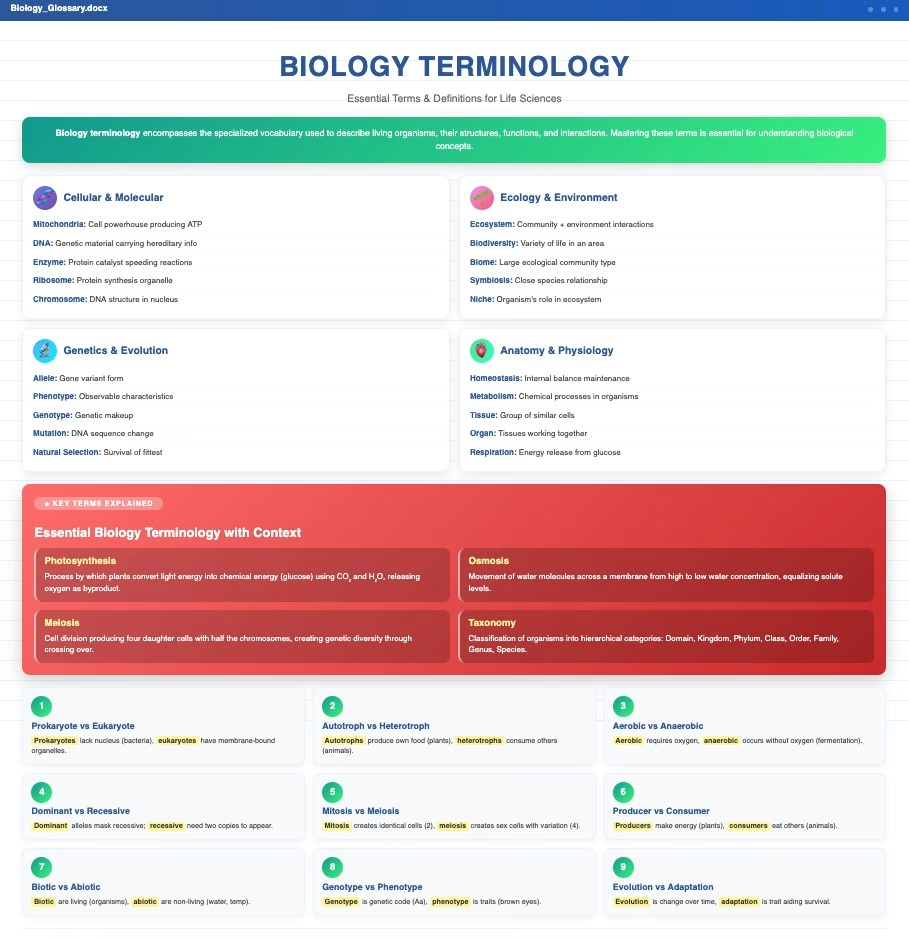
Understanding biology terminology is essential for mastering life sciences. Whether you are studying cells and tissues, molecular processes, or the growth and development of living organisms, knowing key biological terms allows you to communicate ideas clearly and accurately. Biology is a vast discipline, and its vocabulary reflects the complexity of life—from the smallest DNA molecule to entire ecosystems.
In this comprehensive guide, we break down essential biology terms, explain their definitions, and provide practical examples. This resource is especially useful for students building a glossary of biology terms for coursework, research papers, or exam preparation.
Biology: Core Concepts and Fundamental Terms
At its foundation, biology is the scientific study of life. It explores living organisms, their structure, function, evolution, and interactions with their environment. Biology encompasses everything from microscopic cells to complex vertebrate systems.
Organism
An organism is any individual living entity capable of carrying out life processes. Organisms can be unicellular (like bacteria) or multicellular (like animals and plants).
Living Organisms
Living organisms share key characteristics: growth and development, reproduction, response to stimuli, and the ability to maintain homeostasis.
Cells and Tissues
Cells are the basic unit of life. Groups of similar cells form tissues, which perform specialized functions in animals and plants.
Cell Biology: Structure and Function of Living Cells
Cell biology focuses on the structure and function of living cells.
Animal Cell and Plant Cell
An animal cell lacks a cell wall but contains a cell membrane, nucleus, and organelles. In contrast, plant and animal cells differ in that plant cells contain a cell wall and chloroplasts.
Organelle
An organelle is a specialized structure within a cell that performs a specific function. Examples include the mitochondria and nucleus.
Nucleus
The nucleus houses the cell’s genetic material and controls cellular activities.
Cell Membrane
The cell membrane regulates what enters and exits the cell, maintaining internal balance.
Cell Wall
The cell wall, found in plants, provides structural support and protection.
Cell Cycle
The cell cycle describes the stages a cell undergoes during growth and division.
Molecular Biology: DNA, Genetic Material, and Biological Molecules
Molecular biology examines biological processes at the molecular level, particularly the DNA molecule and proteins.
DNA Molecule and Double Helix
The DNA molecule carries genetic information in a structure known as the double helix.
Chromosome
A chromosome is a thread-like structure composed of DNA and proteins, containing genes.
Nitrogenous Bases
DNA consists of nitrogenous bases:
- Adenine
- Thymine
- Cytosine
- Guanine
Adenine pairs with thymine, and cytosine pairs with guanine. Cytosine and thymine are examples of pyrimidine bases.
Genetic Material
Genetic material refers to DNA, which stores hereditary information passed from a common ancestor to descendants.
Gamete and Germ Cell
A gamete (such as sperm or egg) is a reproductive cell. A germ cell gives rise to gametes.
Biological Molecules and Biochemical Reactions
Life depends on complex organic compounds known as biological molecules.
Proteins and Lipids
Proteins and lipids are essential macromolecules. Proteins perform structural and enzymatic functions, while lipids form cell membranes and store energy.
Synthesize
To synthesize means to produce complex molecules from simpler ones, such as synthesizing proteins from amino acids.
Biochemical Reactions
Cells carry out thousands of biochemical reactions necessary for survival.
Chemical Reaction
A chemical reaction involves the transformation of substances. For example, cellular respiration converts glucose into carbon dioxide and water.
Citric Acid Cycle
The citric acid cycle is a key metabolic pathway that produces energy in living cells.
Molecular Nitrogen
Molecular nitrogen (N₂) is essential in biological systems, especially in nitrogen fixation processes.
Molecular Weight
Molecular weight refers to the mass of a molecule, important in laboratory analysis.
Need Help With a Biology Terminology Assignment?
Order your custom biology assignment today and submit with confidence.
Cells and Systems: From Blood Cells to Blood Vessels
Biology also studies how specialized cells function within systems.
Blood Cells
Blood cells include red blood cells (oxygen transport), white blood cells (immune defense), and platelets (clotting).
Blood Vessels
Blood vessels transport blood throughout the body, delivering oxygen and nutrients to tissues.
Vertebrate
A vertebrate is an organism with a backbone, including mammals, birds, reptiles, amphibians, and fish.
Used in Biology: Key Laboratory and Conceptual Terms
Many terms are widely used in biology across disciplines:
- Protein coat: The protective outer layer of a virus.
- Cell signaling: Communication between cells using chemical signals.
- Living cells: Cells capable of metabolic activity and reproduction.
- Growth and development: Changes in size and complexity over time.
- Cells and tissues: Fundamental organizational levels in multicellular organisms.
Understanding terminology used in biology allows students to interpret research papers, lab reports, and textbooks accurately.
Glossary of Biology: Why Terminology Matters
Building a glossary of biology terms strengthens comprehension and academic performance. Biology terminology connects disciplines such as:
- Cell biology
- Molecular biology
- Ecology
- Genetics
- Physiology
For example, recognizing how a chromosome contains genetic material, how DNA consists of adenine and thymine pairs, and how biochemical reactions drive growth and development helps students see the interconnectedness of life processes.
Common Assignments Related to Biology Terminology
Biology terminology assignments are designed to test whether students understand scientific vocabulary and can apply it accurately in context—not just memorize definitions.
1️⃣ Glossary of Biology Terms
One of the most common assignments is creating a glossary of biology terminology.
What it involves:
- Defining key terms (e.g., organism, chromosome, nucleus, organelle)
- Providing examples
- Using terms in sentences
- Including diagrams or illustrations (sometimes)
Example:
Define cell membrane, DNA molecule, and gamete, then explain how they relate within living organisms.
Professors often assess:
- Accuracy
- Clarity
- Scientific precision
- Proper use of terminology
2️⃣ Concept Explanation Essays
Students are asked to explain biological processes using correct terminology.
Example Prompts:
- Explain the cell cycle using appropriate biological terms.
- Describe the structure of the DNA double helix and the role of adenine, thymine, cytosine, and guanine.
- Discuss how biochemical reactions support growth and development in living cells.
These assignments test whether students can:
- Apply terminology in context
- Organize scientific explanations logically
- Demonstrate understanding beyond memorization
3️⃣ Diagram Labeling Assignments
Many instructors provide diagrams of:
- Animal cells
- Plant cells
- Chromosomes
- Blood vessels
- Cell organelles
Students must label structures like:
- Nucleus
- Cell membrane
- Cell wall
- Organelles
- Genetic material
This tests vocabulary recognition and structural knowledge.
4️⃣ Matching and Definition Quizzes
These are common in introductory biology courses.
Examples:
- Match molecular nitrogen with its function.
- Match germ cell with reproductive role.
- Identify which nitrogenous base pairs with cytosine.
These assignments reinforce terminology retention.
5️⃣ Short-Answer Terminology Applications
Instead of simply defining terms, students must apply them.
Example:
Explain how the citric acid cycle contributes to the production of carbon dioxide and water in cells.
This requires:
- Using terms correctly
- Connecting processes
- Demonstrating conceptual understanding
6️⃣ Research-Based Terminology Papers
Advanced biology students may be required to:
- Write about molecular biology processes
- Explain the role of proteins and lipids in cellular function
- Discuss how complex organic compounds are synthesized
These assignments demand:
- Proper scientific vocabulary
- Accurate explanations
- Academic formatting (APA, MLA, etc.)
7️⃣ Comparative Terminology Assignments
Students compare similar biological terms, such as:
- Plant and animal cells
- Positive vs negative regulation in cell signaling
- Germ cells vs somatic cells
- Vertebrate vs invertebrate organisms
These assignments test precision and clarity.
8️⃣ Case Study Analysis Using Terminology
Students analyze real biological scenarios and must incorporate key vocabulary.
Example:
Explain how mutations in a chromosome affect genetic material and protein synthesis.
This tests:
- Understanding of biological molecules
- Knowledge of cellular processes
- Accurate use of terminology
9️⃣ Flashcard or Vocabulary Portfolio Projects
Common in high school and introductory college courses:
- Create flashcards for 50 biology terms
- Develop a study guide
- Create a concept map linking related terms
🔬 What Professors Look For
In biology terminology assignments, instructors evaluate:
- Accuracy of definitions
- Correct scientific usage
- Ability to connect terms logically
- Clarity and organization
- Evidence of understanding
Memorization alone is not enough—students must demonstrate application.
Final Thoughts
Biology terminology forms the language of life sciences. From the DNA molecule’s double helix structure to the citric acid cycle’s role in energy production, understanding these terms is crucial for success in biology courses and research.
Mastering vocabulary such as organism, organelle, cell membrane, gamete, molecular weight, and biochemical reactions empowers students to analyze scientific concepts with clarity and precision.
Need Help With Your Biology Assignment?
If you’re struggling with:
- Biology essays
- Lab reports
- Molecular biology research papers
- Cell biology assignments
- Glossary development
IvyResearchWriters.com offers:
✔ Expert biology writers
✔ Clear definitions and structured explanations
✔ Accurate scientific terminology
✔ APA, MLA, Chicago formatting
✔ Undergraduate to PhD-level assistance
Order your custom biology paper today at IvyResearchWriters.com and elevate your academic performance.
Frequently Asked Questions
What is terminology in biology?
Terminology in biology refers to the specialized vocabulary used to describe concepts, structures, processes, and interactions within living organisms. Because biology studies everything from microscopic living cells to entire ecosystems, precise language is essential.
In simple terms:
- It is the scientific language used in biology.
- It allows researchers to communicate accurately.
- It helps students understand complex ideas clearly.
For example, instead of saying “the control center of the cell,” biologists use the term nucleus. Instead of saying “the molecule that carries hereditary information,” they say DNA molecule or genetic material.
Biology terminology includes words related to:
- Cells and tissues
- Molecular biology
- Biochemical reactions
- Growth and development
- Organisms and evolution
At IvyResearchWriters.com, we help students not only memorize biology terms but also understand how to use them properly in essays, lab reports, and research papers.
What are 10 science vocabulary words?
Here are 10 essential science vocabulary words commonly used in biology:
- Organism – An individual living entity.
- Chromosome – A structure containing genetic material.
- Organelle – A specialized structure inside a cell.
- Nucleus – The control center of a cell.
- Cell membrane – A protective barrier regulating what enters and exits the cell.
- Gamete – A reproductive cell (sperm or egg).
- Chemical reaction – A process where substances are transformed.
- Adenine – A nitrogenous base found in DNA.
- Protein – A biological molecule essential for structure and function.
- Vertebrate – An organism with a backbone.
These terms are foundational and frequently appear in exams and biology coursework.
If you need detailed explanations and examples for assignments, IvyResearchWriters.com provides structured academic support tailored to your level.
What are 50 science words?
Here is a list of 50 important science words commonly used in biology:
- Organism
- Cell
- Tissue
- Organelle
- Nucleus
- Cell membrane
- Cell wall
- Chromosome
- DNA molecule
- Genetic material
- Double helix
- Adenine
- Thymine
- Cytosine
- Guanine
- Pyrimidine
- Nitrogenous base
- Gamete
- Germ cell
- Blood cells
- Blood vessels
- Vertebrate
- Molecular biology
- Cell biology
- Biological molecules
- Proteins and lipids
- Complex organic compounds
- Biochemical reactions
- Chemical reaction
- Synthesize
- Molecular weight
- Citric acid cycle
- Carbon dioxide and water
- Cell cycle
- Cell signaling
- Living cells
- Animal cell
- Plant cell
- Growth and development
- Common ancestor
- Molecular nitrogen
- Protein coat
- Cells and tissues
- Living organisms
- Animals and plants
- Nitrogenous compounds
- Metabolism
- Evolution
- Homeostasis
- Ecosystem
This type of glossary of biology terms is extremely useful for revision and exam preparation.
IvyResearchWriters.com can also create customized vocabulary lists based on your syllabus.
What are some biology words?
Some common biology words include terms related to structure, function, genetics, and life processes.
Examples include:
- Cell membrane
- Nucleus
- Chromosome
- Gamete
- DNA molecule
- Organelle
- Blood cells
- Cell cycle
- Citric acid cycle
- Molecular nitrogen
Biology words often describe:
- Structures inside living cells
- Processes like biochemical reactions
- Molecules such as adenine and thymine
- Systems like blood vessels
- Evolution from a common ancestor
Understanding these terms helps students grasp how animals and plants function and how growth and development occur in living organisms.

