

Basque People Physical Traits: What Science Says (and What It Does Not)
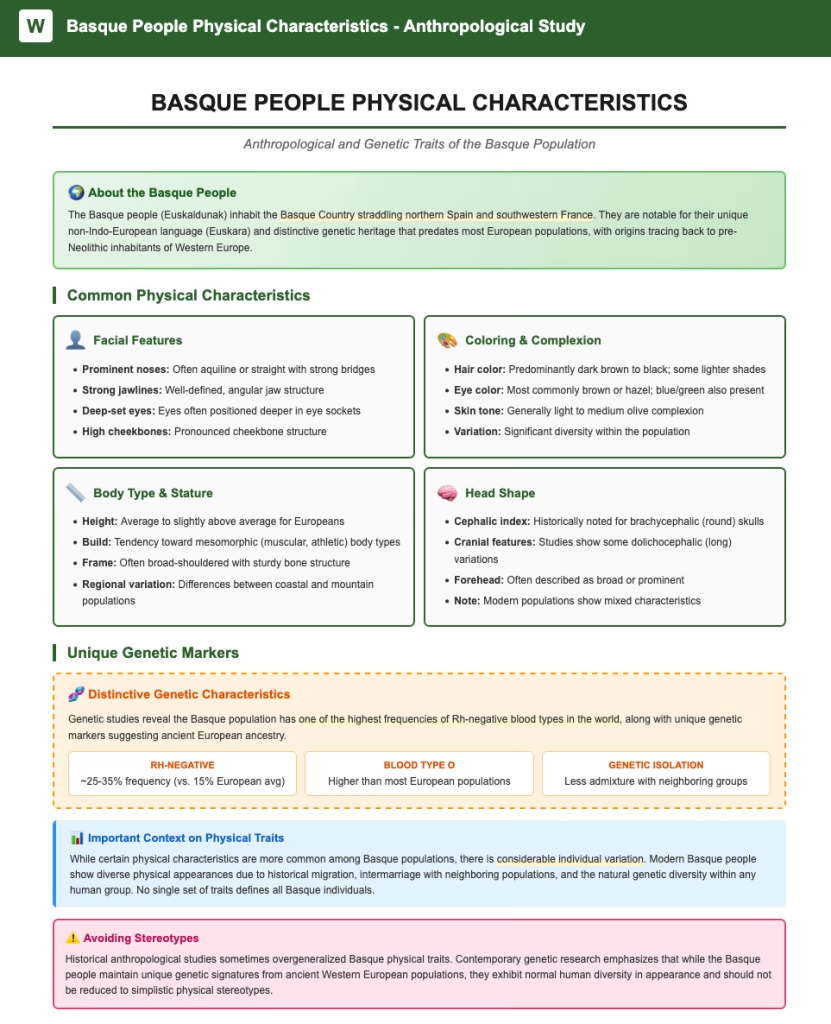
Searches like “Basque people physical characteristics” often come with two goals: curiosity about what makes Basques distinctive, and a desire for clear, accurate information for a school project, genealogy write-up, or cultural blog post. The tricky part is that “physical traits” are frequently mixed with stereotypes—especially about the nose or a so-called Basque nose—and those stereotypes can oversimplify a real, diverse population.
This article explains what researchers can say with evidence (for example, blood-group patterns and population history) and what we should treat cautiously (claims of a single “Basque look”). You will also learn the basics of the Basque Country, Basque culture, and how migration and history shaped today’s Basque population.
Basques in the Basque Country: identity, geography, and what “Basque people” means
The term Basques (or Basque people) generally refers to an ethnolinguistic group indigenous to a region spanning parts of Spain and France—especially northern Spain and southern France near the western Pyrenees. This broader homeland is often called Euskal Herria, and the Basque language is Euskara.
A key marker of Basque identity is language: Euskara is a language isolate and is often described as the only surviving remnant of pre-Roman languages of southwestern Europe.
Examples to ground the geography
- Bilbao is a major city in the Spanish Basque area and is central to modern Basque economic and cultural life.
- The Basque region is commonly discussed as spanning the borderlands of France and Spain, with “French Basque” and “Spanish Basque” often used as shorthand for communities on either side.
Physical characteristics and “unique physical” claims: what physical features can and cannot prove
When people ask about physical characteristics, physical features, physical traits, or physical attributes, they often expect a checklist. However, from a scientific standpoint:
- No single set of physical traits reliably identifies someone as Basque.
- Individuals in the Basque population show the same wide variation in hair and eyes, height, and general facial structure you see across Western Europe, especially among Iberian groups.
- Many features people label as “Basque physical” are not exclusive to Basques and overlap heavily with neighboring Spaniards, other Spaniards in the Iberian Peninsula, and populations in France and Spain generally.
So, if you are writing academically, a safer and more accurate framing is:
Basque distinctiveness is better supported by population history, language, and some genetic patterns than by any single “look.”
That distinction matters, especially because physical “typecasting” can drift into misinformation fast.
Structured Outline for a Basque Research Paper
Working Title Options (choose one)
- Basque Identity in Context: Language, Population History, and Culture in the Western Pyrenees
- Euskara and Basque Identity: Continuity, Change, and Modern Diversity
- Basques in France and Spain: An Interdisciplinary Study of Identity and History
1. Introduction
- Background (context and importance)
- Define the Basque people as an ethnolinguistic community in the western Pyrenees across France and Spain.
- Briefly introduce Euskara as a language isolate and a key marker of identity.
- Problem statement
- Explain why Basque identity is often misunderstood (language vs genetics vs culture vs stereotypes).
- Purpose/Aim
- State that the paper examines Basque identity through history, language, population history, and culture.
- Research question (pick one)
- RQ1: How has language shaped Basque identity across history and modern life?
- RQ2: What does research suggest about Basque population history and distinctiveness, and how should it be interpreted ethically?
- RQ3: How have migration and state boundaries (France/Spain) influenced Basque identity?
- Objectives
- Define the Basque region and identity markers.
- Summarize historical developments influencing identity.
- Review evidence on language and (optionally) genetics/blood group patterns.
- Discuss cultural practices and modern identity politics.
- Significance
- Explain relevance to anthropology, history, linguistics, sociology, and identity studies.
2. Conceptual Framework and Key Definitions
- Key terms
- Basque / Basque identity / Euskal Herria
- Euskara (Basque language)
- Ethnolinguistic group
- Identity (cultural vs political vs biological)
- (Optional) Population genetics terminology: allele frequency, population structure, gene flow
- Conceptual lens (choose one)
- Ethnolinguistic identity framework
- Social identity theory
- Historical institutionalism (France/Spain governance effects)
- Cultural transmission and heritage reproduction
3. Geographic and Historical Context
- The Basque region
- Where it is: northern Spain + southwestern France; western Pyrenees.
- Key places: Bilbao and other major towns (as examples).
- History of the Basque
- Pre-Roman and Roman periods (high-level overview).
- Medieval to early modern governance and local institutions.
- Industrialization and urbanization (Bilbao as a case).
- 20th–21st century identity politics and autonomy debates (neutral academic tone).
- Basque tribes (historical framing)
- Explain “tribes” as historical labels; clarify limits of linking ancient groups to modern identity.
4. Euskara as an Ancient Language and Identity Anchor
- What makes Euskara distinctive
- Language isolate status and historical continuity claims.
- Language and identity
- Euskara as culture, belonging, and heritage.
- Variation in fluency: identity beyond language proficiency.
- Policy and education
- How schooling, media, and institutions support or weaken language transmission across French and Spanish contexts.
5. Population History and Genetics (Optional Section Depending on Assignment)
Use this section only if your course allows genetics/biological discussion; keep it population-level and ethical.
- What “distinctiveness” means
- Population-level structure vs individual identity.
- Evidence commonly discussed
- Genetic differentiation patterns, micro-geographic structure, and the role of geography.
- Blood group and Rh factor (if included)
- Explain why Rh negative frequency is discussed and why it is not a personal identity test.
- Ethical cautions
- Avoid determinism, stereotypes, and “purity” narratives.
6. Basque Culture as Lived Experience
- Core cultural elements
- Foodways, festivals, music/dance, oral traditions.
- Community and belonging
- Local institutions and intergenerational transmission.
- Rural sports (as a cultural example)
- Use as a case study of tradition (avoid biological claims like “stronger people”).
7. Migration, Modern Diversity, and Cross-Border Identity
- Migration patterns
- Rural-to-urban and national/international migration.
- French and Spanish Basque experiences
- Differences shaped by state policy, schooling, media, and identity politics.
- Contemporary Basque identity
- Multiple identities: Basque + Spanish/French + European/global.
8. Basque Surnames and Heritage (Optional)
- Why surnames matter
- Place-based naming traditions and heritage clues.
- Limitations
- Surnames do not prove ancestry; explain why.
9. Discussion
- Synthesis of key findings
- How history, language, and culture interact to shape identity.
- Interpretation
- Explain continuity + change as a balanced conclusion.
- Common misconceptions addressed
- “Basque look,” genetic essentialism, simplistic labels (race/ethnicity confusion).
- Implications
- For identity studies, cultural preservation, and ethical public communication.
10. Limitations
- Limitations of sources (historical gaps, translation issues, regional variation).
- If genetics included: limitations of inference and population-level data.
11. Conclusion
- Restate the research aim and main takeaways.
- Emphasize nuanced identity: language, culture, history, and lived belonging.
12. References
(If required) official statistics or institutional reports
Plan for a mix of:
Academic books or peer-reviewed articles
Reputable encyclopedias or cultural institutes
The nose question: how the “Basque nose” stereotype formed, and what it really means
The stereotype of a Basque nose usually points to a prominent bridge or convex profile. You will see it described as part of the “characteristics of Basque” appearance. But in practice:
- Nose shapes vary widely among Basque communities, just as they do in neighboring regions.
- Anthropological interest in nasal variation exists, but a “Basque nose” is not a scientific diagnostic category you can apply to individuals.
How to use this in writing (example sentence):
“Although popular culture sometimes emphasizes the nose as a distinctive marker, facial morphology varies widely and cannot reliably establish Basque heritage on its own.”
Basque DNA, ancient DNA, and origins of Basque populations: the “why” behind distinctiveness
If you want evidence-based distinctiveness, research is stronger on genetics and population history than on external appearance.
Large-scale genomic work suggests that Basques show genetic differentiation from surrounding populations, shaped by geography, periods of relative isolation, and language barriers, with meaningful internal variation correlated with geography.
In addition, researchers discussing ancient DNA emphasize continuity in the region and later historical processes that affected admixture patterns differently across Iberia—helping explain why the Basque genetic profile can look somewhat distinct compared with neighbors.
Definition (useful in assignments):
- Basque origin / origins of Basque (in scholarly discussion) refers to long-term population history in the western Pyrenees region and how demographic events (Neolithic expansions, later movements, and varying levels of gene flow) shaped modern Basque genetic patterns.
Blood type, blood group, and Rh negative: the best-known biological pattern in the Basque region
One of the most frequently cited biological findings involves blood type and the Rh factor.
A peer-reviewed genetic study reported an RhD negative frequency of 47.2% in Basque samples—high relative to other compared populations and consistent with earlier reports in the broader Franco-Cantabrian region (roughly mid-40s to mid-50s ranges in prior immunological studies).
Other scholarly discussions note that Basques have historically been reported with high frequencies of Rhesus negative blood types and also high frequencies of blood group O in some contexts—findings that helped motivate decades of population-genetic research.
Important clarification:
- High rh negative frequency is a population-level statistic. It does not mean an individual Basque person must have negative blood or that Rh negative automatically signals Basque ancestry.
Migration and mixing: why “Basque physical” appearance is not uniform
Over centuries, migration and economic change reshaped settlement patterns, especially in major urban areas. Modern Basque communities include people with long local ancestry and people who moved in from elsewhere in Spain and France (and beyond).
This matters because:
- More movement and intermarriage tends to increase variation in visible traits.
- Even in relatively stable populations, appearance is shaped by many genes plus environment—so a single “Basque look” is not realistic.
Ready to turn Basque identity, genetics, and history into a strong, well-cited paper?
You will get:
A topic-focused outline (genetics, identity, surnames, or culture)
A research-ready draft with credible sources and careful wording
Clean editing + formatting to match your course requirements (APA, Harvard, or your style)
Basque culture, basque surnames, and basque heritage: practical markers people actually use
If you are exploring Basque heritage, practical cultural and historical indicators are often more meaningful than guessing from appearance.
Common non-physical markers used in family and cultural research
- Basque language (Euskara / Euskara) use in family lines and local communities
- Regional ties to towns across the Basque Country area (for example, communities near the Pyrenees and major cities like Bilbao)
- Basque surnames (helpful clues in genealogy, but not proof on their own)
- Participation in Basque culture (music, dance, sports, festivals, food traditions)
You may also encounter discussions of Basque nationalism as part of modern political identity; it is important to separate cultural identity and politics from biological claims about physical traits.
Characteristics of Basque identity: what to write instead of “unique physical features”
If you need a clean academic takeaway, use a balanced statement like:
- Basques are an ethnolinguistic group in the western Pyrenees region of France and Spain whose Basque language (Euskara) is a European language isolate and a major pillar of identity.
- Claims about “unique physical” appearance are unreliable because visible physical features vary widely within Basque communities and overlap with neighboring Iberian and French populations.
- The most consistent biological pattern discussed in the literature is the relatively high frequency of Rh negative blood types in Basque samples, alongside population-genetic distinctiveness shaped by history and geography.
Get a research-ready write-up for your assignment
If you are writing a paper, blog, or genealogy report and want this topic handled accurately (without stereotypes), IvyResearchWriters.com can help you:
- refine your topic into a strong research question (culture, genetics, migration, identity),
- build a properly sourced section with scholarly references,
- and present it in a clear, plagiarism-safe, academically appropriate tone.
Visit IvyResearchWriters.com and message: “BASQUE PROFILE WRITE-UP” to get a structured outline and research-backed draft tailored to your rubric.
Frequently Asked Questions
1) What is unique about Basque genetics?
In population history terms, what stands out is not a “mysterious” origin, but how the history of the Basque region shaped genetic patterns over time.
- Population structure shaped by geography + culture: Multiple genome-wide studies describe Basque groups as showing measurable genetic differentiation compared with many nearby populations, often linked to long-term demographic history and reduced gene flow in parts of the Basque area.
- Language and social boundaries matter: Researchers have suggested that the Basque ancient language (Euskara) and related cultural boundaries may have helped maintain separation in some periods, reinforcing distinct patterns at the population level.
- Not one single “Basque gene”: Genetics does not work like a single marker. There is variation within Basque communities, and across French and Spanish Basque areas, reflecting local histories and migration differences.
- Historical depth: When people reference older Basque tribes, they are usually pointing to the long continuity of communities around the western Pyrenees; modern genetic findings are best understood as the outcome of many centuries of settlement patterns, not a single event.
Need a research-ready paragraph? IvyResearchWriters.com can turn this into a strong “background + evidence + implications” section for a genetics, anthropology, or history paper (with correct citations and cautious wording).
2) Is Basque white or Hispanic?
This depends on whether you mean identity, U.S. census categories, or European ethnolinguistic classification.
In U.S. data collection (important for assignments):
- Hispanic/Latino is an ethnicity, not a race. Federal standards define “Hispanic or Latino” as relating to Cuban, Mexican, Puerto Rican, Central/South American, or “other Spanish culture or origin,” regardless of race.
- A Basque person from Spain may be counted under “Spanish origin” (and therefore “Hispanic” in that administrative sense), while someone who is French and Spanish by regional background could be classified differently depending on birthplace/ancestry and how they self-identify.
- “White” is a race category and many people from Europe (including Basques) identify as White in U.S. contexts—while still being Basque as an ethnicity/heritage.
In plain terms: Basque is an ethnolinguistic identity rooted in a European region; “Hispanic” is a U.S. ethnicity label tied to Spanish origin; individuals choose how they self-identify.
3) Are Basque people physically strong?
There is no scientific basis for claiming Basques (or Basque men) are inherently stronger than other populations. Strength varies by individual, training, nutrition, occupation, and lifestyle.
That said, the Basque region has famous traditions that celebrate strength:
- Herri kirolak (Basque rural sports) include stone lifting, wood chopping, weight carrying, and other events derived from farming and maritime labor. These traditions can give the impression of a “strong Basque” stereotype, but they are cultural sports, not proof of biological superiority.
Good academic phrasing: “Basque culture includes rural strength sports rooted in historical work practices, but physical strength is not a fixed ethnic trait.”
4) What is a typical Basque surname?
A “typical” Basque surname is often toponymic (place-based) and linked to Basque-language meanings—reflecting land, houses, churches, valleys, and locations.
Common examples used in credible references include:
- Etxeberria (often seen in Spanish/French spellings too)
- Other well-known Basque surnames include Agirre/Aguirre, Elizalde, Aramburu, and many more (spellings can vary across French and Spanish administrative traditions).
Two cautions (important for grading):
- A surname alone does not prove Basque ancestry.
- Many Basque families also carry very common Iberian surnames due to long historical and administrative influences.

