

Quotation Citation Examples: APA & MLA Guide for Academic Writing
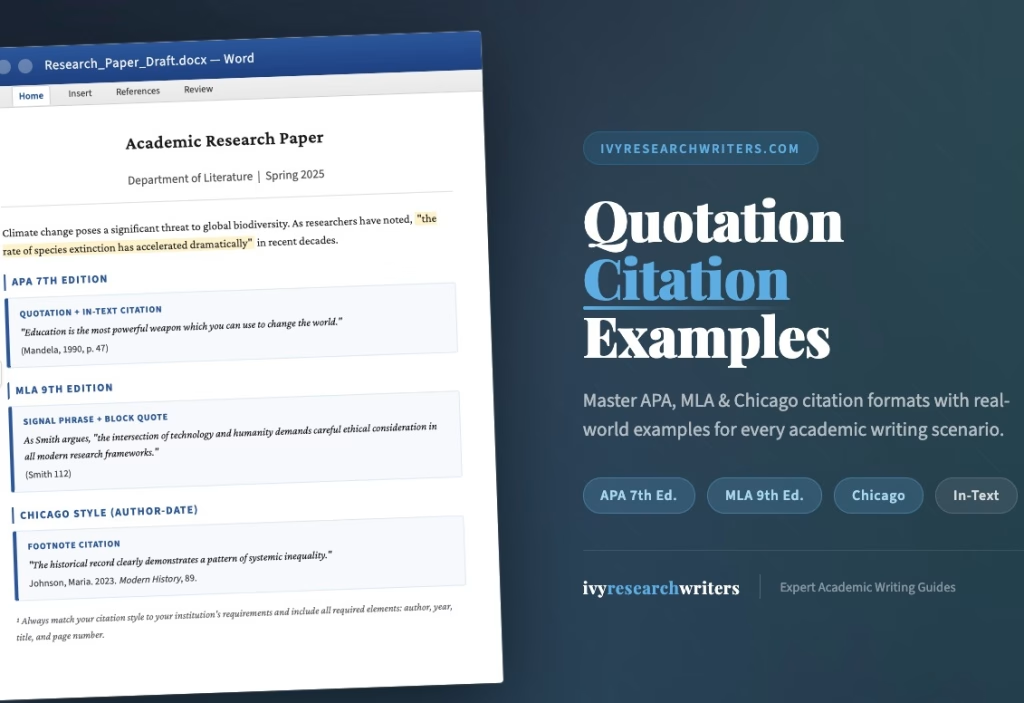
When writing research papers, knowing how to correctly cite a quotation is essential. Whether you are using APA style, MLA, or another citation style, properly formatted citations protect you from plagiarism and demonstrate academic credibility.
In this complete guide from IvyResearchWriters.com, you’ll learn:
- How to cite a direct quote
- How to format an APA in-text citation
- How to write narrative and parenthetical citations
- When to use a block quotation
- How to include page numbers
- When it’s best to paraphrase
Let’s break everything down clearly with examples.
What Is a Citation?
A citation is a reference to another source that gives credit to the original author. When quoting or paraphrasing another work, you must:
✔ Include the author
✔ Include the year of publication (APA)
✔ Include the page number when quoting directly
✔ Ensure sources that are cited appear in the reference list at the end
Every source cited in the text must appear in the reference list, and every entry in the reference list must be cited in the text.
APA Style: How to Cite a Direct Quotation
In APA style (7th edition, from the American Psychological Association), you must include:
- Author’s last name
- Year of publication
- Page number in parentheses
Short Direct Quote (Under 40 Words)
A short direct quotation (fewer than 40 words) should be:
- Enclosed in double quotation marks
- Followed by a parenthetical citation
Example (Parenthetical Citation)
“Academic integrity is essential for scholarly credibility” (Jones, 2020, p. 45).
Notice:
- Use double quotation marks
- Place the closing punctuation mark after the citation
- Include the page number
Narrative Citation Example
According to Jones (2020), “Academic integrity is essential for scholarly credibility” (p. 45).
This is called a narrative citation, because the phrase includes the author’s name in the sentence.
How to Introduce the Quotation (Signal Phrase)
It is good practice to introduce the quotation using a signal phrase.
Example:
According to Jones (2020), “Academic integrity is essential for scholarly credibility” (p. 45).
Or:
Jones (2020) argues that “academic integrity is essential for scholarly credibility” (p. 45).
A quotation with a signal phrase helps smoothly integrate quotations from sources into your text.
APA Block Quotation (40 Words or More)
If your direct quote is 40 words or more, use a block quotation.
Formatting Rules:
✔ Start the quotation on a new line
✔ Indent the entire quotation 0.5 inch from the left margin
✔ Do NOT use quotation marks
✔ Place the parenthetical citation after the closing punctuation
Example (Block Quotation):
Jones (2020) explains:
Academic integrity remains the foundation of scholarly writing. Students must understand how to correctly cite sources, paraphrase effectively, and maintain ethical research practices. Failure to do so can result in serious academic consequences. (p. 45)
In block quotation format:
- The quote appears as a free-standing block of typewritten lines
- Indent the first line of your paragraph normally, but indent the entire block
- The citation appears after the final punctuation mark
Including Page Numbers in APA
When quoting directly, always include the page number:
- Single page → (p. 45)
- Multiple pages → (pp. 45–47)
If no page numbers are available (e.g., website):
- Use paragraph number → (para. 3)
Paraphrase vs Direct Quote
A paraphrase restates an idea in your own words. It is often best to paraphrase instead of using an entire quotation.
Example of Paraphrase:
Jones (2020) emphasizes that ethical citation practices are central to academic credibility.
Notice:
- No quotation marks
- Page number optional (but encouraged)
- Author and year required
It is often best to paraphrase when referring to an idea rather than quoting word-for-word.
MLA Style: How to Cite a Direct Quote
In MLA, the format differs slightly.
Short Quote (MLA)
“Academic integrity is essential for scholarly credibility” (Jones 45).
Notice:
- No year included
- Only author’s last name and page number
- No comma between name and page
MLA Block Quotation
If quoting more than four lines in MLA:
✔ Start on a new line
✔ Indent one inch from the left margin
✔ Omit quotation marks
✔ Place citation after the closing punctuation
Using Ellipsis in Quotations
If you omit part of the original source:
Use an ellipsis (…) within the quotation.
Example:
“Academic integrity … remains essential for scholarly credibility” (Jones, 2020, p. 45).
Do not alter meaning when using ellipsis.
Common Quotation Citation Mistakes
❌ Forgetting the page number
❌ Missing year in APA
❌ Incorrect punctuation
❌ Not indenting block quotation
❌ Failing to include source in reference list
❌ Incorrect parenthetical citation
❌ Not including the author
Every source cited in the text must appear in the reference list at the end.
APA In-Text Citation Quick Guide
Parenthetical Citation:
(Author, Year, p. #)
Narrative Citation:
Author (Year) states… (p. #)
Block Quotation:
- 40 words or more
- Indent
- No quotation marks
- Citation after punctuation
Need Help Formatting Quotations?
Submit your draft today to IvyResearchWriters.com for expert citation review and submit your paper with confidence.
Why Correct Citation Matters
Correctly cite sources to:
✔ Avoid plagiarism
✔ Demonstrate research credibility
✔ Follow academic standards
✔ Strengthen research papers
Plagiarism occurs when you:
- Fail to cite the original source
- Use another source without credit
- Omit citation information
Reference List Requirements (APA)
Sources cited in the text must:
✔ Appear in the reference list
✔ Include author
✔ Include year
✔ Include full publication details
✔ Match in-text citation
Example Reference Entry:
Jones, M. (2020). Academic integrity in higher education. Academic Press.
When to Use Direct Quotes vs Paraphrase
Use a direct quotation when:
- The wording is powerful
- The phrase is unique
- The author’s language is precise
Use paraphrase when:
- Referring to an idea
- Summarizing multiple pages
- Avoiding overuse of quotations
Final Checklist for Quotation Citation
Before submitting your research paper:
✔ Did you include the author?
✔ Did you include the year (APA)?
✔ Did you include the page number?
✔ Did you use double quotation marks properly?
✔ Did you indent block quotations correctly?
✔ Did all cited sources appear in the reference list?
✔ Is punctuation correct?
| Feature | APA (7th Edition) | MLA (9th Edition) |
|---|---|---|
| Full Name | American Psychological Association | Modern Language Association |
| Commonly Used In | Psychology, Nursing, Education, Social Sciences | Literature, Humanities, Arts |
| In-Text Citation Format | (Author, Year, p. #) | (Author #) |
| Example In-Text Citation | (Smith, 2022, p. 45) | (Smith 45) |
| Narrative Citation Example | Smith (2022) states… | Smith states… (45) |
| Year Required in Text? | ✅ Yes | ❌ No |
| Page Number Required for Direct Quote? | ✅ Yes | ✅ Yes |
| Reference Page Title | References | Works Cited |
| Author Format (Reference Entry) | Last Name, First Initial. | Last Name, First Name. |
| Title Capitalization | Sentence case (capitalize first word only) | Title Case (Capitalize Major Words) |
| Italicize Book Titles? | Yes | Yes |
| Short Quote Format | Under 40 words in quotation marks | Under 4 lines in quotation marks |
| Block Quote Format | 40+ words; indent 0.5 inch; no quotation marks | 4+ lines; indent 1 inch; no quotation marks |
| Page Numbers in Citation | p. 45 or pp. 45–47 | 45 or 45–47 |
| Multiple Authors (2 authors) | (Smith & Jones, 2022) | (Smith and Jones 45) |
| Website Citation Includes URL? | Yes | Yes |
| DOI Included? | Yes, formatted as URL | Yes (if available) |
| Date Placement in Reference | After author (in parentheses) | After container, before URL |
| Use of “et al.” | 3+ authors (first citation onward) | 3+ authors (in-text only) |
| Running Head Required? | Student papers: No (usually) | No |
| Title Page Required? | Yes (for most papers) | Usually No (unless instructor requires) |
Need Help with Citation Formatting?
At IvyResearchWriters.com, we help students:
✔ Correctly cite sources in APA and MLA
✔ Format block quotations properly
✔ Fix in-text citation errors
✔ Edit research papers for citation accuracy
✔ Prevent plagiarism
✔ Ensure compliance with APA format
Whether you’re writing a thesis, dissertation, or undergraduate paper, we ensure your citations are flawless.
👉 Order professional citation review and formatting support today at IvyResearchWriters.com and submit your paper with confidence.
Frequently Asked Questions
How to cite a quotation example?
Citing a quotation properly depends on the citation style (e.g., APA or MLA), but the core rule is simple: whenever you use someone else’s exact words, you must cite the source.
Basic APA Example (Short Quotation)
“Academic writing requires careful citation practices” (Jones, 2020, p. 45).
Notice:
- The quote is enclosed in quotation marks.
- The citation appears in parentheses after the quotation.
- The citation includes the last name and the year.
- You must place the page number for a direct quote.
Narrative Citation Example
According to Jones (2020), “Academic writing requires careful citation practices” (p. 45).
Here:
- A signal phrase that includes the author’s name introduces the quote.
- The author’s last name followed by the date of publication appears earlier in the sentence.
- The page number still appears in parentheses after the quotation.
MLA Example
“Academic writing requires careful citation practices” (Jones 45).
In MLA:
- No year is included.
- Only the author’s last name and page number appear.
- If quoting from multiple pages, include a page range (e.g., Jones 45–47).
If you’re unsure how to format citations correctly, a professional citation guide or the expert editors at IvyResearchWriters.com can ensure your paper is accurate and properly formatted.
What is a quotation citation?
A quotation citation is a reference that identifies the source of a direct quote used in academic writing.
It tells readers:
✔ Who said it (author’s last name)
✔ When it was published (date of publication in parentheses, APA)
✔ Where it appears (page number or page range)
In academic writing, every quotation must:
- Be properly enclosed in quotation marks (for short quotes)
- Include citation details
- Match an entry in the reference list
Quotations must be cited whether using a parenthetical or narrative format.
Failure to cite the source can result in plagiarism.
When to use 1 or 2 quotation marks?
In American academic writing:
🔹 Use Double Quotation Marks (” “)
For:
- Short direct quotes
- Words taken exactly from another source
- Quotation examples in APA and MLA
Example:
“Research integrity is fundamental” (Smith, 2022, p. 10).
🔹 Use Single Quotation Marks (‘ ‘) Inside a Quote
Single quotation marks are used when quoting material within a quotation.
Example:
Smith (2022) explains, “The term ‘academic integrity’ refers to ethical scholarship” (p. 10).
🔹 Do NOT Use Quotation Marks for Block Quotes
If a quotation is long (APA: 40 words or more):
- Start it on a new line
- Indent the entire quote
- Use typewritten lines and omit quotation marks
- Place the citation after the final punctuation
This format creates a free-standing block of text.
What is an example of a quotation?
Here are several examples across formats:
Example 1: Short APA Quotation
“Students must understand how to cite sources correctly” (Brown, 2021, p. 22).
Example 2: Narrative Citation
Brown (2021) states that “students must understand how to cite sources correctly” (p. 22).
This includes a phrase that includes the author’s name in the sentence.
Example 3: Block Quotation (APA)
Brown (2021) explains:
Academic writing requires careful attention to citation. Students must ensure that every quotation is properly referenced. Failure to cite sources can undermine academic credibility. (pp. 22–23)
Notice:
- The quotation appears as lines and omit quotation marks.
- The citation is placed after the punctuation.
- A page range is used for multiple pages.
Quick Citation Reminders
Before submitting your paper, confirm:
✔ Is the quote enclosed in quotation marks (for short quotes)?
✔ Did you include the author’s last name?
✔ Did you include the date (APA)?
✔ Did you place the page number correctly?
✔ Did you use parentheses after the quotation?
✔ Does the source appear in your reference list?
Reliable research guides (e.g., Purdue OWL) provide general instructions, but if you need precise formatting review, IvyResearchWriters.com ensures complete citation accuracy.
Why Correct Quotation Citation Matters
Correct citation:
- Protects you from plagiarism
- Strengthens academic credibility
- Demonstrates research integrity
- Helps readers locate the original source
Whether you’re using APA, MLA, or another format, proper citation is essential.

