

Operant Conditioning Examples: Clear Definitions, Real-Life Applications, and Reinforcement Explained
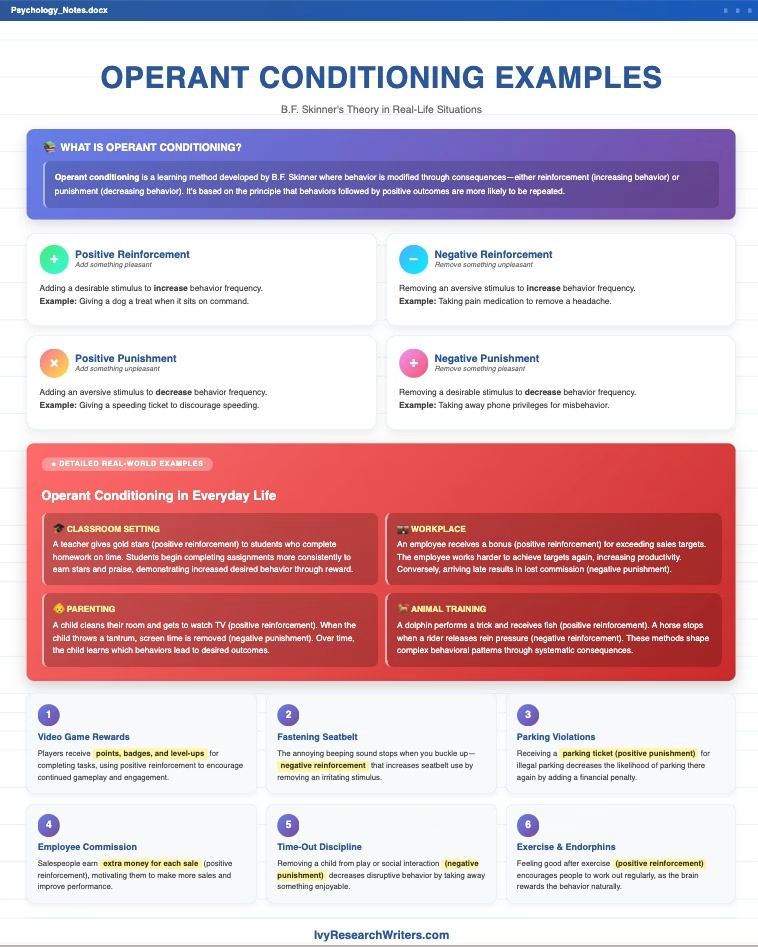
If you’ve ever trained a pet, rewarded a child for good grades, or been fined for speeding, you’ve seen operant conditioning in action. In behavioral psychology, operant conditioning explains how rewards and consequences shape behavior over time.
In this comprehensive guide, we’ll break down operant conditioning examples, define key terms like positive reinforcement and punishment, explore research by psychologist B.F. Skinner, and explain how reinforcement schedules influence the likelihood of that behavior happening again.
Operant Conditioning: Definition and Core Principles
Operant conditioning is a learning process in which behavior is shaped by its consequences. Also known as instrumental conditioning, it focuses on how voluntary behaviors are strengthened or weakened over time.
Operant conditioning was first described through the law of effect by psychologist Edward Thorndike, who proposed that behaviors followed by satisfying consequences are more likely to repeat. Later, psychologist B.F. Skinner expanded this work and developed what became known as Skinnerian conditioning.
At its core:
- Behavior is influenced by consequences
- Reinforcement increases behavior
- Punishment decreases behavior
- Behavior is strengthened or made less likely to repeat depending on outcomes
Understanding operant conditioning helps explain behavior change in humans and animals.
Classical Conditioning vs Operant Conditioning
Before diving into operant conditioning examples, it’s helpful to distinguish it from classical conditioning.
- Classical conditioning involves associative learning between two stimuli (e.g., Pavlov’s dogs salivating at a bell).
- Operant conditioning relies on consequences following behavior.
In classical conditioning, a stimulus triggers an automatic response.
In operant conditioning, behavior is shaped by reinforcement or punishment.
Positive Reinforcement: Encouraging Desired Behavior
Positive reinforcement involves adding a pleasant stimulus to increase the likelihood of a behavior.
A positive reinforcer is something rewarding that strengthens a specific behavior.
Example of Positive Reinforcement
- You give a dog a treat when it sits.
- The dog gets a treat.
- Sitting behavior increases.
In this case:
- Reinforcement occurs because the reward increases the likelihood of that behavior happening again.
Other real-life examples include:
- A student earns praise for completing homework.
- An employee receives a bonus for meeting targets.
- A child earns extra screen time for good behavior.
Positive reinforcement to encourage desired behavior is widely used in education, parenting, and workplace management.
Negative Reinforcement: Removing an Unpleasant Stimulus
Negative reinforcement increases behavior by removing an unpleasant stimulus.
Many people confuse negative reinforcement with punishment. However:
- Negative reinforcement increases behavior.
- Punishment decreases behavior.
Example of Negative Reinforcement
- You buckle your seatbelt.
- The car’s annoying alarm stops.
- Buckling behavior increases.
Here, reinforcement occurs because taking away an aversive stimulus strengthens the target behavior.
Another example of negative reinforcement:
- A student studies to avoid parental criticism.
- Studying increases because criticism (an unpleasant stimulus) is removed.
Need Help With Your Psychology Assignment?
Order your custom psychology paper today and submit with confidence.
Punishment: Decreasing Behavior
Punishment aims to decrease a behavior.
There are two types:
Positive Punishment
Adding an unpleasant stimulus to decrease behavior.
Example of punishment:
- A child talks back and receives a time-out.
- The unpleasant consequence decreases the behavior.
Negative Punishment
Taking away something desirable to decrease behavior.
Example of negative punishment:
- Loss of privileges (e.g., losing phone access).
- Behavior decreases because a valued reinforcer is removed.
Punishment makes behavior less likely to repeat.
Operant Conditioning Examples in Everyday Life
Operant conditioning is widely used in real-world settings.
1️⃣ Training Animals
- You train your dog to sit.
- When it sits, you give a treat.
- Behavior increases.
Skinner conducted research using a rat or pigeon inside an operant conditioning chamber, also called a Skinner box. In these experiments:
- A rat would press a lever.
- It received food.
- Lever pressing increased.
This demonstrated the principles of operant conditioning.
2️⃣ Parenting
- Positive reinforcement: Praise for good behavior.
- Negative punishment: Removing screen time.
3️⃣ Workplace Motivation
- Bonuses reinforce productivity.
- Pay cuts serve as punishment.
4️⃣ Education
- Teachers use positive reinforcement to encourage participation.
- Detention serves as punishment.
Reinforcement Schedule: Timing and Frequency Matter
A reinforcement schedule determines how often reinforcement occurs.
Schedules of Reinforcement
There are several different schedules of reinforcement:
- Fixed ratio (after a set number of responses)
- Variable ratio (after varying number of responses)
- Fixed interval (after fixed time period)
- Variable interval (after varying time periods)
Interval Reinforcement Schedules
Interval reinforcement schedules depend on time.
The frequency of reinforcement and rate of reinforcement influence how quickly behavior increases.
For example:
- A paycheck (fixed interval schedule)
- Slot machines (variable ratio schedule)
Research on operant conditioning shows that variable schedules often produce stronger and more persistent behaviors.
Reinforcement and Punishment: Positive and Negative Explained
In operant conditioning:
- Positive means adding something.
- Negative means removing something.
This does not mean good or bad.
Summary Table
| Type | Adds or Removes | Effect |
|---|---|---|
| Positive Reinforcement | Adds reward | Behavior increases |
| Negative Reinforcement | Removes unpleasant stimulus | Behavior increases |
| Positive Punishment | Adds unpleasant stimulus | Behavior decreases |
| Negative Punishment | Takes away reward | Behavior decreases |
Understanding operant conditioning requires distinguishing between positive and negative reinforcement and punishment.
Principles of Operant Conditioning
Operant conditioning principles include:
- Behavior is shaped by its consequences.
- Reinforcement increases frequency.
- Punishment decreases frequency.
- Timing and consistency matter.
- Behavior change occurs gradually.
Behavior happening repeatedly is shaped through reinforcement.
Applications of Operant Conditioning
Operant conditioning plays a crucial role in:
- Behavioral therapy
- Classroom management
- Parenting strategies
- Workplace motivation
- Animal training
Operant conditioning helps modify behavior effectively.
Behavioral psychology relies heavily on these principles for understanding how behavior is influenced by consequences.
Common Exam Questions on Operant Conditioning
Multiple-Choice Questions
- Which of the following is an example of positive reinforcement?
a. Taking away recess for misbehavior
b. Giving a bonus for meeting a sales target
c. Scolding a child for talking back
d. Assigning extra homework as punishment - Negative reinforcement involves:
a. Adding a pleasant stimulus to increase behavior
b. Removing an unpleasant stimulus to increase behavior
c. Adding an unpleasant stimulus to decrease behavior
d. Removing a pleasant stimulus to decrease behavior - Which reinforcement schedule produces the highest and most consistent response rate?
a. Fixed Ratio
b. Variable Ratio
c. Fixed Interval
d. Continuous Reinforcement - B.F. Skinner conducted many of his operant conditioning experiments using:
a. Thorndike’s Puzzle Box
b. Pavlov’s Chamber
c. The Operant Conditioning Chamber (Skinner Box)
d. Watson’s Behavior Booth - Which of the following is an example of negative punishment?
a. Giving detention
b. Removing a teenager’s phone privileges
c. Praising a student
d. Giving a treat to a dog
Short-Answer Questions
- Define operant conditioning in your own words.
- Explain the difference between positive reinforcement and negative reinforcement.
- Describe the Law of Effect and how it relates to operant conditioning.
- Provide a classroom example of positive reinforcement.
- Provide an example of negative punishment in parenting.
Application-Based Questions
- A student studies hard to avoid parental criticism.
- Is this reinforcement or punishment?
- Is it positive or negative? Explain.
- A company gives employees bonuses for meeting monthly goals.
- What type of conditioning is this?
- Why does it increase performance?
- A driver wears a seatbelt to stop an annoying alarm.
- What type of reinforcement is occurring?
Essay Questions
- Compare and contrast operant conditioning and classical conditioning.
- Discuss how reinforcement schedules affect the strength and persistence of behavior.
- Evaluate the advantages and limitations of using punishment to modify behavior.
- Explain how operant conditioning principles are used in modern education or workplace management.
Higher-Level (Analytical) Questions
- Why is variable ratio reinforcement considered highly resistant to extinction?
- How might overreliance on external reinforcement impact intrinsic motivation?
- Critically assess the role of operant conditioning in contemporary behavioral therapy.
Understanding Operant Conditioning in Modern Psychology
“Operant conditioning” remains foundational in behavioral psychology. It explains how behavior is strengthened or weakened through reinforcement and punishment.
Whether training a dog, motivating employees, or designing educational programs, operant conditioning techniques continue to shape modern learning systems.
Operant conditioning is one of the most influential theories in psychology because it demonstrates that behavior change is predictable when shaped by consistent consequences.
Final Thoughts
Operant conditioning explains how rewards and consequences shape behavior. Through positive or negative reinforcement, or through punishment, behavior is influenced by outcomes.
From the pigeon in the Skinner box to everyday parenting strategies, operant conditioning is widely used and deeply embedded in how we understand learning.
Mastering the principles of operant conditioning helps clarify how behavior increases, decreases, and adapts over time.
Need Help With a Psychology Essay?
If you’re writing about:
- Operant conditioning examples
- Classical vs operant conditioning
- Reinforcement schedules
- Behavioral psychology theories
- Research on Skinner and Thorndike
IvyResearchWriters.com offers:
✔ Expert psychology writers
✔ Clear definitions and structured examples
✔ APA, MLA, Chicago formatting
✔ Undergraduate to PhD-level support
👉 Order your custom psychology paper today at IvyResearchWriters.com and submit with confidence.
Frequently Asked Questions
What are some operant conditioning examples?
“Operant conditioning” refers to a learning process where behavior is shaped by consequences. A clear example of operant conditioning involves rewards or penalties that influence whether a behavior increases or decreases.
Here are some common examples:
- Training a dog: You give a dog a treat when it sits. The dog repeats the behavior. This is known as an operant conditioning process because the reward reinforces the action.
- Workplace bonuses: Employees receive financial incentives for meeting performance goals.
- Speeding ticket: A driver receives a fine for speeding. The negative consequences make them less likely to repeat the behavior.
- Homework rewards: A child earns extra screen time for completing assignments.
In each case, behavior is influenced by consequences. Operant conditioning is used widely in everyday life—even if people do not consciously recognize it.
At IvyResearchWriters.com, we help students clearly explain such examples in academic essays using accurate terminology and structured analysis.
What are the 4 types of operant conditioning?
There are four primary types of operant conditioning, based on reinforcement or punishment and whether something is added or removed.
1️⃣ Positive Reinforcement
- Adding a reward to increase behavior.
- Example: A student earns praise for good grades.
2️⃣ Negative Reinforcement
- Removing something unpleasant to increase behavior.
- Example: Doing chores to avoid parental criticism.
3️⃣ Positive Punishment
- Adding an unpleasant stimulus to decrease behavior.
- Example: Receiving detention for disruptive behavior.
4️⃣ Negative Punishment
- Taking away something desirable to decrease behavior.
- Example: Loss of phone privileges.
The key distinction lies between reinforcement and punishment, and between positive and negative punishment. “Positive” means adding something; “negative” means removing something.
Understanding these categories is essential in psychology coursework, and IvyResearchWriters.com ensures students articulate them correctly in research papers and exams.
Which is a good example of operant conditioning in the classroom?
A good classroom example of operant conditioning involves structured rewards and consequences.
For example:
- A teacher gives participation points for raising hands before speaking.
- Students earn extra credit for completing assignments on time.
- Conversely, students may lose privileges if they disrupt class.
These are examples of operant conditioning because behavior is shaped by reinforcement or punishment.
In classroom settings:
- Positive reinforcement increases engagement.
- Negative consequences decrease disruptive behavior.
- Timing and frequency of reinforcement strongly influence effectiveness.
Educators carefully manage the timing and frequency of reinforcement to ensure that desired behaviors become consistent.
If you need help crafting classroom-based psychology examples in academic format, IvyResearchWriters.com can provide clear, well-structured explanations.
How is operant conditioning used today?
Operant conditioning is used in many modern settings beyond the classroom.
1️⃣ Parenting
Parents use rewards and consequences to guide children’s behavior.
2️⃣ Animal Training
Professionals use operant conditioning to teach animals specific behaviors through treats and cues.
3️⃣ Workplace Management
Employers provide bonuses or performance reviews to encourage productivity.
4️⃣ Behavioral Therapy
Psychologists use operant conditioning techniques to support behavior change.
Operant conditioning is used because it explains how behavior is strengthened or weakened based on consequences. The principles remain foundational in behavioral psychology.
Moreover, the effectiveness of operant conditioning depends on the timing and frequency of reinforcement. When reinforcement is consistent and immediate, behavior change is more likely to occur.

