

Hasty Generalization Examples: A Practical Guide to Spotting (and Fixing) This Common Logical Fallacy
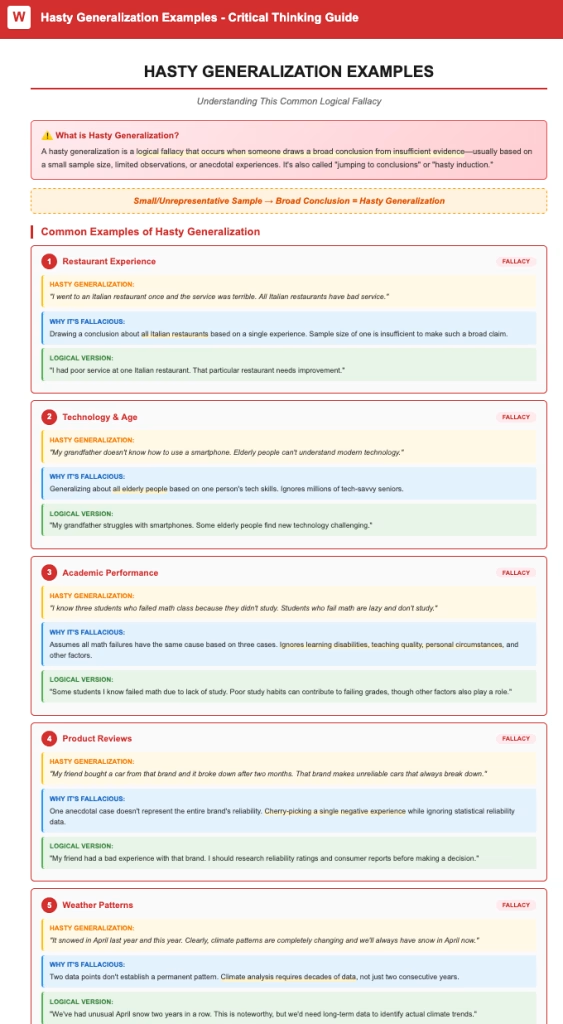
If you are searching for hasty generalization examples, you are probably writing an essay, preparing a debate, or trying to strengthen your argumentation. This topic matters because a hasty generalization can make an argument sound persuasive at first—yet collapse under scrutiny once you examine the evidence.
A hasty generalization is a logical fallacy (specifically one of the informal fallacies) where someone draws a broad conclusion from too little or biased information. In simple terms, it is a faulty generalization—an erroneous leap from a few cases to an “always” or “everyone” claim. Below, you will learn the definition, see clear hasty generalization examples, understand how the fallacy works, and learn how to avoid it in academic writing.
Understanding the hasty generalization fallacy: Why this fallacy matters in critical thinking and argumentation
A hasty generalization fallacy occurs when an argument makes a broad claim about an entire population based on an insufficient sample, small samples, or limited evidence. In most cases, it is conclusion based on insufficient evidence—meaning the conclusion goes beyond what the facts can support.
This fallacy is “informal” because the problem is not the structure of a formal syllogism; the problem is the quality of evidence and inference. In practical terms:
- The argument is based on a sample that is too small or not representative.
- The conclusion is based on too small a dataset—often a small sample size.
- The reasoning is inductive, but the induction is weak.
- It frequently involves bias or sampling bias (for example, only asking one type of person in a poll).
This is why the hasty generalization fallacy matter: it can produce unfair conclusions, poor decisions, and stereotypes.
How the fallacy works: hasty generalization fallacy work, fallacy occurs when an argument jumps from small sample to broad conclusion
To explain how the fallacy works, it helps to show the typical pattern. The hasty generalization usually follows this formula:
- Observe a few cases (often an isolated incident or two).
- Treat those cases as if they represent the whole group.
- Infer a general rule about the group.
- Present the claim as if it has sufficient evidence.
In other words, the fallacy occurs (and more specifically, fallacy occurs when an argument makes a leap) from “some” to “all.”
This is also called:
- called overgeneralization or overgeneralization
- argument from small numbers
- a type of hasty generalization known as generalize from a small sample
Even if the cases are true, the reasoning is still faulty when the evidence is not enough to support the broad claim.
Want your fallacies section to sound sharp, academic, and easy to grade?
You will get a clean paragraph set (definitions + examples + fixes) that you can paste into your essay or speech outline—without weak reasoning.
What makes evidence insufficient: Sample size, unrepresentative sample, and sampling bias
Many students know they need “evidence,” but they are not sure what makes evidence strong. Here are the most common evidence problems that create hasty generalization fallacies.
Small sample size and insufficient sample
A claim becomes fallacious when it is based on an inadequate amount of information—like interviewing three people and assuming the whole city thinks the same way. A small of a sample cannot reliably represent the entire population, especially when the population is diverse.
Example:
- “I asked two classmates and they both hate statistics, so students hate statistics.”
This is a conclusion based on an insufficient sample and small a sample size.
Unrepresentative sample and random sampling problems
Even a larger sample can be poor if it is not random and representative. A sample drawn from one setting can misrepresent a wider group.
Example:
- If you run a poll about national politics but only ask people leaving one rally, you likely have an unrepresentative sample.
Sampling bias
Sampling bias occurs when the method of sampling systematically selects some people and excludes others. This makes the result erroneous and can still produce generalizations based on skewed data.
Example:
- Surveying only night-shift workers about “work-life balance” will distort results if you claim it represents all employees.
Hasty generalization examples: Everyday, academic, and workplace scenarios (with quick fixes)
Below are strong examples of the hasty generalization you can use in essays, presentations, and logic assignments. Each includes a brief fix showing what “good reasoning” would look like.
1) Everyday example (from an isolated incident)
Claim: “I had one bad meal at that restaurant. The food there is always terrible.”
- Problem: generalize from an isolated incident; based on limited evidence.
- Fix: “I had a bad experience once, but I would need more visits or reviews to judge overall quality.”
2) Student-life example (argument from small numbers)
Claim: “Two people in my dorm were rude, so everyone in this dorm is rude.”
- Problem: based on too small a sample; small samples cannot represent everyone.
- Fix: “Some people I met were rude, but I cannot generalize to the whole dorm.”
3) Stereotype-based example (leads to stereotyping)
Claim: “One teenager shoplifted, so teenagers are criminals.”
- Problem: lead to stereotyping; conclusion based on insufficient evidence.
- Fix: “One case does not justify a claim about all teenagers; crime varies by many factors.”
4) Academic writing example (weak research inference)
Claim: “A study of 12 participants proves this method works for all adults.”
- Problem: small sample size; may be unrepresentative sample; lacks population based evidence.
- Fix: “The findings suggest a trend, but larger, diverse samples are needed before making broad claims.”
5) Workplace example (unrepresentative sample)
Claim: “I talked to three customers today and they complained, so customers are unhappy with our company.”
- Problem: insufficient sample; possible sampling bias (only those who spoke up).
- Fix: “We need broader customer feedback data across locations and time periods.”
6) Social media example (anecdotal evidence)
Claim: “I saw two viral posts about a product failing. That brand is unreliable.”
- Problem: relies on anecdotal evidence; not random and representative.
- Fix: “Viral posts are not reliable sampling; check product defect rates, reviews across platforms, and recall records.”
7) Public opinion example (poll misuse)
Claim: “This online poll shows most people support the policy.”
- Problem: online polls often have self-selection bias; not random sampling; likely unrepresentative sample.
- Fix: “Use probability sampling or reputable surveys and report margins of error.”
Why hasty generalization is unreasonable: Induction, inference, and the difference between a hypothesis and a general rule
Most hasty generalizations are problems with induction. Inductive reasoning can be valid and useful, but only when the evidence is strong. The fallacy appears when:
- the conclusion is based on an inadequate evidence base,
- the claim is stronger than what the data can support,
- the inference tries to become a general rule too quickly.
A good academic move is to convert a general claim into a cautious hypothesis:
- Weak: “X causes Y in everyone.”
- Stronger: “In this sample, X is associated with Y; further research is needed.”
That is how you keep your argument logically sound while still discussing patterns.
Avoid a hasty generalization: A checklist for students and writers
If you want to avoid a hasty generalization, use this quick checklist:
- What is the sample size? Is it based on too small a number?
- Is the sample representative? Or is it an unrepresentative sample?
- How was it selected? Watch for sampling bias.
- Is the evidence anecdotal? Anecdotal evidence is not enough for broad claims.
- Does the conclusion match the evidence? Or is it a broad conclusion that goes beyond what the data supports?
- Are you generalizing to an entire population? If yes, you need stronger evidence.
- Can you rephrase the claim more cautiously? Use “may,” “in this context,” “suggests,” or “in this sample.”
These steps strengthen critical thinking and make your writing more defensible.
Hasty generalization and bias: How faulty generalization can lead to stereotypes and erroneous beliefs
Hasty generalization is closely tied to bias, because people often notice evidence that confirms their existing beliefs and ignore evidence that contradicts them. This is why generalizations based on limited personal experiences can become stereotypes. Stereotypes are often supported by vivid anecdotes, not by representative data.
When you see claims that “all” members of a group behave a certain way, you should immediately ask:
- What evidence supports this?
- Is it representative?
- Is the conclusion logically warranted?
If not, the claim is likely fallacious and potentially harmful.
Quick summary: The core idea behind hasty generalization fallacies
A hasty generalization fallacy involves drawing a broad conclusion about an entire population from insufficient or biased evidence. It is a logical fallacy because the conclusion is not justified by the data. It is “informal” because the error is in the content and evidence, not in a strict formal structure.
Finally on hasty generalization fallacy matter
If you are writing an essay on logic, reasoning, critical thinking, or informal fallacies and want a strong, well-structured draft with clean examples and high-level analysis:
Visit IvyResearchWriters.com and message: “HASTY GENERALIZATION HELP.”
You will get a polished, ready-to-submit write-up with strong argumentation, clear definitions, and example-driven explanations that meet academic standards.
Frequently Asked Questions
1) What is an example of a hasty generalization?
A clear example is when someone draw conclusions about a whole group from a tiny, limited experience—meaning the claim is based on a hasty generalization and lacks enough evidence to support the conclusion.
Example (simple):
- “I met two rude cashiers at that store, so the store hires rude people.”
Why it is hasty: it tries to make claims about the entire business based on too few observations and without evidence that supports a broad conclusion.
2) What is an example of a hasty generalization in a speech?
In speeches, this fallacy often shows up as persuasive, emotional language that uses one story as proof of a general rule—often examples without representative data.
Example (speech-style):
- “Last week I spoke to three local parents who said the school is failing. That proves our schools are failing across the entire district.”
Why it is hasty: the speaker is trying to draw conclusions about a whole district from a few anecdotes, without evidence to support district-wide claims or evidence that supports generalization.
3) What is an example of generalization argument?
A generalization argument is not always wrong. It becomes weak only when the evidence is inadequate. A strong generalization uses sufficient, representative data; a weak one is based on a hasty generalization.
Weak generalization argument (problematic):
- “I saw two teens vandalize property, so teenagers are irresponsible.”
This tries to make claims about an entire age group with minimal evidence to support it.
Stronger generalization argument (better):
- “In a large, representative survey, most respondents reported X; therefore, it is reasonable to infer X is common in the population.”
This relies on evidence that supports the inference rather than anecdotes.
4) Which words often appear in hasty generalizations?
Hasty generalizations often use “absolute” words that sound confident—especially when the speaker is using examples without data to back them up.
Common trigger words/phrases:
- “All,” “always,” “everyone,” “no one,” “never”
- “Every time,” “everybody knows,” “the whole group”
- “Most” (when there is no data to justify it)
- “Proves,” “clearly,” “obviously” (signals overconfidence without evidence to support)
When you see these, pause and ask: What evidence to support this? Does the speaker have evidence that supports the claim, or are they trying to draw conclusions from a few stories?

