

Literature Synthesis Example: How to Synthesize Sources in a Literature Review (With a Synthesis Matrix Template)
A strong literature review is not a stack of summaries. It is a literature synthesis: you synthesize (or synthesise) information from various sources to create an argument about the state of knowledge on a research topic. If you are writing a thesis, dissertation, or PhD proposal, your evaluator is looking for evidence that you can analyze, evaluate, and combine findings across studies—not just report what each source said.
This guide explains what synthesis is, provides a clear literature synthesis example, shows how to build a synthesis matrix (a matrix/worksheet), and demonstrates how to turn notes into a high-quality synthesis paragraph with correct citation practices (including APA style).
What “synthesis” means in academic writing and why synthesis is an important skill
Synthesis in academic writing means integrating ideas from multiple studies to explain patterns, relationships, disagreements, and gaps. When you synthesize sources, you:
- identify common themes and similarity across studies
- highlight disagreement and explain why results differ (methods, samples, variables, context)
- evaluate study quality (methodological strengths/limitations)
- combine evidence to support an argument that answers your research question
- draw a conclusion about what is known, what is uncertain, and what needs more research
In other words, synthesis is an important move from “I read sources” to “I understand and can explain the research landscape.”
Synthesize vs summarize: the difference that changes your grade
A summary tells the main points of each source.
A synthesis weaves together various sources to show the relationships between sources.
Summarize (source-by-source):
- Source A found X.
- Source B found Y.
- Source C found Z.
Synthesize (theme-by-theme):
- Across different sources, X appears consistent, but Y differs depending on context and methodological choices, suggesting variable effects and potential outliers.
If you are trying to write a literature review for higher education standards, you need synthesis—not a collection of mini book reports.
The role of the research question: your synthesis should answer something
Synthesis becomes much easier when you anchor everything to a research question. A research question acts like a filter: it helps you decide what is relevant information, what to extract, and what to leave out.
Example research question:
- How does social media use relate to perceived social isolation among young adults?
With a clear idea of the question, you can group studies by main ideas, variables, theory, and results.
How to create an overview and outline for a literature synthesis
Before writing paragraphs, create an overview and an outline that organizes sources by themes rather than by author.
A simple synthesis outline might look like:
- Conceptual background (theoretical frameworks)
- Key empirical findings (what the evidence shows)
- Disagreement and methodological explanations
- Gaps, outliers, and future directions
- Conclusion linking evidence to your thesis argument
This outline helps your lit review read like a coherent essay rather than a list of sources in order.
The synthesis matrix: the best tool to keep track of sources and themes
A synthesis matrix is a table (matrix) that helps you:
- keep track of what each source contributes
- compare findings across different sources
- spot similarity, disagreement, outliers, and methodological patterns
- plan your synthesis paragraphs
Think of it as a worksheet for integration.
Synthesis matrix example (structure)
Use a table with sources as rows and themes as columns—or vice versa. The goal is to organize main ideas and evidence fast.
Option A: Sources as rows, themes as columns
| Source | Research design / methodological notes | Sample / context | Key finding | Theme 1: relationship strength | Theme 2: mechanism / theory | Theme 3: limitations / outliers |
|---|---|---|---|---|---|---|
| Source 1 | empirical / statistical | young adults | isolation ↑ with use | supports association | social comparison | cross-sectional |
| Source 2 | qualitative | university students | mixed effects | conditional | identity & belonging | self-report bias |
| Source 3 | conceptual | general | explains pathways | n/a | theoretical model | not empirical |
Option B: Themes as rows, sources as columns
| Theme | Source A | Source B | Source C | What you conclude |
|---|---|---|---|---|
| Association | supports | supports | mixed | overall positive association |
| Mechanism | social comparison | displacement | mixed | multiple pathways likely |
| Limitations | cross-sectional | small sample | measurement issues | explains disagreement |
Either matrix format helps you move beyond “sources in conversation” into synthesis.
Step-by-step: how to synthesize sources using a matrix
Here is a practical workflow you can follow for any research paper, thesis, dissertation, or PhD chapter:
- Collect sources from your library databases (journal articles, recent research, scholarly books, credible reports).
- Take notes using consistent fields: research topic, variables, method, findings, limitations, theory.
- Extract key phrases or results (not long quotes) and record them in your synthesis matrix.
- Group studies by theme (not by publication date).
- Evaluate quality: identify methodological differences that might explain disagreement.
- Combine evidence to write synthesis paragraphs that answer the research question.
- Cite correctly using your citation style (for example, APA).
- Draft a mini conclusion for each theme, then link themes into your overall thesis argument.
Literature synthesis example: a worked mini-synthesis across different sources
Below is an example of synthesis showing how to integrate different sources into one paragraph. This example is written in APA-style in-text citation format, but you should adjust it to your required citation style.
Example synthesis paragraph (theme-based, not source-by-source)
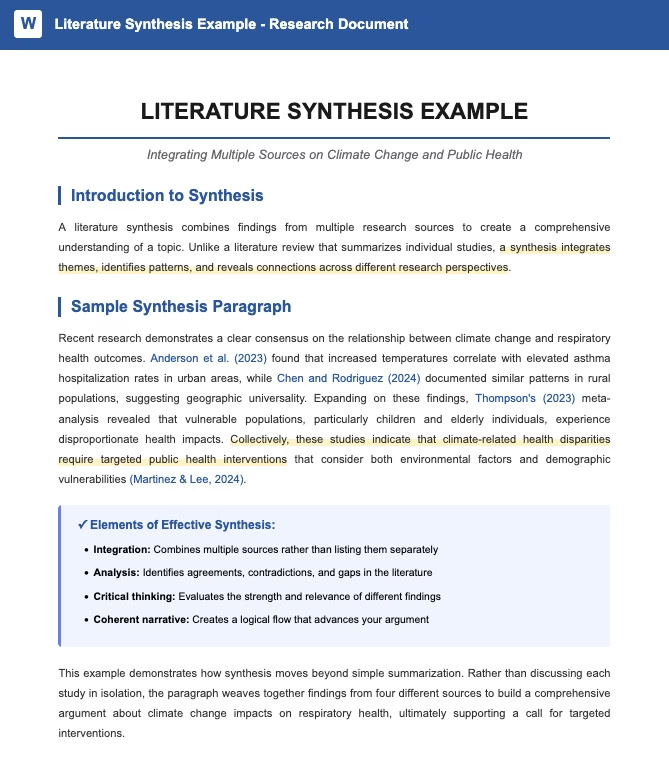
Across empirical studies, social media use is frequently associated with higher perceived social isolation among young adults, although the strength of the relationship varies by platform, measurement strategy, and user motivations. Several studies suggest that passive consumption (scrolling without interaction) may amplify social comparison processes, which can increase feelings of exclusion, while active, supportive interaction can buffer negative effects by reinforcing belonging.
The disagreement across findings appears partly methodological: cross-sectional designs cannot clarify directionality, and self-report measures may misestimate actual time spent on social platforms. Taken together, the evidence indicates a conditional relationship in which outcomes depend on how and why individuals engage online, highlighting the need for future research that combines behavioral data with theory-driven models of identity and social connection.
Why this counts as synthesis:
- It weaves across sources.
- It states commonality (association shows up frequently).
- It addresses disagreement and explains why (methodological factors).
- It draws a conclusion and points to future research.
Need a literature synthesis that reads like a top-grade literature review—not a list of summaries?
At IvyResearchWriters.com, we help you build a synthesis matrix, group sources by themes, write critically integrated synthesis paragraphs, and format everything with accurate in-text citations and a clean reference list.
Example of synthesis using “they agree / they disagree” language
A helpful technique is to explicitly show relationships:
- Similarity: “Multiple studies agree that…”
- Disagreement: “However, others report…”
- Clarify: “This difference may be explained by…”
- Conclusion: “Overall, the state of knowledge suggests…”
This makes your literature synthesis easier to read and more persuasive.
Synthesizing sources in a literature review: how to write paragraph by paragraph
A strong synthesis paragraph often follows this pattern:
- Topic sentence (theme + claim)
- Evidence from various sources (2–4 citations, paraphrased)
- Analysis (your interpretation: why the findings matter)
- Evaluation (limitations, methodological issues, outliers)
- Mini-conclusion (what the theme means for the thesis / research question)
This structure avoids the common trap of writing “main points of each source” without integration.
Dealing with disagreement, outliers, and methodological differences
Disagreement is not a weakness—it is an opportunity to show critical thinking.
When sources disagree, consider:
- different populations or contexts
- different variables or measurements
- different research designs (qualitative vs statistical studies)
- timing (older vs recent research)
- theory differences (conceptual framing)
An outlier study can be valuable if you explain why it differs and what it reveals about boundaries of the phenomenon.
How to cite and keep track of sources: bibliography and citation tips
Synthesis requires careful source management so you do not lose track.
Best practices:
- Use a reference manager (Zotero, Mendeley) or a simple spreadsheet “generator-like” tracker.
- Record the full citation immediately (author, year, title, journal).
- Keep page numbers for any direct quotes.
- Stick to a consistent citation style (for example, APA) from day one.
- Build your bibliography as you read, not after writing.
This reduces errors and makes dissertation and thesis writing far faster.
Common mistakes in literature synthesis (and how to fix them)
Mistake 1: Writing sources in order (Source A, then Source B…)
Fix: write by themes and show relationships between sources.
Mistake 2: Too much summary, not enough analysis
Fix: after each claim, add “why this matters” and “what explains differences.”
Mistake 3: No connection to the research question
Fix: end paragraphs with a sentence that links back to the research question.
Mistake 4: Weak integration
Fix: use explicit connective language (similarly, however, in contrast, collectively).
Literature Synthesis Example
Topic: Social Media Use and Mental Health Outcomes Among Young Adults
Working Research Question: How is social media use associated with mental health outcomes (for example, depression, anxiety, and perceived social isolation) among young adults?
Mini Synthesis Matrix (Codes → Themes → Evidence Quotes)
| Codes (from sources) | Theme | Evidence quotes (short excerpts) |
|---|---|---|
| Passive use, social comparison, reduced belonging | Passive engagement can increase social comparison and isolation risk | “passive social media use… may increase social comparison” (Verduyn et al., 2017, p. 276); “perceived social isolation” linked with higher social media use (Primack et al., 2017, p. 6) |
| Active use, supportive interaction, connection | Active/social use can improve social support and well-being | “active use… can enhance social capital and connectedness” (Verduyn et al., 2017, p. 274) |
| Measurement differences, cross-sectional limits, directionality | Design and measurement explain inconsistent findings | Cross-sectional studies limit causal inference (Keles et al., 2020, p. 83); effects depend on “how” and “why” people use platforms (Verduyn et al., 2017, p. 279) |
Literature Synthesis (Theme-Based, Not Source-by-Source)
Across recent research, social media use is frequently associated with mental health outcomes among young adults, but the direction and magnitude of effects depend on how platforms are used and how outcomes are measured. A consistent pattern across studies is that higher overall social media use correlates with greater risk of adverse psychosocial outcomes such as perceived social isolation, suggesting that heavy engagement may coincide with reduced offline social connection or heightened feelings of exclusion (Primack et al., 2017, p. 6).
However, evidence also indicates that not all engagement is equivalent: passive consumption (scrolling without interaction) is more strongly linked to negative outcomes through social comparison processes, while active, meaningful interaction may strengthen perceived support and belonging, producing more neutral or positive effects (Verduyn et al., 2017, pp. 274–276).
Although these findings appear broadly aligned, the literature includes disagreement that can be explained by methodological differences. Studies relying on cross-sectional designs provide valuable snapshots but cannot establish directionality—meaning it remains unclear whether social media use worsens mental health or whether individuals with lower well-being seek more online engagement (Keles et al., 2020, p. 83). Measurement variability also contributes to mixed results, because “time spent” on platforms does not capture the quality or purpose of engagement, which may be the true mechanism connecting use to outcomes (Verduyn et al., 2017, p. 279).
Taken together, the state of knowledge supports a conditional relationship: social media is not uniformly harmful or beneficial, but its impact is shaped by engagement type (passive versus active), individual motivations, and contextual factors such as existing social support (Keles et al., 2020, p. 84). Future research would be strengthened by longitudinal designs and mixed measures that combine behavioral usage data with validated mental health instruments to clarify mechanisms and inform targeted interventions.
References
Keles, B., McCrae, N., & Grealish, A. (2020). A systematic review: The influence of social media on depression, anxiety and psychological distress in adolescents. International Journal of Adolescence and Youth, 25(1), 79–93. https://doi.org/10.1080/02673843.2019.1590851
Primack, B. A., Shensa, A., Sidani, J. E., Whaite, E. O., Lin, L., Rosen, D., Colditz, J. B., Radovic, A., & Miller, E. (2017). Social media use and perceived social isolation among young adults in the U.S. American Journal of Preventive Medicine, 53(1), 1–8. https://doi.org/10.1016/j.amepre.2017.01.010
Verduyn, P., Ybarra, O., Résibois, M., Jonides, J., & Kross, E. (2017). Do social network sites enhance or undermine subjective well-being? A critical review. Social Issues and Policy Review, 11(1), 274–302. https://doi.org/10.1111/sipr.12033
A mini template you can copy: synthesis matrix + paragraph starter
Synthesis matrix starter (copy-paste)
- Column 1: Source (APA citation)
- Column 2: Research question / purpose
- Column 3: Methodological approach (empirical, qualitative, conceptual)
- Column 4: Sample / setting
- Column 5: Main finding
- Column 6: Theme category (A/B/C)
- Column 7: Limitations / notes
- Column 8: How it supports your thesis argument
Paragraph starter (copy-paste)
“Across multiple sources, [theme] appears [pattern]. While several studies report [common finding], others find [difference], likely due to [methodological/contextual reason]. Overall, the evidence suggests [conclusion], which supports the research question by [link].”
Why IvyResearchWriters.com is useful for literature synthesis (especially for a thesis, dissertation, or PhD)
If you are working on a thesis, dissertation, or PhD proposal, IvyResearchWriters.com can help you:
- build a clean synthesis matrix and a theme-based outline
- identify relationships between sources and craft a strong argument
- write synthesis paragraphs that meet higher education standards
- maintain accurate in-text citation and a complete bibliography in APA (or another style)
- turn a lit review into a coherent “state of knowledge” chapter instead of summaries
If you want, share your research question and 6–10 sources (titles or links), and Ivy Research Writers can generate a tailored synthesis matrix plus two sample synthesis paragraphs that match your exact topic.
Frequently Asked Questions
What is a synthesis in literature example?
A synthesis in literature is when you critically combine ideas from multiple studies to show what the overall evidence means—rather than summarizing one source at a time. Here is a short example you can model (using a psychology-style topic):
- Example synthesis: “Across psychology studies on social media and well-being, findings often converge on the idea that passive use is linked to poorer outcomes, while active, supportive interaction can be protective. However, results vary by measurement and context, suggesting that the relationship is conditional rather than universal. Taken together, these sources point to multiple pathways (social comparison and belonging), and the weight of evidence supports examining both user motivations and platform features in future research.”
This is synthesis because you are sources and drawing conclusions—you are connecting patterns, explaining differences, and stating what the research collectively suggests.
If you want a polished synthesis paragraph that fits your exact topic, IvyResearchWriters.com can produce a theme-based synthesis that reads like a high-scoring literature review.
How to start a literature synthesis?
A strong start is a tight “map” of what you are synthesizing and why. Use this sequence:
- Open with your research question (or thesis) in one sentence.
- Provide a 2–3 sentence overview of what the literature generally shows.
- Name the main themes you will synthesize (not authors).
- Signal that you will evaluate the evidence critically (strengths, limitations, disagreements).
Starter sentence you can copy:
- “This literature synthesis examines research on [topic] to clarify what is known, where findings disagree, and what gaps remain.”
Tip: If you are overwhelmed, a matrix tracker (or a simple “generator”-style table you build in a spreadsheet) helps you group studies by themes and move quickly into synthesis instead of summary. IvyResearchWriters.com can create a done-for-you synthesis matrix and theme outline so you can start writing immediately.
What is the best example of synthesis?
The best example of synthesis is one paragraph that does three things at once:
- combines multiple sources into one claim
- explains similarities and disagreements
- ends with sources and drawing conclusions that answer the research question
High-quality synthesis example (psychology):
“Evidence across psychology research suggests that perceived social support consistently predicts better mental health outcomes, but the magnitude of this effect differs across age groups and study designs. Longitudinal findings tend to show stronger predictive relationships than cross-sectional studies, implying that time ordering may matter when interpreting causality. Overall, the literature supports social support as a key protective factor, while also indicating that measurement choices and context shape observed effects.”
That is “best” because it is critically integrated: you are not listing studies; you are interpreting the state of knowledge.
How to write a literary synthesis essay?
A literary synthesis essay (or synthesis-style literature review) is essentially: theme-based argument + integrated evidence + critical evaluation.
A simple structure you can follow:
- Introduction: research question/thesis + brief overview of the literature
- Theme 1 paragraph(s): pattern + evidence + critical evaluation + mini conclusion
- Theme 2 paragraph(s): same structure
- Theme 3 paragraph(s): same structure (include disagreements/outliers here)
- Conclusion: summarize what the sources collectively show, clarify gaps, propose next steps (this is where “sources and drawing conclusions” should be strongest)
If you want the fastest path to a high grade, IvyResearchWriters.com can help by: building a synthesis plan (themes + outline), drafting synthesis paragraphs in an academic voice, and ensuring your writing stays critically analytical rather than descriptive.

