

Term Paper on Cyber Security: A Complete Guide to Writing a High-Scoring Academic Paper
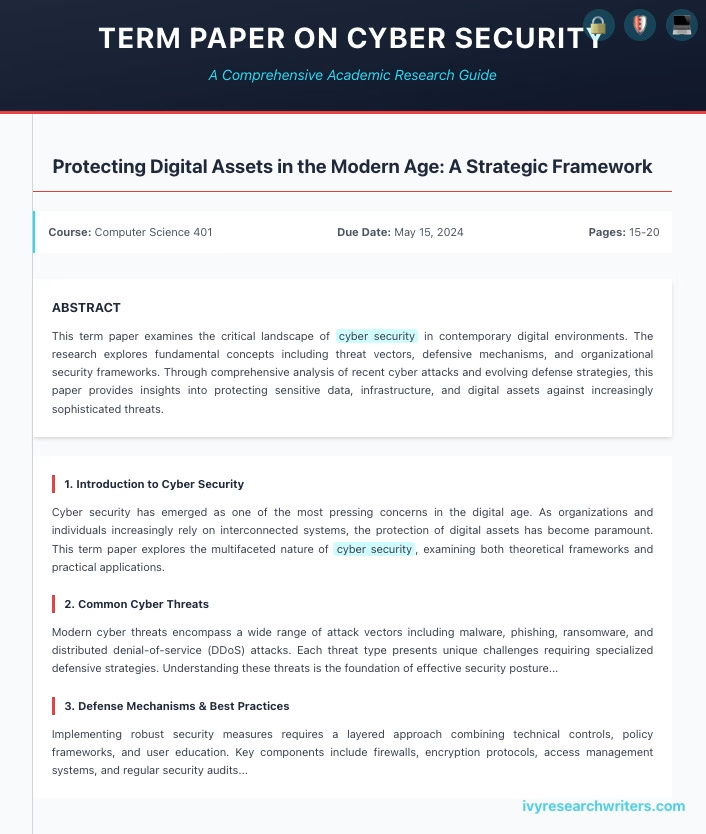
Writing a term paper on cyber security is easier when you treat it like a structured investigation rather than a long opinion piece. Cyber security is a fast-evolving area of computer science and information technology where security threats, cyberattacks, and data breaches keep changing as systems, connected devices, and attacker tools evolve. A strong paper shows that you understand the basics (definitions and concepts), can analyze real-world risks (threats, vulnerabilities, intrusion), and can propose prevention and mitigation strategies that protect personal data, sensitive data, and critical infrastructure.
Below is a practical, student-friendly roadmap you can follow—complete with definitions, topic ideas, outline structure, and examples you can adapt.
How to frame your paper: what professors expect in a term paper on cyber security
A good term paper is not just a list of cyber security facts. It should deliver:
- A clear thesis or problem statement (what you are arguing or analyzing)
- A well-scoped topic in an area of cybersecurity (not “everything about cyber”)
- Evidence-based reasoning supported by credible sources (journal articles, conference papers, research center reports, regulatory guidance, and open access sources when possible)
- A structured architecture: introduction → background → analysis → recommendations → conclusion
Pro tip: If your instructor wants a “research” paper, treat it like a mini study: define the research question, explain method (literature-based analysis, case study, comparative review), then discuss findings and recommendations.
Cybersecurity foundations: clear definitions you can use in your term paper
Use precise definitions early so your reader knows you understand the field.
- Cyber security / cybersecurity: The practice of safeguarding information systems, networks, software, and connected devices from malicious activity, unauthorized access, disruption, theft, or damage.
- Threat: A potential cause of an unwanted incident (for example, phishing campaigns by cybercriminals, ransomware, or insider misuse).
- Vulnerability: A weakness that can be exploited (misconfiguration, outdated software, weak authentication, insecure architecture, exposed application programming interfaces).
- Exploit: A technique or code that takes advantage of a vulnerability to cause harm.
- Intrusion: Unauthorized entry into a system or network (often leading to surveillance, data theft, or disruption).
- Data breach: Exposure, exfiltration, or theft of personal data or sensitive data.
These terms let you explain cyber vulnerabilities logically: threat + vulnerability + exploit = risk.
Information security versus cyber security: how to explain the difference (and why it matters)
Many instructors expect you to distinguish information security from cyber security.
- Information security (InfoSec): Protects the confidentiality, integrity, and availability of information—whether digital, printed, spoken, or stored in any form.
- Cyber security: Often focuses more specifically on protecting digital systems, networks, and connected devices from cyberattacks.
In a term paper, you can argue that cyber security is part of a broader information security strategy because modern organizations store an enormous amount of data across cloud services, mobile endpoints, and the Internet of Things (IoT).
Planning your topic using cybersecurity research: what to write about and how to narrow it
A common mistake is choosing a topic that is too broad: “issues related to cybersecurity worldwide.” Instead, narrow to a specific area and a specific risk environment.
Here are strong, researchable cybersecurity topics (each works well as a term paper focus):
1) Phishing and social engineering
- How phishing leads to credential theft and business email compromise
- Prevention: training, email authentication, filtering, multi-factor authentication, incident response playbooks
2) Internet of Things and connected devices
- IoT security risks: default passwords, weak update chains, insecure firmware
- How connected devices expand the attack surface and create potential vulnerabilities in home and enterprise networks
3) Data protection and regulatory compliance
- Data protection principles and how regulatory expectations affect architecture and access controls
- Balancing transparency with security in reporting and breach notification
4) Critical infrastructure security
- Cyberattacks on energy, healthcare, transport, and water systems
- Why critical infrastructure is a high-risk target and how to mitigate with layered systems security
5) Supply chains and software dependency risk
- Security threats in supply chains (third-party libraries, vendors, managed service providers)
- How attacker “chains” (multi-step intrusion paths) exploit trust relationships
6) Digital forensics and incident response
- How forensics helps reconstruct malicious activity and support legal and organizational response
- Evidence handling, timeline analysis, and intrusion detection artifacts
Pick one of these and define a narrow thesis, such as:
“This paper argues that phishing remains the highest-leverage intrusion vector for cybercriminals because it bypasses technical defenses by targeting human access decisions; it then evaluates prevention strategies and threat detection controls.”
Using current research and credible sources without getting lost
Cyber security is evolving quickly, so your professor will often expect you to engage with current research. The goal is not to cite hundreds of sources—it is to select a small set of authoritative work and analyze it well.
Where students typically find strong sources:
- Peer-reviewed venues (for example, the Journal of Cybersecurity and other computer science security journals)
- University research center publications (cybersecurity research center outputs, working papers)
- Open access preprints and reputable conference proceedings
- Standards and regulatory bodies (frameworks, guidelines, compliance documents)
- Industry reports with transparent methodology (use carefully and compare claims)
Practical strategy: Use a “triangle” of evidence:
- peer-reviewed research (foundational and cutting-edge)
- standards/regulatory guidance (what organizations must do)
- real-world breach/case reports (how attacks happen in practice)
AI and artificial intelligence in cyber security: a powerful angle for a modern term paper
If you want a high-scoring modern topic, focus on AI, artificial intelligence, and machine-learning-based security.
Key points you can develop:
- A machine learning approach can help predict suspicious behavior patterns and support threat detection at scale.
- AI can classify phishing emails, detect malware variants, and analyze massive log data (useful when organizations face a growing amount of data).
- Attackers also use AI to improve phishing, automate exploit discovery, and scale malicious activity, which changes security threats worldwide.
Example thesis:
“Artificial intelligence improves threat detection, but it also increases attacker capability; therefore, organizations must pair AI tools with strong architecture, human oversight, and transparent evaluation metrics.”
A step-by-step outline you can follow for a term paper on cyber security
Use this structure to keep your paper academic and clear.
1) Introduction
- Define the topic and why it matters (impact on personal data, sensitive data, infrastructure)
- Provide your thesis statement
- Briefly preview what you will cover
2) Background and key concepts
- Define threat, vulnerability, exploit, intrusion, data breach
- Explain the environment (cloud, IoT, information systems)
3) Threat landscape and security risks
- Identify main threat actors (cybercriminals, insider threats, hacktivists, state-linked groups)
- Describe common attacks (phishing, ransomware, credential theft, unauthorized access)
4) Technical and organizational analysis
- Discuss architecture and systems security controls
- Explain how attackers move through a chain of weaknesses (misconfiguration → exploit → privilege escalation → exfiltration)
5) Prevention and mitigation strategies
- Prevention: secure configuration, patching, segmentation, multi-factor authentication
- Detection: monitoring, intrusion detection, log analysis, anomaly detection
- Response: incident response, forensics, containment, recovery, transparency in communication
6) Discussion: trade-offs and ethics
- Address ethical considerations (surveillance vs privacy, data protection, transparency)
- Evaluate what works and what fails in real environments
7) Conclusion
- Restate the thesis
- Summarize key insights and practical recommendations
- Suggest future directions (where cybersecurity research focuses next)
Term Paper on Cyber Security Example
A term paper on cyber security on the title “Strengthening Cyber Security in Modern Organizations: Threats, Vulnerabilities, and Evidence-Based Mitigation Strategies”
Practical examples you can include (phishing, IoT, data breaches, and critical infrastructure)
Example 1: Phishing leading to intrusion
A staff member receives a realistic email requesting an urgent password reset. The employee clicks a link and enters credentials on a fake login page. The attacker uses the credentials for unauthorized access, then escalates privileges and extracts sensitive data. This shows how phishing is both a technical and human-factor problem—perfect for a term paper section on prevention strategies.
Example 2: IoT vulnerability and connected devices
A smart camera uses a default password and does not receive firmware updates. A hacker scans the internet, finds the device, and exploits the weak access control to join a botnet or spy through surveillance features. This example supports a discussion of IoT, internet of things architecture, and potential vulnerabilities.
Example 3: Data breach and data protection failures
A cloud storage bucket is left public due to misconfiguration. Personal data is exposed, creating data protection failures and reputational harm. This example fits a paper about security risks, governance, and regulatory obligations.
Example 4: Critical infrastructure disruption
A hospital network experiences ransomware that locks systems needed for patient care. This example links cybersecurity issues to real harm, critical infrastructure, healthcare operations, and the urgent need to safeguard systems.
Need a high-scoring term paper on cyber security—fast and correctly structured?
At IvyResearchWriters.com, we help you choose a focused cybersecurity topic, write a strong thesis, use credible sources, and produce a polished research paper with clear definitions, real-world examples, and practical mitigation recommendations.
Writing the analysis section: how to show insight, not just description
A high-grade term paper explains why an issue happens and how to mitigate it. Good analysis often includes:
- Threat modeling: what can go wrong and where
- Root-cause thinking: why vulnerabilities persist (budget, complexity, legacy systems, human behavior)
- Control mapping: how a prevention strategy reduces likelihood or impact
- Trade-offs: usability vs security, transparency vs operational risk, surveillance vs privacy
Use phrases that signal evaluation:
- “This control mitigates…”
- “A key limitation is…”
- “The likely mechanism is…”
- “A major security risk emerges when…”
Ethical and regulatory dimensions: privacy, surveillance, and transparency
Cyber security is not only technical. It intersects with ethics and policy.
Key ethical questions you can include:
- How much user monitoring is justified for threat detection?
- When does surveillance become harmful to privacy and trust?
- How should organizations balance transparency about incidents with the risk of aiding attackers?
- What counts as responsible disclosure when vulnerabilities are discovered?
Framing these questions improves the academic quality of your paper and shows mature reasoning about issues related to cybersecurity.
Common mistakes to avoid in a term paper on cyber security
- Being too broad (“everything about cyber security worldwide”)
- Using only blogs or marketing sources without peer-reviewed support
- Listing attacks without explaining mechanism (threat → vulnerability → exploit → impact)
- Ignoring prevention and mitigation (a good paper proposes solutions)
- Forgetting to connect cyber security to patient outcomes, public services, or business continuity when discussing critical infrastructure
How IvyResearchWriters.com can help you produce a stronger term paper
If you want your term paper to read like high-quality academic work (not a generic summary), IvyResearchWriters.com can help you:
- choose a focused, researchable topic in an area of cybersecurity
- develop a thesis, outline, and argument flow
- locate credible open access and peer-reviewed sources (including current research)
- write clear definitions and real-world examples (phishing, IoT, supply chains, forensics)
- strengthen analysis, prevention strategies, and mitigation recommendations
Whether your focus is artificial intelligence, data protection, intrusion, cyberattacks, or critical infrastructure, the key is a clean structure and defensible reasoning—exactly what instructors reward in a strong cyber security paper.
Frequently Asked Questions
How to write a research paper on cyber security?
A strong cyber security research paper is built like a mini investigation: define a problem, analyze evidence, then recommend controls that reduce real security risk.
A practical IvyResearchWriters.com approach (you can follow this exactly):
- Pick a tight topic (avoid “cybersecurity in general”). Examples: phishing-driven data breaches, Internet of Things (IoT) vulnerabilities, supply chain attacks, Artificial Intelligence (AI) in threat detection, critical infrastructure security.
- Write a one-sentence thesis (your main claim). Example: “This paper argues that phishing remains a primary intrusion vector because it targets human access decisions and bypasses technical controls; it evaluates prevention and detection strategies.”
- Define key terms early (threat, vulnerability, exploit, intrusion, data breach) so your paper reads academic and precise.
- Use a clean structure aligned to standard research paper sections (see the 7 parts below).
- Ground your analysis in evidence: peer-reviewed cybersecurity research plus standards/guidance (and open access sources when possible).
- Add one concrete case example (a breach scenario, phishing chain, IoT misconfiguration) and map it to controls: prevention, detection, response.
- End with actionable recommendations (mitigate, safeguard, data protection, least privilege, multi-factor authentication, monitoring).
If you want a faster, higher-scoring result, cybersecurity researchers at IvyResearchWriters.com can help you narrow your topic, build an outline, and craft a thesis that matches your rubric.
What are the 5 C’s of cyber security?
The 5 C’s of cybersecurity are commonly listed as:
- Change (threats evolve; defenses must evolve)
- Continuity (business continuity and resilience)
- Compliance (regulatory and policy requirements)
- Cost (risk-based budgeting and prioritization)
- Coverage (breadth of protection across systems, users, and data)
Important note: Some organizations use slightly different “5 C’s” (for example, including culture/collaboration), but the Change–Continuity–Compliance–Cost–Coverage framework is one of the most widely cited versions.
What are the 7 parts of a research paper?
Many instructors expect the standard academic structure. A common 7-part format is:
- Title (or Title Page)
- Abstract
- Introduction (problem, purpose, thesis)
- Literature Review / Background
- Methodology (how you gathered/analyzed evidence—often a literature-based method for term papers)
- Results + Discussion (or separate Results and Discussion, depending on your course)
- References
For cyber security term papers, it is normal for “Results” to be framed as findings from your reviewed sources (for example, common attack chains, most effective mitigations), then discussed critically.
What are the terms used in cyber security?
Here are core cyber security terms you can define in your paper (and actually use correctly in analysis):
Threat and weakness language
- Threat: potential danger that can cause harm by exploiting weaknesses
- Vulnerability: a weakness/flaw that can be exploited
- Exploit: method or code used to take advantage of a vulnerability
- Intrusion / unauthorized access: entry into systems without permission
Common attack terms
- Phishing: deceptive messages to steal credentials or deliver malware
- Malware / ransomware: malicious software; ransomware encrypts data to extort payment
- Data breach: exposure or theft of personal/sensitive data
Core protection and control terms
- Authentication and authorization (who you are vs what you are allowed to do)
- Encryption (protects data in transit and at rest)
- Confidentiality, Integrity, Availability (CIA triad): foundational information security model

