

Research Gap Example: How to Find, Define, and Write One for Your Dissertation
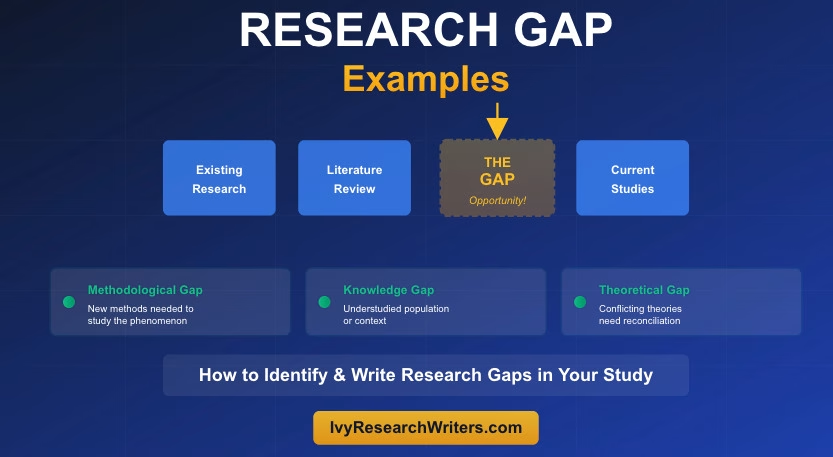
If you have ever stared at a blank page thinking, “What exactly am I supposed to contribute that has not already been done?”—you are already thinking like a researcher. In academic writing, your strongest foundation is a clear research gap. A research gap example shows what is missing in the existing literature and why your new research matters.
A research gap is essentially a missing piece of knowledge or understanding in the existing research on a particular topic. It is not about proving other scholars wrong. Instead, it is about showing there is a need for further research—whether because there is limited research, an inconsistency in results, an unexplored population, or a weak fit between theory and practical application.
This blog post is your complete guide—Research Gap 101—with definitions, examples, and practical ways to identify research gaps, especially when writing a dissertation, a research proposal, or a full research project.
Gap
A gap in research refers to something important that is missing or underdeveloped in academic study. It can mean:
- a lack of evidence on a specific research question
- weak or outdated research methods
- absence of study in specific contexts
- incomplete explanation of research findings
- unanswered questions in the range of research available
In simple terms, a gap exists when scholars and researchers cannot confidently explain what is happening, why it is happening, or how it applies in real-world settings due to a lack of understanding or missing data.
A good gap statement does not just say “there is not enough research.” It shows what is missing, why it matters, and what your study will do differently.
Research gap
A research gap is the specific missing area that your work will address. It is discovered by evaluating existing research, especially through a careful review of the literature. You identify what scholars have covered and what they have not covered.
A clear research gap definition (Research Gap 101)
A research gap is the difference between:
- what is currently known from the existing literature, and
- what still needs to be known to deepen knowledge or understanding.
This gap becomes the reason your study exists. In academic publishing, your gap helps you justify why research is needed and why your topic deserves attention.
Research gap example (simple but strong)
Topic: Telemedicine and chronic disease management
Existing research: Many journal articles show telemedicine improves appointment adherence.
Gap: Most studies focus on high-income settings; there is limited research on rural, low-resource communities.
Gap statement: Despite significant research on telemedicine outcomes, there remains a contextual gap in understanding how telemedicine supports chronic disease management in rural, low-resource settings, where infrastructure and patient accessibility may influence effectiveness.
This is a complete research gap example because it names the evidence, the missing context, and why it matters.
Different types of research gaps
Not all gaps are the same. Understanding the different types of research gaps helps you choose a strong direction for your research topic and sharpen your research question.
Here are the most common types:
1) Literature gap
A literature gap happens when the existing literature does not fully address an issue. It may be missing theory, outcomes, populations, or comparisons.
Example:
Many research articles explain social media addiction in teenagers, but fewer explore the same issue among older adults.
Why it matters:
This creates an under-explored area where future research can expand understanding.
2) Methodological gap
A methodological gap occurs when researchers rely heavily on one methodology, and other approaches are missing. This often impacts the quality of evidence.
Example:
Most studies on workplace burnout use surveys only. There is a lack of qualitative interviews that capture deeper experiences.
Why it matters:
Survey data can overlook lived experiences, motivation, and context. A new study can improve evidence through better data collection and richer analysis.
3) Contextual gap
A contextual gap appears when a topic has been studied, but only within certain settings—such as Western countries, urban areas, or specific industries.
Example:
Customer loyalty has been widely studied in retail industries, but remains under-explored in micro-business markets in developing economies.
Why it matters:
Context shapes outcomes. Ignoring context creates a gap in practical application and policy relevance.
4) Empirical research gap
An empirical research gap exists when claims are made theoretically but lack real data evidence.
Example:
Scholars claim digital learning improves engagement, but only a few studies measure actual performance outcomes over time.
Why it matters:
This is where research efforts can move the topic from assumptions to validated results.
5) Inconsistency gap
An inconsistency gap happens when studies reach conflicting results—one study says X, another says Y.
Example:
Some research findings show remote work increases productivity, while others show it reduces productivity due to isolation and communication barriers.
Why it matters:
This gap is ideal for deeper evaluation, replication studies, or improved research design.
Research topic
Your research topic is the general subject you want to investigate. But the topic alone is not enough. A strong topic must connect directly to a gap and lead to a focused research question.
How to choose a research topic with a strong gap
When you choose a research area, ask:
- What does existing research say about this particular topic?
- What is missing in the review of the literature?
- Where is there limited research or an under-explored angle?
- Are there specific contexts that scholars have ignored?
- Are there problems in practical application that the research does not solve?
A good research topic naturally creates space for potential research because it is tied to a real gap.
Literature gap
A literature gap is a specific kind of research gap found directly in the literature. It is often discovered when the literature:
- does not cover a specific variable or population
- does not address newer trends
- relies on outdated evidence
- lacks clarity or depth in explanation
- does not test important relationships
Literature gap example (detailed)
Research on a particular topic: Mental health support for university students
Existing literature: Many studies measure anxiety and depression prevalence
Gap: Few studies evaluate the effectiveness of campus mental health interventions in real time (actual outcomes after intervention)
Literature gap statement:
Although significant research documents mental health challenges among university students, the existing literature shows a lack of understanding regarding how specific interventions influence measurable outcomes over time, indicating research is needed to evaluate effectiveness and long-term impact.
This is a strong literature review, literature gap example because it goes beyond “not enough studies” and points to a measurable missing area.
Identify research gaps
To identify research gaps, you must follow a structured research process. Many students search randomly and feel overwhelmed by the range of research available. The solution is to search strategically.
Step-by-step: How to identify research gaps effectively
1) Start with a broad review of the literature
Use Google Scholar and discipline-specific databases like PubMed (especially in health sciences). Filter results to the last 5–10 years for current relevance.
What to look for:
- repeated calls for “need for further research”
- “limitations” sections in research articles
- contradictions (inconsistency)
- repeated narrow contexts
2) Map themes and trends
As you read journal articles, group findings into themes:
- what researchers agree on
- where research findings are unclear
- what outcomes are poorly measured
This step helps you evaluate where the topic is overdone and where it is under-explored.
3) Track methods and data collection
Pay attention to whether studies rely on:
- surveys only
- small samples
- short time frames
- limited settings
- outdated existing methods
This is where methodological weaknesses become visible.
4) Identify what is unexplored
A gap is often located in:
- new populations
- new countries
- new technologies
- new policy environments
- overlooked stakeholder voices
This creates potential research gaps that are meaningful.
5) Write your gap as a “missing link”
A gap statement should connect:
- topic + existing evidence + what is missing + why it matters
Finding a research
Many students confuse finding a topic with finding a research gap. The truth is: you can begin with a topic, but you must refine it into a gap-based study.
Finding a research gap example process
Let us walk through a realistic student pathway:
- Initial research topic: Cybersecurity awareness among employees
- Search existing research: Many studies show training improves awareness
- Spot the gap: Most focus on corporate environments, not small businesses
- Refine to specific contexts: Micro-enterprises or informal business settings
- Form the research question:
How does cybersecurity awareness training influence security behavior among employees in small businesses? - Justify the gap:
Existing research lacks focus on small-business constraints (time, budget, informal systems), so research is needed for better practical application.
This is how identifying a gap shapes your direction.
Dissertation
Your dissertation must contribute new value. Whether you are writing a master’s dissertation or a Ph.D dissertation, your supervisor and examiners will look for a gap-driven argument.
Why the research gap for your dissertation is non-negotiable
A dissertation is not just a long essay. It is an independent investigation that:
- addresses a real problem
- uses appropriate methodology
- produces defensible research findings
- contributes to academic publishing standards
Your research gap for your dissertation explains:
- why your study is necessary
- how it extends existing research
- what it adds to knowledge or understanding
Dissertation-level research gap example
Topic: Digital forensics training and evidence reliability
Existing research: Many studies explain tools and procedures
Gap: Limited research evaluates how training quality affects courtroom evidence interpretation in real cases
Gap statement:
Despite significant research on digital forensic tools and processes, limited research addresses how professional training influences evidence reliability and decision-making in legal contexts, suggesting research is needed to strengthen practical application and judicial trust.
This is dissertation-ready because it links research to real-world impact.
Research gap 101
Research Gap 101 is simple: the gap is the reason your research exists.
A useful structure looks like this:
- What is known: summarize existing literature
- What is missing: identify the gap (contextual, literature, methodological, empirical, inconsistency)
- Why it matters: practical application, theory, policy, or outcomes
- What you will do: state your research question and study focus
Template you can copy
Although existing research has examined [topic], there remains a [type of gap] in understanding [missing element] within [specific contexts]. Therefore, research is needed to explore [your focus], contributing to improved knowledge or understanding and supporting future research and practical application.
Need a topic that fits your professor’s rubric and has a strong research gap?
IvyResearchWriters.com can help you choose a winning topic, write the gap, and develop a complete proposal outline.
Qualitative
A qualitative study is one of the best ways to fill certain gaps—especially when the field has too many numbers but not enough human experience.
When qualitative research fits best
Choose qualitative methods when:
- you are exploring perceptions, experiences, or meaning
- the topic is under-explored and needs discovery
- surveys cannot explain “why” something happens
- you need deeper understanding of stakeholder voices
Qualitative research gap example
Topic: Patient trust in telemedicine
Existing research: many studies report satisfaction scores
Gap: lack of understanding of why patients distrust the technology
Qualitative gap statement:
While existing research reports telemedicine satisfaction levels, a qualitative contextual gap remains in understanding patient concerns, beliefs, and lived experiences that shape trust in virtual care, indicating research is needed to capture deeper insights.
This type of gap is ideal for interviews, focus groups, or thematic analysis.
Methodological
Methodological choices affect what you can claim. Many gaps exist simply because researchers use limited approaches.
Common signs of a methodological gap:
- only cross-sectional studies (no long-term tracking)
- overreliance on self-report surveys
- small samples that cannot be generalized
- lack of triangulation (only one data source)
A methodological gap invites better research methods, stronger evidence, and more credible findings.
Research design
Your research design is the blueprint of your study. It ties the gap to your methodology.
A good design answers:
- what data you will collect (data collection)
- how you will collect it (interviews, surveys, experiments, documents)
- who your participants are
- how you will analyze findings
The strongest research design is gap-driven. If your gap is contextual, your design must include context. If your gap is methodological, your design must fix the method problem.
Research articles
To find gaps, you need to read research articles strategically. Do not read everything. Read with a purpose.
Where the best gaps hide inside journal articles
Look at:
- the “limitations” section
- the “recommendations for future research” section
- the discussion section (where inconsistency often appears)
- the methodology section (to spot weak methods)
Scholars and researchers often reveal the gap themselves. Your job is to capture it clearly and turn it into a strong research question.
Tools to use
- Google Scholar for broad searching
- PubMed for health/medical topics
- reference chaining (checking what papers cite and are cited by key sources)
This keeps your research process efficient.
Methodological gap
A methodological gap is one of the most powerful gaps because it creates immediate value: you are improving how knowledge is produced.
Methodological gap example (strong and publishable)
Research on a particular topic: Employee motivation in remote work
Existing methods: mostly online surveys
Gap: lack of observational or interview-based data
Methodological gap statement:
Although existing research explores remote work motivation through surveys, a methodological gap exists due to limited qualitative inquiry that captures workplace dynamics and personal meaning, suggesting research is needed to strengthen evidence through richer methods.
This gap is clear, specific, and logically leads to a qualitative or mixed-method design.
Final takeaway: A research gap example is your academic “why”
A strong research gap example does three things:
- proves you understand existing research and the existing literature
- shows a specific missing area (literature gap, contextual gap, methodological gap, inconsistency)
- leads directly into your research question and research design
If you can do that, your dissertation (or Ph.D study) becomes easier to justify, easier to structure, and far more likely to succeed in academic publishing.
If you want help to identify a research gap, refine your research topic, and write a dissertation-ready research proposal, IvyResearchWriters.com can help you move from “I have an idea” to a gap-driven, supervisor-approved study with a clear research process and defensible methodology.
Frequently Asked Questions
How to write a study gap?
A study gap (also called a research gap) explains what is missing in existing studies and why your research is needed. The best way to write it is to move from what is known → what is missing → why it matters → what your study will do.
A simple 4-step format (use this in your paper):
- Summarize existing research:
Briefly state what scholars already know about the topic. - Show what is missing:
Identify the exact gap (for example: population, setting, method, or inconsistent results). - Explain why it matters:
Link the gap to real impact (practice, policy, theory, outcomes). - State what your study will address:
End with your direction (research question, aim, or objectives).
Strong study gap template (copy + edit):
“Although existing studies have examined [topic], there remains limited evidence on [missing area], particularly in [context/population]. This gap is important because [why it matters]. Therefore, this study will explore [your focus] to strengthen understanding and inform future research/practice.”
What are the 7 research gaps?
Here are 7 common types of research gaps (used widely in proposals and dissertations):
- Literature gap – not enough studies exist on the topic
- Methodological gap – weak or limited research methods dominate (example: only surveys used)
- Theoretical gap – lack of strong theory or unclear conceptual framework
- Contextual gap – studies exist but not in your setting/country/industry
- Population gap – certain groups are not studied (age, gender, profession, culture)
- Empirical gap – claims exist, but not enough real data or evidence supports them
- Inconsistency gap – research findings contradict each other (mixed results)
What are examples of gaps?
Here are clear examples of research gaps (short, realistic, and usable):
- Contextual gap: “Most studies focus on urban hospitals; rural settings remain under-explored.”
- Methodological gap: “Prior research relies on questionnaires only, limiting deeper insight.”
- Population gap: “Few studies examine this issue among older adults.”
- Literature gap: “There is limited research addressing this problem directly.”
- Inconsistency gap: “Studies report conflicting findings on whether the intervention works.”
- Empirical gap: “Many articles discuss the issue theoretically, but data-based research is scarce.”
- Practical application gap: “Research exists, but it does not show how findings can be applied in practice.”
What are the 10 examples of research topics?
Here are 10 research topic examples you can use (across business, health, education, technology, and social science):
- The impact of social media use on academic performance among university students
- Employee motivation and productivity in remote work environments
- Factors influencing customer loyalty in online businesses
- The effect of telemedicine on patient satisfaction in primary care
- Cybersecurity awareness and safe online behavior among employees
- Barriers to mental health care access among adolescents
- Leadership styles and employee retention in healthcare organizations
- The influence of parental involvement on learners’ academic achievement
- Causes and prevention strategies of workplace stress among nurses
- The effectiveness of digital learning tools in improving classroom engagement

