

Examples of Stereotypes: What They Are, How They Work, and Why They Matter
If you are writing essays or research papers for psychology, sociology, or education, you will eventually have to deal with examples of stereotypes. Stereotypes shape everything from academic achievement to hiring decisions, yet many people still treat them as harmless shortcuts or even assume that stereotypes are accurate.
For a writer or student using a site like ivyresearchwriters.com, understanding how stereotypes operate is essential. In social psychology, a stereotype defined simply means beliefs about groups of people. These beliefs oversimplify reality, turn people into categories, and can easily lead to discrimination in the classroom, the legal system, and the workplace.
Below, we walk through five core ideas every serious writer should know: stereotype, negative stereotype, stereotype threat, intergroup processes, and stereotyping and prejudice. Along the way we will use real examples of gender, racial, cultural, age, disability, and sexuality-based stereotypes.
Stereotype
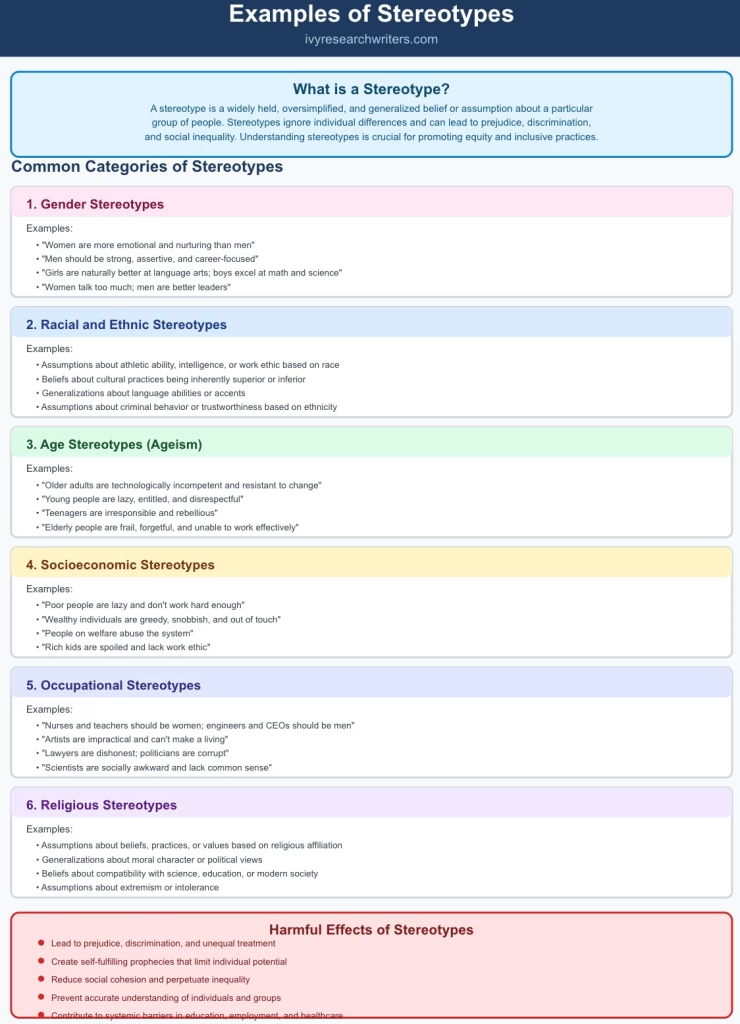
In everyday language, people use “stereotype” casually, but stereotype definition psychology gives us something more precise. A stereotype is a generalization – a mental shortcut – that we apply to a social group, assuming that all its members share the same personality traits, abilities, or values. Historically, the word stereotype was used in printing for a fixed metal plate. Today, it refers to “fixed” ideas that are widely held and hard to change.
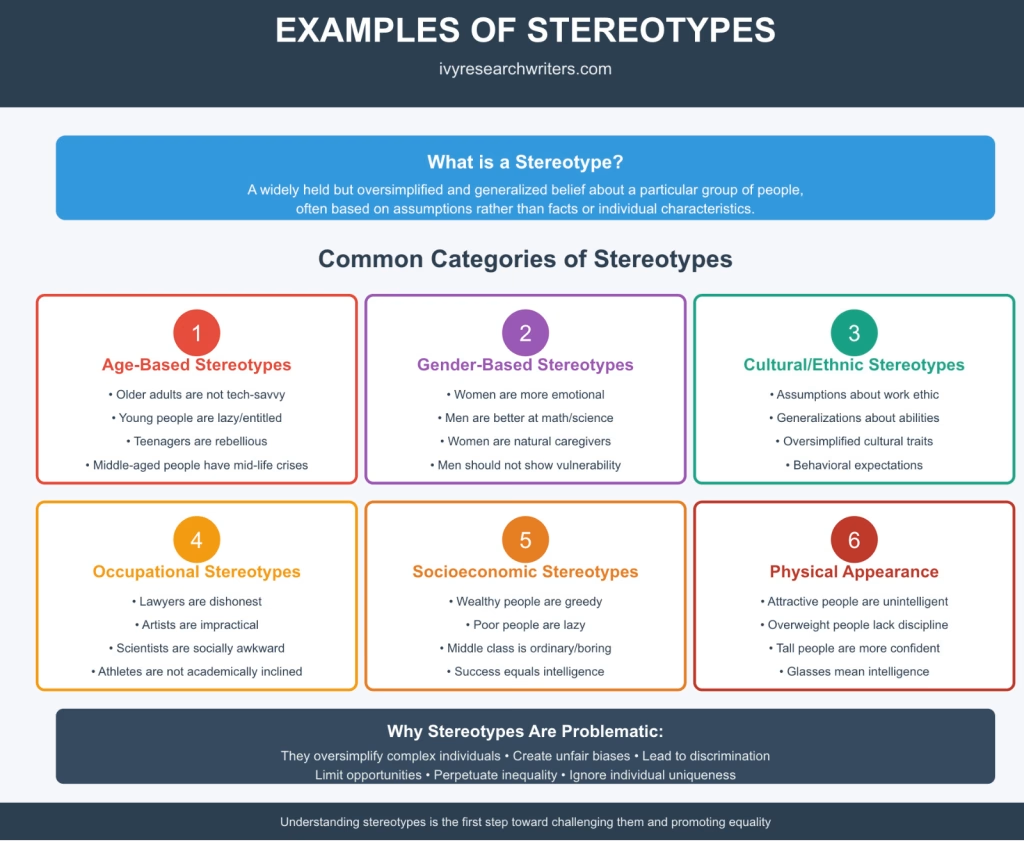
Stereotypes categorize people into neat boxes. We sort people into groups based on race or ethnicity, gender, age, social class, sexuality, or ability and attach labels such as “hardworking,” “lazy,” “greedy,” “nurturing,” or “dangerous.” These are beliefs about groups of people, not observations of individual character.
Some classic cases:
- Stereotypes about women: that women are emotional, caring, and built for nurture, but not analytical or assertive.
- What are the gender stereotypes about men? That they should be tough, unemotional, and the “breadwinners.”
- Racial stereotype examples: Asian Americans are “naturally good at math,” Black people are threatening, Jewish people are rich and greedy, migrants are “taking jobs.”
- Age stereotypes: older people, older adults, and elderly people are assumed to be slow, forgetful, and bad with technology.
- Stereotypes of people with disabilities: that they are dependent, inspirational, or tragic, rather than ordinary people whose environments are often inaccessible.
We also see cultural stereotype narratives tied to ethnicity, such as “Latinos are family-oriented,” “British people are cold,” or “Africans are poor but happy.” These ethnic stereotypes show up in popular culture and popular cultural images – films, songs, memes – and they perpetuate simplified stories about entire continents.
Even when stereotypes sound “nice,” they still limit people. A common stereotype is that Asian Americans excel in math or that Jewish people are financial geniuses. Being seen as good at math, social psychology research shows, can push students into narrow academic paths and make it harder to be taken seriously in arts or humanities fields.
Researchers have debated whether stereotypes are accurate, but a key point for writers is this: stereotypes may contain fragments of truth, yet they oversimplify complex histories and stereotypes are often used to justify unequal systems such as systemic racism or ageism.
Negative stereotype
A negative stereotype directly attributes something bad to a group. Think of assumptions that:
- People are lazy if they are poor or unemployed.
- Black women fit the “angry Black woman” trope, where any complaint is read as aggression.
- Gay men are effeminate, obsessed with fashion, and not “real men.”
- Bisexual people are promiscuous or “confused.”
- People with disabilities “cannot really work” or are “too much effort” to hire.
These stereotypes can lead to real harm. In housing, a landlord who believes a racial stereotype that some groups of people are irresponsible may refuse to rent to them. In the workplace, a manager who assumes older people are slow or forgotful may never offer them training or promotion. Here, stereotyping leads straight to unfair treatment.
Negative stereotypes show up strongly in examples of gender stereotypes. For instance:
- Women are “too emotional” to lead, but expected to do all the emotional labour and nurture others.
- Men must not cry, show vulnerability, or take parental leave.
- Girls are told they are not suited for math and science, even when they have strong math skills and could easily excel in math.
We also stereotype social class. Wealthy people may be stereotyped as cold and greedy, while poor people are seen as irresponsible or lacking discipline. When these images are baked into hiring, promotion, or policy decisions, stereotypes contribute to long-term inequality.
Remember, stereotypes can also look “positive” on the surface. Saying “all women are natural caregivers” or “all older adults are wise” sounds kind, but still restricts career aspirations, makes it harder for people to step outside expected roles, and perpetuates inequalities like the leadership gender gap.
Ready to turn all this theory on stereotypes into an A-level paper?
If you are:
Struggling to explain stereotype threat, stereotyping and prejudice, or intergroup bias clearly.
Unsure how to weave real-life examples of stereotypes into a strong thesis.
Tired of fighting with structure, arguments, and referencing on your own.
then it is time to get support.
Stereotype threat
One of the most important ideas in social psychology is stereotype threat. Stereotype threat occurs when a person is worried about confirming a negative stereotype about their social group, and that worry actually harms their performance.
For example, research by Steele and Aronson found that Black students performed worse on a difficult test when it was described as measuring intelligence, because they were subtly reminded of the racial stereotype that Black people are less intelligent. The effect of stereotype threat lowered their scores, even when their ability was equal. This is a powerful example of how stereotypes can damage academic achievement.
You see the same pattern with gender and math and science:
- When women are reminded of the gender stereotype that they are “bad at math,” stereotype threat occurs. Anxiety about confirming the stereotype makes it harder to think clearly, especially under time pressure.
- As a result, women may answer fewer questions correctly, perform below their actual ability, and then internalise the idea that they really are not “math people,” even though they could excel in math.
Over time, stereotype threat can shape career aspirations. If girls keep hearing that engineering or physics are not for them, they may stop choosing those subjects. This feeds into a gender gap in high-paying, male-dominated fields, even when there are no real differences in math skills.
Stereotype threat is not limited to gender and race. It also impacts:
- Older adults taking memory tests after hearing that elderly people are forgetful.
- Students from working-class backgrounds sitting exams at elite universities.
- Gay men or bisexual people who fear confirming stereotypes in specific professional roles.
Social psychologists like Fiske et al, Ellemers, and Operario have also connected stereotype threat to the stereotype content model. This model says most stereotypes can be described using two dimensions: warmth and competence. Some groups are seen as high in perceived warmth but low in competence (for example, older people or some people with disabilities), while others are seen as highly competent but cold (for example, some wealthy people, Jewish people, or Asian Americans in certain narratives). This stereotype content helps explain why different groups face different kinds of pressure.
The key point: stereotypes do not just sit in people’s heads. They shape social identities, performance, wellbeing, and the choices people make about school, work, and relationships.
Intergroup
The word intergroup simply means “between groups.” Intergroup processes concern what happens when members of one social group interact with another – for example, men and women, citizens and migrants, majority and minority racial groups, disabled and non-disabled people.
Social psychology shows that people are surprisingly quick to sort people into groups and build an in-group / out-group mindset. In simple terms, bias refers to the tendency to favour one’s own in-group, see it as more varied and human, and view out-groups as more homogeneous (“they are all the same”).
Because humans categorize so quickly, we are often likely to stereotype when we meet someone new. Under stress or time pressure, this gets worse: we fall back on shortcuts and fill in the blanks using cultural stereotype images from media and upbringing.
Intergroup research also helps explain why stereotypes reflect power and status. According to the stereotype content model, groups seen as high status tend to be judged as more competent, while groups seen as competing with “us” are judged as less warm. This is why:
- Some wealthy people or Jewish people may be stereotyped as competent but cold and greedy.
- Some older people and people with disabilities are cast as warm but incompetent.
- Marginalised ethnic stereotypes can portray entire groups as low in both warmth and competence, justifying exclusion and even violence.
These patterns show up in policy debates about immigration, policing, welfare, and education. Intergroup dynamics are not only about individual attitudes; they are built into institutions, networks, and systemic racism.
Stereotyping and prejudice
Finally, it is crucial to connect stereotyping and prejudice and to understand the difference between prejudice and discrimination.
A simple way to separate the terms:
- Stereotypes: what you think (cognitive beliefs about a group).
- Prejudice: what you feel (liking or disliking a group).
- Discrimination: what you do (actions that treat people differently).
So, prejudice vs discrimination is basically feeling versus behaviour. Prejudice stereotyping happens when negative beliefs and negative emotions reinforce one another; for example, believing that “people are lazy” if they are unemployed and feeling contempt towards them.
What about prejudice versus racist or racism vs prejudice? Prejudice is an individual-level emotion. Racism involves prejudice, stereotypes, and institutional power. Racism operates when police, schools, banks, or employers act on racial stereotype beliefs in ways that lead to discrimination against certain race or ethnicity groups. In racism, stereotyping leads not just to rude comments but to patterns of exclusion and harm backed by structures and laws.
Think about how this plays out in the workplace:
- A manager who believes that older people are less productive may never hire them, reinforcing ageism.
- A recruiter who assumes people with disabilities are less capable may design interviews that they cannot access.
- A supervisor who thinks gay men are effeminate and “not assertive” enough may ignore them for leadership roles.
In each case, stereotypes may look “rational” from the biased person’s point of view, yet they create systematic patterns of unfair treatment. Over time, stereotypes contribute to wage gaps, under-representation in leadership, and unequal access to healthcare and housing.
From a writing perspective, it is useful to remember:
- Bias refers to the tendency to favour the in-group and explain away evidence that contradicts our stereotypes.
- Stereotypes are also self-reinforcing; they shape expectations, which shape behaviour, which then seems to “confirm” the stereotype.
- Challenging stereotypes requires questioning not just individuals but also institutions, narratives, and popular cultural images that perpetuate them.
Bringing it together for your essays and blog posts
For anyone writing about social psychology, education, or inequality, stereotypes are not just interesting examples – they are core mechanisms you must be able to explain clearly.
Key takeaways you can use in assignments or blog posts:
- Start with a clear stereotype definition psychology style: cognitive generalization about a social group that can oversimplify and categorize.
- Use concrete cases: stereotypes about women, age stereotypes, racial stereotype narratives, assumptions about gay men, bisexual people, people with disabilities, Asian Americans, Jewish people, wealthy people, and older adults.
- Show how negative stereotype beliefs and stereotype threat can shape academic achievement, performance under time pressure, and long-term career aspirations.
- Connect individual attitudes to intergroup processes, in-group bias, social identities, and larger systems such as systemic racism and ageism.
- Always explain the difference between prejudice and discrimination, and how racism vs prejudice links personal feelings to institutional power.
Understanding these ideas not only improves your grades and the quality of your arguments, it also helps you recognise when “just a joke” or “just a belief” is part of a larger pattern that perpetuates harm. That kind of insight is exactly what markers look for in high-level essays and what readers expect from thoughtful, well-researched content on sites like ivyresearchwriters.com.
Frequently Asked Questions
1. What are some of the common stereotypes?
A stereotype defined in stereotype definition psychology is a generalization: a set of beliefs about groups of people that are widely held, even if they are not always true. Historically, the word stereotype was used for a fixed printing plate; in social psychology it now describes “fixed” ideas that categorize people into groups based on race or ethnicity, gender, age, class, or ability. These beliefs oversimplify complex personality traits and experiences.
Common examples include:
- Gender stereotypes
- Stereotypes about women: “women are emotional,” “women are naturally good at nurture but not math and science,” or that they should not be too assertive.
- “What are the gender stereotypes about men?” Often that men should never cry, must be strong breadwinners, and are naturally better leaders.
- These examples of gender stereotypes help explain the gender gap in leadership and STEM fields and are a classic topic in social psychology assignments.
- Racial and ethnic stereotypes
- Racial stereotype: Black women cast under the “angry Black woman” label whenever they speak up.
- Ethnic stereotypes of Asian Americans as “naturally good at math” and always able to excel in math, or Jewish people as wealthy and greedy.
- Cultural stereotype images about “British people being cold,” “Latin Americans being passionate,” or entire regions reduced to poverty or violence.
- Age stereotypes and ageism
- Age stereotypes about older people, older adults, and elderly people being slow, passive, and forgetful, or “too old to learn technology.”
- These feed into ageism, where employers assume “people are lazy” once they reach a certain age, or doctors ignore symptoms because “that is just old age.”
- Stereotypes about sexuality and disability
- “Gay men are effeminate,” or all gay men love fashion and not sport; bisexual people are “confused” or promiscuous.
- People with disabilities stereotyped as helpless or inspirational but not as ordinary workers or students.
- Class and wealth stereotypes
- Wealthy people portrayed as cold, selfish, and greedy, while those in poverty are seen as irresponsible or lacking effort (“people are lazy”).
These stereotypes do not stay on paper. Stereotypes can lead to unfair treatment, because stereotyping leads teachers, employers, and officials to treat entire groups of people in the same way. At ivyreresearchwriters.com, expert writers show you how these patterns fit into theories like the stereotype content model, where stereotype content is organised around warmth and competence, perceived warmth, and status.
Why this matters for your assignment:
Ivy Research Writers can help you move beyond simply listing stereotypes to connecting them with stereotyping and prejudice, intergroup relations, and how stereotypes contribute to systemic racism, ageism, and other forms of inequality.
2. What is an example of a good stereotype?
Students often ask if there is such a thing as a “good stereotype.” In everyday talk, people sometimes say that “some stereotypes are accurate” or that there are “positive” ones. For example, calling Asian Americans “naturally good at math” or assuming women are always caring and good at nurture might sound positive.
However, stereotypes are often double-edged:
- They still oversimplify individual differences and social identities.
- They can trigger stereotype threat and damage academic achievement when people feel pressure to live up to the image.
- They perpetuate the idea that outcomes are about “group nature,” not unequal opportunities or systemic racism.
A classic “good stereotype” example you can use in essays:
- The belief that Asian Americans excel in math
- It seems flattering, but stereotypes can also:
- Push students away from humanities, arts, or caregiving careers because everyone expects “math skills only.”
- Mask the diversity within the group, including students who struggle.
- Create stereotype threat for those who worry about “failing” their group by not being perfect at maths.
- It seems flattering, but stereotypes can also:
Social psychologists like Steele and Aronson show that stereotype threat occurs when someone fears confirming a stereotype, which can reduce performance under time pressure. Fiske and colleagues (Fiske et al) explain through the stereotype content model how such “good stereotypes” about competence but low warmth and competence balance can lead to resentment and discrimination against high-status groups such as some wealthy people, Jewish people, or high-achieving minorities.
In other words:
- A “good stereotype” is still a generalization about a social group.
- It still categorize[s] people into groups in ways that can lead to discrimination and limit career aspirations.
- It is part of the same stereotyping and prejudice system as more obviously negative views.
How Ivy Research Writers helps:
On ivyreresearchwriters.com, you can get support to analyse why so-called “good stereotypes” are risky, compare racism vs prejudice, and use theories from social psychology (like work by Ellemers, Operario, and Fiske et al) to argue that even flattering images can harm individuals and groups of people.
3. What is an example of a stereotype in real life?
A useful real-life example for essays is a workplace hiring or promotion scenario. It lets you illustrate stereotype defined, prejudice vs discrimination, and how stereotypes can lead to structural inequality.
Example scenario (you can adapt for your paper):
A manager must choose between two candidates for a leadership role. One is a 30-year-old man, the other is a 58-year-old woman with a disability.
- Because of age stereotypes, the manager assumes older adults and elderly people are slower, more forgetful, and less willing to learn new technology.
- Because of stereotypes about people with disabilities, the manager expects higher costs, lower performance, and more “hassle.”
- Because of gender stereotypes, he believes the woman is less assertive and more suited to support or nurture roles.
- Influenced by this stereotype content, he concludes that promoting the younger man is more “rational” – even though the woman has stronger experience.
Here, several things are happening at once:
- Stereotyping and prejudice
- Stereotypes are also beliefs: “older workers are slow,” “people with disabilities are a burden.”
- Prejudice shows up as subtle discomfort or distrust.
- Difference between prejudice and discrimination / prejudice vs discrimination
- The biased feelings are prejudice.
- The decision not to promote her is discrimination.
- Racism vs prejudice / prejudice versus racist
- If you add race or ethnicity (for example, if she is a Black woman facing the “angry Black woman” trope), you can show how racism vs prejudice brings in institutional patterns, not just personal dislike.
- Intergroup and in-group bias
- The manager sees the younger man as part of his in-group (same gender, similar age, perhaps same background).
- In social psychology, bias refers to the tendency to favour the in-group and assume they are more competent or a “better fit.”
- Consequences
- This is not just one decision. Similar decisions across many workplaces create ageism, gender gaps, and barriers for people with disabilities.
- Stereotyping leads to lower pay, stalled careers, and reduced academic achievement when students anticipate such treatment and lower their career aspirations.
You can build many other real-life examples:
- Teachers assuming girls are weaker in math and science, so they call on boys more often.
- Media portraying gay men only as fashion-obsessed or gay men are effeminate, influencing how viewers treat them.
- Popular culture and popular cultural narratives showing wealthy people as cold and greedy, or people in poverty as lazy.
Where Ivy Research Writers fits in:
ivyresearchwriters.com can help you turn everyday cases like this into structured essays, linking them to stereotype threat, effect of stereotype threat, the stereotype content model, and core authors such as Aronson, Ellemers, Operario, and Fiske et al.
4. What does stereotype example?
If you are asking “What does a stereotype example actually do in an essay or paper?”, the answer is: it shows how abstract theory works in practice. A good stereotype example demonstrates how stereotypes are often:
- Widely held
- Used to categorize people into groups
- Built on beliefs about groups of people and not on careful evidence
- Part of broader patterns of stereotyping and prejudice
A strong stereotype example for academic work should highlight that:
- Stereotypes reflect more than personal opinion
- They mirror intergroup power, status, and history.
- The stereotype content model shows how stereotype content fits into warmth and competence, connecting to how groups like wealthy people, Jewish people, Asian Americans, older adults, or people with disabilities are judged in terms of perceived warmth and ability.
- Stereotypes are also linked to performance and behaviour
- Through stereotype threat, students facing stereotypes (for example, women in math and science, or minorities in elite schools) may underperform, especially under time pressure.
- The effect of stereotype threat is to reduce academic achievement and narrow career aspirations – a point you can strengthen with research by Aronson and colleagues.
- Stereotypes may appear neutral or positive
- Saying a group is “family-oriented” or “naturally good at math” still oversimplify[s] and can hide systemic racism or other structural issues.
- Stereotypes can lead and contribute to inequality
- Over time, stereotypes can lead to policy choices and everyday decisions that lead to discrimination in schools, housing, and jobs.
- Stereotypes contribute to patterns like the gender gap in high-status jobs, lower expectations for people with disabilities, and persistent ageism against older people and elderly people.
Finally, an example helps you connect micro-level bias to macro-level theory:
- You can contrast prejudice vs discrimination and racism vs prejudice.
- You can show how bias refers to the tendency to favour the in-group, and how people are more likely to stereotype out-groups.
- You can cite scholars such as Ellemers, Operario, and Fiske et al to explain why stereotypes are accurate only in a very limited sense, and why relying on them is poor social science and poor ethics.
How Ivy Research Writers supports you here:
At ivyreresearchwriters.com, professional writers help you take a simple stereotype example (for instance, stereotypes about gay men, bisexual people, people with disabilities, or age stereotypes) and develop it into a full argument. They can integrate core theories, clarify the difference between prejudice and discrimination, explore “prejudice stereotyping” and “prejudice versus racist,” and show how stereotyping leads to unfair treatment across contexts.

