

Action research
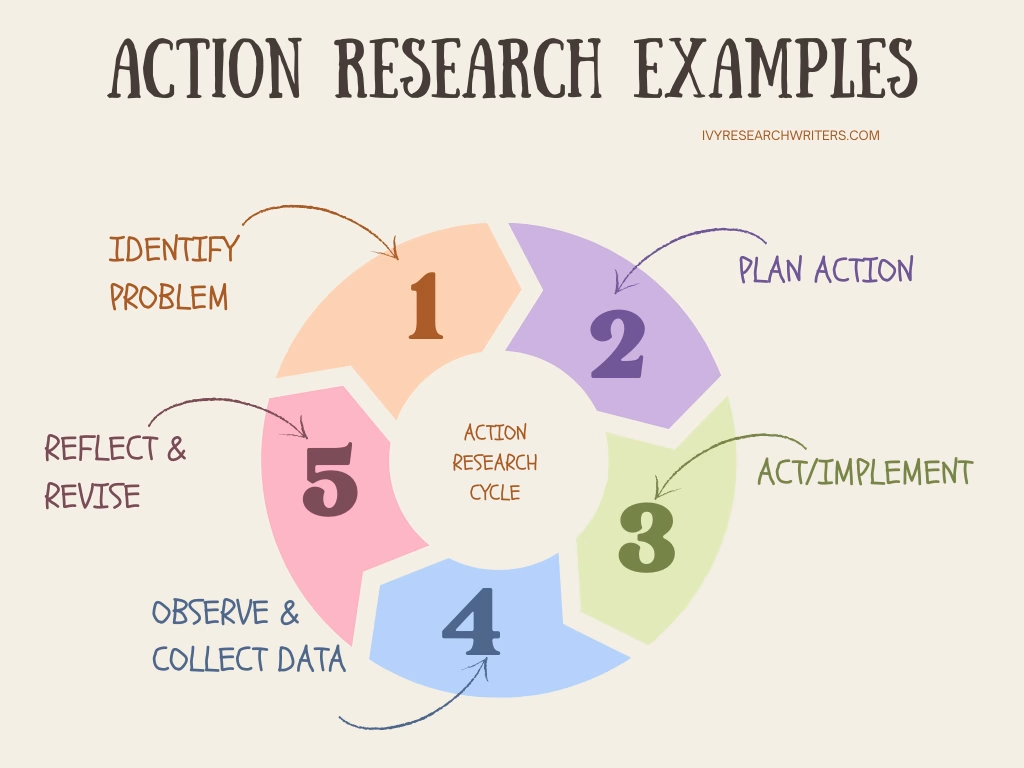
Action research is a structured way for practitioners—especially classroom teachers—to study their own practice and improve it at the same time. Action Research Examples and Ideas: Explore action research in the classroom with these research methods & project examples. It is different from just “trying something new” because it uses a cycle:
- Identify a specific problem.
- Plan an action to address it.
- Implement the action.
- Collect data on what happened.
- Reflect and adjust.
- Repeat the cycle.
Because it is action in research, it is both practical and reflective. You are not researching in a laboratory. You are researching in a real classroom, with real learners, real time pressure, and real school policies. That is why action research is very popular in education, social science, and community development.
Core characteristics of action research:
- Participatory: those in the situation (teachers, students, sometimes parents) are part of the inquiry.
- Contextual: it is done in a specific classroom, grade, or school.
- Actionable: the outcome is a changed teaching strategy or improved classroom practice.
- Iterative: it is not one and done; every cycle feeds the next.
- Practical solutions: the aim is to solve real classroom or school problems.
- Data-driven: you collect evidence, not just impressions.
Action research project
An action research project is what you submit, share, or publish after doing the actual cycle. It pulls together the thinking, the doing, and the evidence. For platforms such as ivyresearchwriters.com, this is exactly the kind of content that can be edited, expanded, or shaped into an academic-style report.
Typical components of an action research project:
- Title
Make it specific and classroom-focused:
“Using peer discussion to improve student engagement in Grade 9 language arts.”
“Integrating low-cost technology to support science teachers in a K–12 setting.” - Introduction / Background
Explain the specific issue in the educational context. Describe the school’s intake, the class profile, or the teaching and learning challenges. Mention that research is important for improving classroom practices. - Problem statement
One clear, narrow problem, for example:- Students’ participation in group tasks is low.
- Learners do not complete homework.
- Classroom management during project-based learning is difficult.
- Students respond poorly to traditional, teacher-centred methods.
- Purpose of action research
State that the purpose is to improve teaching practice, enhance student learning, strengthen classroom management, or make the learning environment more inclusive. - Action research methodology
Describe the cyclical process: plan, act, collect data, reflect, re-plan. Say that you will use simple, classroom-friendly research methods. - Data collection
Explain the tools: observation, student work, short questionnaires, exit slips, mini-tests, attendance, behaviour tracking. Emphasise that data collection is done during normal teaching. - Findings and reflection
Present what changed, how students responded, and what teaching techniques were most effective. - Next steps
Show that action research provides a basis for continuous improvement. Indicate that the next cycle will build on current findings.
Research projects: where action research fits
In education and social science, there are many types of research:
- Experimental design
- Survey-based research
- Qualitative research and case studies
- Traditional research (longer, more detached)
- Action research
- Participatory action research
Action research sits on the practice-improvement side of that spectrum. Traditional research often asks: “What is generally true?” Action research often asks: “What will work in this classroom, with these students, this term?”
So, action research is:
- smaller in scale,
- more local,
- more immediate,
- and more flexible.
That makes it ideal for teachers, school counsellors, instructional coaches, and education students who have limited time but still want their work to be research-based.
Action research in the classroom
This is the most common and most relatable application. Classroom teachers constantly deal with specific issues:
- Some students dominate discussion while others stay silent.
- A new curriculum requires more participatory learning, but students are shy.
- Technology is available, but students use it passively.
- There is a gap between students’ performance in classwork and their performance in tests.
- The learning environment is not inclusive for multilingual learners.
Action research is a way to handle these issues methodically.
How a classroom teacher might do it:
- Focus the problem
“My students do not stay on task during group science activities.” - Plan an action
“I will assign group roles (leader, timekeeper, reporter, materials handler) and display task steps.” - Implement
Teach the lesson using this structure for two weeks. - Collect data
- Teacher observation checklist on on-task behaviour
- Student self-report (very short)
- Quality of group products
- Reflect
Did on-task behaviour improve? Did students respond better to the structured roles? - Adjust
Keep the roles, but shorten the task time; or add visual prompts.
Because the teacher is in control, the action research process can be aligned with the school’s priorities, the teacher’s professional development goals, or even the students’ feedback.
Examples of action research
Let us make this very concrete. Below is a large set of action research examples you can adapt.
1. Student engagement
- Issue: Students are passive during whole-class instruction.
- Action: Introduce think–pair–share, cold-calling with name sticks, and short reflection prompts.
- Data to collect: Number of student responses per lesson; students’ rating of engagement.
- Possible outcome: Engagement increases because students know they will be called to respond.
2. Classroom management
- Issue: Noise levels rise during transitions.
- Action: Teach and practise a three-step transition routine; use a visual timer.
- Data to collect: Time taken to transition; teacher notes on behaviour.
- Possible outcome: Smoother transitions and more time for teaching.
3. Language arts and writing
- Issue: Learners do not edit their work.
- Action: Peer-editing checklists and model texts.
- Data to collect: Draft and final copies of student work.
- Possible outcome: Better writing quality and more awareness of the writing process.
4. Science teachers and practical lessons
- Issue: Students do not record observations accurately.
- Action: Provide structured observation tables and sentence starters.
- Data to collect: Student notebooks, teacher observation.
- Possible outcome: More accurate data recording and better science reports.
5. Technology integration
- Issue: Devices are present, but learning is not improving.
- Action: Use technology only for formative quizzes and instant feedback.
- Data to collect: Quiz scores over several weeks; student feedback.
- Possible outcome: More targeted practice and clearer evidence of learning.
6. Inclusive learning environment
- Issue: Some students are excluded from group work because of language.
- Action: Mixed-ability grouping and visual supports.
- Data to collect: Participation checklists, student comments.
- Possible outcome: More inclusive participation and improved confidence.
7. Project-based learning
- Issue: Students start projects enthusiastically but do not finish.
- Action: Break projects into milestones with mini-deadlines.
- Data to collect: Completion rates, quality of final products.
- Possible outcome: Better time management and stronger final projects.
All of these follow the same logic: specific issue → action → collect data → reflect → improve. That is why action research is so attractive: it scales up or down easily.
Traditional research vs action research
To make the distinction clear for your blog readers:
Traditional research
- Researcher is usually outside the classroom.
- Aims to generalise findings.
- Often slower and more formal.
- May use complex statistical techniques.
- Research participants have less control.
Action research
- Teacher or practitioner is the researcher.
- Aims to improve a specific setting.
- Faster and integrated into teaching.
- Often qualitative or mixed methods.
- Participants (teachers’ and students’) voices are heard.
For classroom teachers, the second option is usually more realistic.
Social science angle
Because action research studies real people in real settings, it is very much a social science activity. Classrooms are social systems: learners have roles, norms, identities, and motivations. When you change the teaching strategy, you do not just change “instruction,” you change the social dynamics.
Action research allows teachers to:
- Explore how students respond to different teaching techniques.
- Check whether classroom management routines affect group behaviour.
- See whether student-centred methods really increase participation.
- Understand which learning strategies work for which students.
This makes action research especially useful for teachers working in diverse, multilingual, or inclusive classrooms.
Action research process (step-by-step guide)
Here is a process you can publish almost as-is on ivyresearchwriters.com:
- Diagnose the problem
- Describe the classroom practices you want to improve.
- Be specific: name the grade, subject, and skill.
- Plan the action
- Choose a teaching strategy (for example, differentiation, project-based learning, cooperative learning, technology integration).
- Make it realistic for your timetable.
- Define your data collection
- Decide what you will collect: student work, checklists, attendance, behaviour notes, quick quizzes, student voice.
- Keep it simple and repeatable.
- Implement
- Teach using the new strategy for a defined period (two lessons, two weeks, or one unit).
- Analyse and reflect
- Compare “before” and “after.”
- Ask: did students engage more? did learning outcomes improve? did classroom management become easier?
- Report and re-plan
- Write up your findings.
- State what you will change next time.
This is a cyclical process. You do not stop after one round. You refine. That is how action research supports continuous improvement.
Data collection in action research
Because teachers are busy, data collection must be simple, fast, and tied to learning.
Let us do the research writing!!
Start with what you have – a problem statement, lesson notes, exit tickets, or a short reflection – and send it to ivyresearchwriters.com.
You already did the action.
Practical data collection tools:
- Observation checklists
- Exit tickets
- Student self-assessment slips
- Short attitude surveys
- Samples of student work before and after the intervention
- Timing sheets (for transitions or task completion)
- Behaviour tallies
What makes it trustworthy?
- Collect data more than once.
- Use more than one source (for example, observation + student work).
- Describe clearly how you collected it.
You do not need lab-grade statistics to make an action research project useful. You need clear, honest evidence that the action made a difference.
Action research topics (you can pitch or assign)
You can include a bank of topics in the blog so readers can pick one and start:
- Improving student engagement during whole-class discussion
- Reducing off-task behaviour in group work
- Increasing reading comprehension in language arts through guided reading
- Using technology to support formative assessment in K–12
- Enhancing participation of students with emerging English proficiency
- Differentiating homework to increase completion rates
- Improving note-taking skills in social science lessons
- Supporting science teachers to make experiments more student-centred
- Introducing project-based learning in middle school
- Using peer assessment to improve writing quality
- Strengthening classroom management through visual schedules
- Building a more inclusive learning environment for students with diverse needs
- Increasing student talk time in second language classrooms
This list makes the blog actionable—teachers can copy a topic and develop it.
How ivyresearchwriters.com fits in
Many teachers and education students can do the teaching part but struggle with the research writing part. That is where a writing service becomes useful.
Possible services to highlight:
- Turning lesson reflections into a full action research report.
- Editing the action research methodology section for clarity.
- Organising data collection findings into tables or point form.
- Expanding a “sample of an action research” into a publishable classroom case.
- Rewriting in a consistent, formal style for submission.
In other words, action research provides the content; professional writing support provides the structure and polish.
Frequently Asked Questions
1. What are examples of action research?
In simple terms, what is action research?
Action research is an action-oriented way for teachers to study their own pedagogical practice, make a change, collect data, and reflect. It is research rather than guesswork because it follows a methodological cycle that goes back to Kurt Lewin’s ideas about planning, acting, observing, and reflecting. “Action research” focuses on improving the educational environment right where you teach.
Typical examples:
- Improving student engagement in a K–12 language arts class by adding think–pair–share.
- Enhancing classroom management by introducing visual routines and timing transitions.
- Making lessons more student-centered by shifting from lecture to project-based tasks.
- Supporting struggling readers with guided reading groups.
- A group of teachers trialling the same instructional methods and meeting to identify best practices.
Why ivyresearchwriters.com matters here:
You can run the lesson and collect the data; they can shape it into a formal action research report that shows critical reflection, theory and practice links (for example, to Bradbury or to Cohen and Manion ideas), and enough trustworthiness to submit to a supervisor.
2. What are the best topics for action research?
The best topics are small, specific, and classroom-based. Action research focuses on problems you can actually change.
Good topic areas:
- Increasing participation in group work in Grade 6 (student-centered, K–12).
- Reducing off-task behaviour during science practicals.
- Using action research to improve inclusive pedagogy for multilingual learners.
- Improving feedback practices in a secondary school English class.
- Integrating technology to boost formative assessment.
- Strengthening instructional methods for learners with low motivation.
- Aligning classroom practices with school-wide educational change.
- Building trustworthiness in peer-assessment activities.
What to keep in mind:
- Topic must fit your educational practice.
- Topic must allow data collection.
- Topic must allow critical reflection.
Where ivyresearchwriters.com helps:
They can turn “I tried this in my class” into “This is a clear definition of action research, this is the pedagogical problem, this is the action, this is the reflection.” That makes the topic defensible.
3. What are the three types of action research?
Writers often organise action research into three broad forms. You can describe them like this:
- Individual / classroom action research
- One teacher, one class, one issue.
- Highly practical, very action-oriented.
- Perfect for improving a single instructional method.
- Collaborative or school-based action research
- A group of teachers work together on the same problem.
- Good for building shared best practices and supporting educational change across grades.
- Stronger on trustworthiness because more than one person sees the data.
- Participatory / critical action research
- Involves students, sometimes parents, sometimes the wider community.
- Links pedagogy with social justice and theoretical perspectives.
- Fits well with the work of people like Bradbury and the classroom-focused approaches discussed by Cohen and Manion.
How this helps your writing:
If you tell ivyresearchwriters.com which of the three you used, they can frame it properly, cite Kurt Lewin’s logic of the cycle, and describe the methodological choices so your project looks like research rather than a casual classroom story.
4. What are the 10 examples of research titles in school?
Here are 10 school-friendly, K–12, action-oriented titles you can lift straight into an assignment:
- “Using cooperative learning to improve student participation in Grade 5 social studies.”
- “Enhancing classroom management through visual schedules in an inclusive educational environment.”
- “Integrating low-cost technology to increase formative assessment in middle school science.”
- “Improving reading fluency through paired reading in a K–12 language arts classroom.”
- “Developing student-centered questioning techniques to boost higher-order thinking.”
- “Using action research to reduce off-task behaviour during project-based learning.”
- “Strengthening feedback loops to improve writing outcomes in Grade 8.”
- “Applying differentiated instructional methods to support mixed-ability mathematics groups.”
- “Building trustworthiness in peer assessment through clear rubrics in high school.”
- “Linking theory and practice: a classroom action research project on vocabulary retention.”
Why these work:
- Each is pedagogical.
- Each can follow the action research process.
- Each allows data collection.
- Each fits the idea of educational change at classroom level.
Where ivyresearchwriters.com adds value:
They can expand any of these titles into a full report with an introduction (definition of action research, brief nod to Kurt Lewin), a clear methodological section (why this data, in this class), and a reflection section that shows you understand how action research focuses on iterative improvement.
Bottom line: if you can teach the lesson and describe the problem, ivyresearchwriters.com can supply the structure, the academic tone, the links to pedagogy, and the explanation that this is research rather than random experimentation.

