

Rebuttal Example: Understanding the Art of Persuasive Argumentation

Rebuttal examples play a crucial role in various forms of communication, from debate competitions to academic writing. This blog post will explore the concept of rebuttal, its different types, and how to craft an effective rebuttal using counterarguments. Let’s dive into the key points.
What is a Rebuttal in Writing?
A rebuttal in writing refers to a counter-argument or response to a claim made by another party. It involves critically analyzing the opposing argument and providing evidence or reasoning to refute it. The goal is to challenge the opponent’s point of view and present a more convincing case. Rebuttals are commonly used in academic essays, debates, and discussions to demonstrate the strength of one’s argument.
Example of Rebuttal:
If someone argues that video games cause violent behavior, a rebuttal could be that research does not consistently show a direct cause-and-effect relationship between gaming and aggression, and other factors like environment or upbringing might contribute more significantly.
The Persuasive Nature of a Rebuttal
A persuasive rebuttal is more than just a counterargument. It aims to change the perspective of the reader or listener by presenting compelling evidence and reasoning. To craft an effective persuasive rebuttal, it’s essential to refute the opponent’s argument and present a logical conclusion supported by facts.
Key Elements of Persuasive Rebuttals:
- Clarity and Precision: Make sure your response is clear and addresses the key points of the opposing argument.
- Logical Fallacies: Identify and refute any logical fallacies in the opponent’s argument.
- Strong Evidence: Back up your rebuttal with reliable evidence and data.
Types of Rebuttal
There are different types of rebuttals, and they depend on the context of the argument being made. Below are the primary types:
1. Direct Rebuttal
This type of rebuttal directly addresses and negates the opposing argument.
- Example: If someone argues that homework negatively impacts students’ well-being, a direct rebuttal would be to present studies showing that homework improves learning and academic performance.
2. Counterargument Rebuttal
A counterargument rebuttal involves offering an alternative view or evidence that challenges the opponent’s claim.
- Example: The claim that video games promote violent behavior can be rebutted by citing studies that show no correlation between gaming and aggression.
How to Write a Rebuttal: A Step-by-Step Guide
Writing an effective rebuttal requires structure and precision. Here’s a guide to help you craft a strong response:
Step 1: Identify the Opposing Argument
- Understand the key points of the argument you’re rebutting.
- Example: “Some argue that the rise in violence is due to video game usage.”
Step 2: Acknowledge the Opposition’s Viewpoint
- Acknowledge the opponent’s argument to show that you’ve considered their position.
- Example: “It’s true that there is some concern regarding the impact of video games on behavior.”
Step 3: Present Your Counter-argument
- Offer your perspective or evidence that contradicts the opponent’s view.
- Example: “However, multiple studies have found no significant correlation between video games and violent behavior.”
Step 4: Support Your Argument with Evidence
- Use facts, studies, and logic to strengthen your rebuttal.
- Example: “A study published by the World Health Organization (2022) concluded that environmental factors, such as family dynamics, contribute more to violent behavior than video games.”
Step 5: Conclude with a Strong Statement
- End your rebuttal by reaffirming your argument.
- Example: “Therefore, while video games may be a concern, they are not the primary cause of violent behavior.”
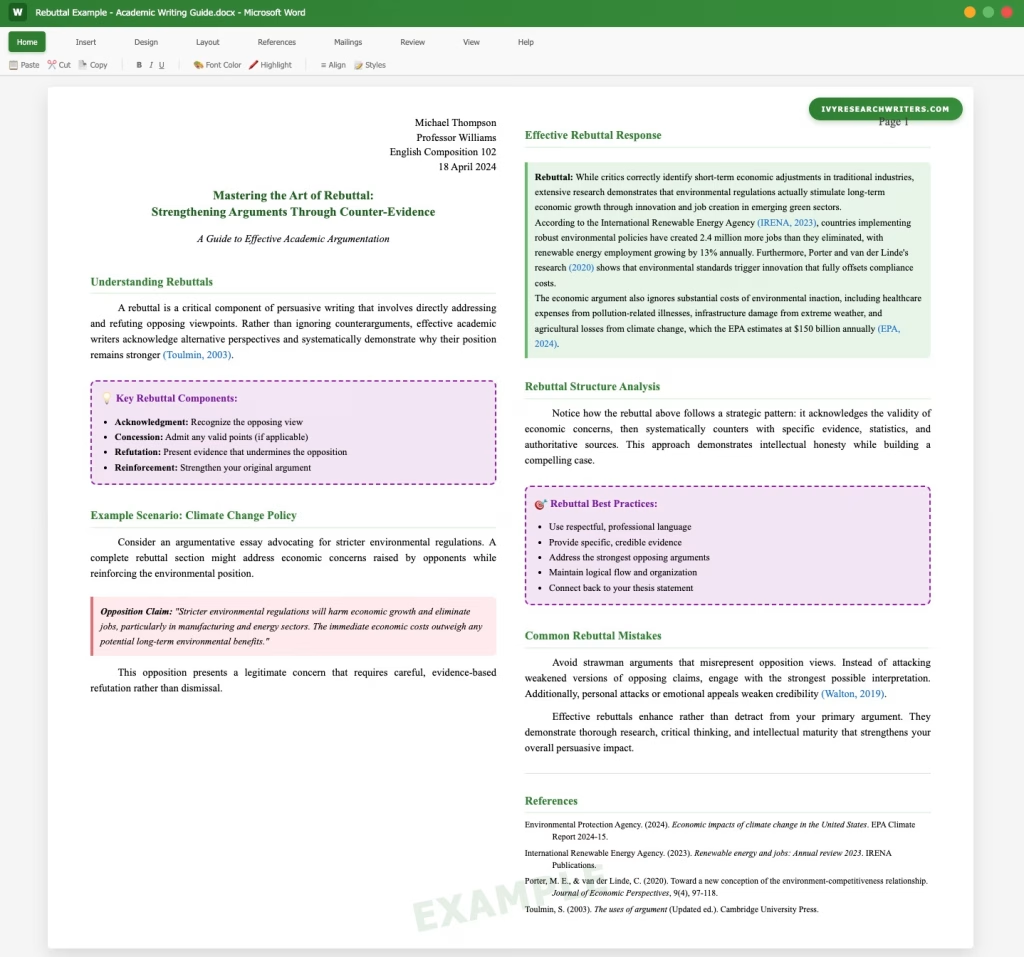
Rebuttal Paragraph Example
A rebuttal paragraph is a single paragraph in which you respond to the opposing argument. Here’s an example:
Example Rebuttal Paragraph:
“While some claim that video games contribute to violent behavior, research consistently shows that this is not the case. Studies, such as one conducted by Smith et al. (2020), indicate that violent behavior is linked more closely to family history and environment rather than gaming habits. Furthermore, video games often serve as a means of stress relief, with studies showing a positive correlation between playing video games and reduced aggression in children. Therefore, attributing violent tendencies solely to video game use is an oversimplification of the issue.”
Here are the extended rebuttal examples with more detailed explanations and evidence:
Examples of Counterarguments and How to Use Them
When writing a rebuttal, you may need to use a counterargument to challenge an opposing claim. Here are some examples:
- Argument: “Homework increases student stress.”
- Counterargument: “However, research shows that structured homework enhances students’ time-management skills and academic performance.”
- Counterargument in a sentence: “While homework can be stressful, it is an essential component of academic success and helps students learn discipline.”
How to Write a Rebuttal Letter
A rebuttal letter is a formal document where you respond to a claim or argument made by another party, such as in a legal or business context. Here’s how to write one:
Key Components:
- Introduction: State the reason for your rebuttal.
- Acknowledgment of the Original Argument: Briefly acknowledge the original claim.
- Refutation: Provide your counter-argument with evidence.
- Conclusion: Reaffirm your stance and suggest next steps.
Rebuttal Letter Example:
“Dear [Recipient’s Name],
I am writing in response to your recent complaint regarding our services. While we understand your concerns about the delay, I would like to clarify that the delay was due to an unexpected supply chain issue, not negligence on our part. We have since taken steps to address this issue and ensure it does not occur again. Thank you for your understanding, and please do not hesitate to contact us with any further questions.”
Writing Effective Rebuttals: Key Techniques and Strategies
What’s a Rebuttal in an Argumentative Essay Example?
- A rebuttal in an argumentative essay responds to the opponent’s argument by presenting evidence or reasoning that contradicts or weakens their point.
- Example:
- Opponent’s argument: “Homework causes stress in students.”
- Rebuttal: “While homework may cause stress for some, studies have shown that regular homework assignments actually improve academic performance and learning outcomes in students. This suggests that homework has a cause-and-effect relationship with better student performance, rather than merely contributing to stress.”
- A rebuttal provides a counter-argument that challenges the claims made, often supported by data or experiments.
- Rebuttals show how an opponent’s claim fails to account for alternative explanations or evidence.
The Power of Metaphors in Rebuttals
- A useful metaphor for rebuttals is that of a debate competition, where you respond to your opponent’s concern and defend your position with evidence and logic.
- Debate involves responding to multiple challenges, much like writing a rebuttal in an essay, where you systematically dismantle opposing arguments.
- Metaphor is imperfect, but it illustrates that a rebuttal is not just about dismissing the opponent’s view but providing a stronger argument.
- The goal is to respond to multiple reviewers or arguments within a debate to present a more compelling position.
Structuring Your Rebuttal: Body Paragraphs
- Body paragraph in an argumentative essay:
- Start by acknowledging the opponent’s argument: Show that you understand their point before countering it.
- Present your rebuttal: Use counter argument examples to demonstrate how their position is flawed or incomplete.
- Provide evidence: Back up your claims with studies, datasets, or experiments to prove the cause-and-effect relationship between variables.
- Challenge the opponent’s logic: Use logical reasoning to expose weaknesses in their argument. For example, if they argue that video games cause violence, you might counter by demonstrating the lack of a cause-and-effect relationship between video games and violent behavior.
- A rebuttal should be thorough: Ensure that all parts of the argument are addressed and refuted.
The Role of Data and Experiments in Rebuttals
- Data and experiments are crucial for a strong rebuttal:
- Refer to datasets or experiments you run to respond to the opponent’s claims.
- For example, if the opponent argues that video games cause violent behavior, you can cite recent studies showing no significant correlation between gaming and aggression.
- If the opponent uses circumstantial evidence, you should present more solid, empirical evidence to support your rebuttal.
- Use new experiments or additional experiments you run to refute claims with more current data, demonstrating the evolution of understanding on the topic.
- Address issues with data: Point out how the opponent’s claim may rely on outdated or misinterpreted data.
Attacking Flawed Arguments and Logical Fallacies
- A rebuttal often involves attacking the logical fallacies in the opponent’s argument:
- Example: If the opponent claims that video games cause violent behavior, but provides no statistical backing, point out the logical fallacy of hasty generalization or false cause.
- Rebuttals also attack unsupported or illogical reasoning, showing that the argument does not hold up under scrutiny.
- Use counter argument examples to show that their logic does not follow from the premises they presented.
The Importance of Starting Positive
- Start positive in your rebuttal to create a more professional tone:
- Acknowledge the merit of the opponent’s argument before presenting your counterpoints.
- Example: “While it is true that some studies suggest a link between video games and aggression, the evidence is not conclusive, and other studies show no such connection.”
- Starting positive allows you to respond to multiple reviewers by demonstrating respect for differing opinions while reinforcing your stronger argument.
Responding to Multiple Viewpoints
- Responding to multiple criticisms or reviewers:
- When the opponent’s argument covers several points, address each one systematically in your rebuttal.
- Save space by responding to multiple concerns in one paragraph or section.
- For instance, if someone argues that video games contribute to violent behavior and also impair social skills, your rebuttal should address both issues, presenting data and research that refute each claim.
- Rebuttals should focus on responding to all aspects of the opponent’s argument, not just one isolated issue.
The Role of Rebuttals in Academic Writing
- In academic writing, rebuttals demonstrate that you have considered the full spectrum of the argument:
- Rebuttals help you back your claim and prove that you have addressed alternative perspectives.
- A well-supported rebuttal is essential to present a strong argument and convince the reader or judges of your point of view.
- Rebuttals not only defend your argument but also address issues with data and circumstantial evidence provided by the opponent.
Responding to Issues with Data
Get Expert Help with Your Argumentative Essays!
Struggling to craft the perfect rebuttal? Let our team of experienced writers at IvyResearchWriters.com help you build strong, evidence-backed arguments for your next essay. Contact us today for customized writing support!
- Issue with data is one of the most common reasons to write a rebuttal:
- If the opponent relies on flawed or outdated data, point out how new experiments provide a clearer or more accurate perspective.
- Example: “The study you referenced was conducted over a decade ago, and since then, new research has shown that there is no conclusive link between video games and violent behavior.”
- Rebuttal should clarify how the opponent’s claim fails to account for more recent data or evidence, strengthening your position.
Attacking Flawed Assumptions
- Rebuttals also attack assumptions made by the opponent that are unsupported or unproven:
- For example, if the adversary argues that homework increases stress, your rebuttal could point out how homework can help build time-management skills and improve academic performance, which are often overlooked by the opponent.
- Point out the imperfect but useful metaphor: just as video games do not cause violence in a straightforward sense, homework doesn’t always lead to stress and can have positive benefits in educational development.
Concluding Your Rebuttal
- A rebuttal should not only refute the opponent’s claims but also present a strong counter-argument.
- Example: “Therefore, while video games might be associated with aggression in certain studies, no cause-and-effect relationship has been proven in the broader context. Additional research would be required to fully understand the role of external factors in shaping behavior.”
- This helps you respond to multiple reviewers by providing a clear, authoritative stance on the issue.
How to Write a Good Rebuttal
To write a good rebuttal, focus on these key aspects:
- Be respectful: A rebuttal should always be civil, even if you strongly disagree.
- Stay relevant: Focus on the core points of the opposing argument and avoid irrelevant details.
- Be thorough: Don’t leave gaps in your rebuttal. Address all aspects of the argument.
Metaphors for Rebuttals
Metaphors can help illustrate the importance of a rebuttal. One commonly used metaphor is that rebuttals are like debates. Just like in a debate competition, you must respond to your opponent’s points effectively and convincingly. In this way, a rebuttal is a critical tool in winning arguments and convincing others of your viewpoint.
Conclusion
A rebuttal is a critical tool in any argument or debate. Whether you’re writing an essay, participating in a debate, or responding to a reviewer’s suggestion, crafting a well-thought-out rebuttal can significantly strengthen your case. By understanding the different types of rebuttals and using persuasive techniques, you can effectively counter your opponent’s arguments and present a more compelling point of view.
FAQs: Rebuttal Examples: Guide to Counterargument & Rebuttal Sections
What is an example of rebuttal?
- Rebuttal in an argumentative essay example: “While the opponent argues that video games cause violence, studies have shown no cause-and-effect relationship between video game use and violent behavior.”
- In debate competitions, a rebuttal directly responds to the adversary’s argument, presenting counterargument examples to refute the claims made.
- An example counterargument could be refuting a claim with new experiments that prove the effect relationship between variables, like correlation between violence and video game use.
What are some good rebuttals?
- A good rebuttal should be thorough, addressing all aspects of the opposing argument.
- Start with a positive tone, then present counterarguments and examples of counterargument that directly challenge the side’s argument.
- Example: “The claim that homework increases stress could be countered by showing research where homework improves learning in students.”
- Use chargeback response templates to structure your rebuttal clearly and professionally.
- Rebuttal should provide logical evidence, such as results of additional experiments to support your claims.
How do you write a rebuttal?
- Rebuttals focus mostly on responding to the opposing argument, offering a counter argument backed with data or examples.
- Start with acknowledging the opposing argument might have some merit, then systematically refute it with facts or evidence.
- Ensure your rebuttal is thorough, addressing the core aspects of the adversary’s argument and backing your claim with experiments or credible sources.
- Use a metaphor for rebuttals like a debate: you must respond to their concern by proving your case stronger than the opposition’s.
- Use the conversational nature of the example responses to make the rebuttal engaging, while maintaining a formal tone in an argumentative essay.
What is a rebuttal sentence?
- A rebuttal sentence is a statement that directly challenges the opposing argument.
- Example: “The opponent’s argument that homework causes stress is flawed because research shows a cause and effect relationship between homework and academic performance improvement.”
- A rebuttal sentence should be concise yet powerful, providing a counter-argument to the opponent’s claim.
- Rebuttal should be thorough and aim to convince the judges of your arguments, providing strong evidence to back your claim.

