

Deductive Reasoning Examples
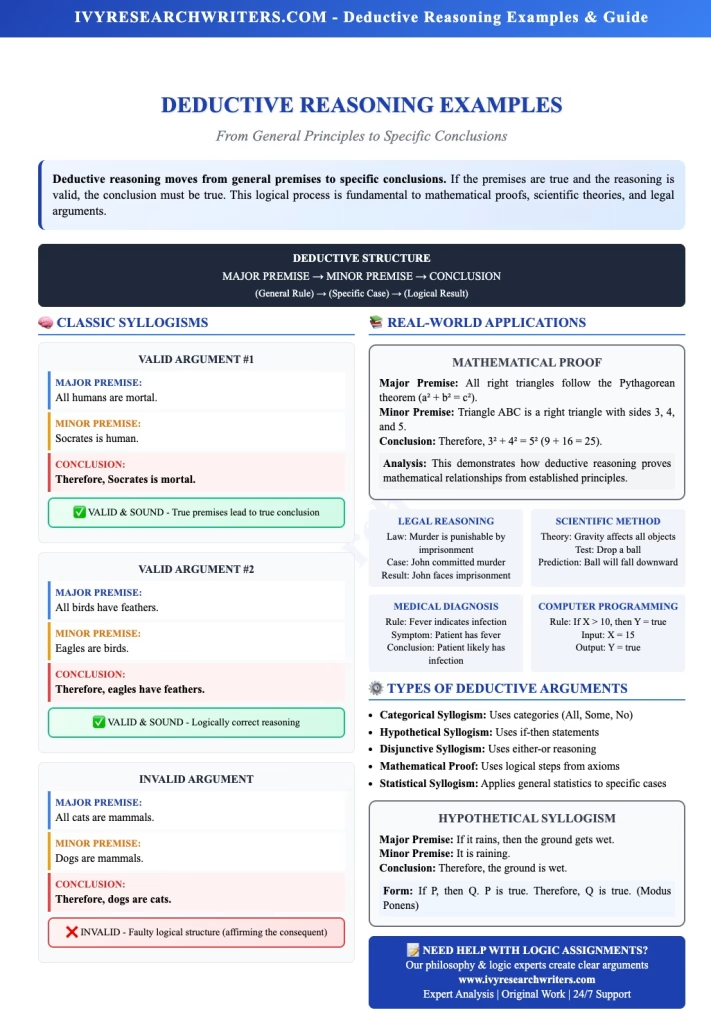
Deductive Reasoning Definition
Deductive reasoning is a logical process that starts with a general statement or hypothesis and examines the possibilities to reach a specific, logical conclusion. It is often referred to as top-down reasoning because it begins with a general principle or theory, which is then applied to specific situations to draw conclusions. The key to deductive reasoning is that if the premises (the initial statements or assumptions) are true, the conclusion derived from them will also be true. Deductive reasoning is a logical process. Explore deductive reasoning examples and understand the difference between deductive vs inductive reasoning.
Example of Deductive Reasoning:
- Premise 1: All humans are mortal.
- Premise 2: Socrates is a human.
- Conclusion: Socrates is mortal.
These deductive reasoning examples demonstrates how deductive reasoning moves from a general truth (all humans are mortal) to a specific conclusion (Socrates is mortal). Since both premises are assumed to be true, the conclusion must also be true, which showcases the logical certainty inherent in deductive reasoning.
Inductive and Deductive Reasoning
Difference Between Inductive and Deductive Reasoning
Inductive and deductive reasoning are both central to logical thought but operate in opposite directions:
- Deductive reasoning begins with a general statement or hypothesis and works towards a specific conclusion. It guarantees that if the premises are true, the conclusion is undeniably true as well.
- Inductive reasoning, on the other hand, begins with specific observations or cases and builds towards a generalization. It offers probable conclusions based on the observed evidence, but the conclusions are not guaranteed to be true.
Example of Deductive and Inductive Reasoning:
- Deductive Reasoning:
- Premise 1: All mammals have a backbone.
- Premise 2: A dog is a mammal.
- Conclusion: A dog has a backbone.
- Inductive Reasoning:
- Observation: Every dog I have seen has a backbone.
- Generalization: All dogs have a backbone.
While both inductive and deductive reasoning examples may arrive at conclusions, deductive reasoning guarantees truth if the premises are true, whereas inductive reasoning merely suggests a likely conclusion.
Inductive vs Deductive Reasoning
Inductive vs Deductive Research
Both inductive and deductive reasoning examples are valuable in research, but they serve different functions:
- Inductive research is often used to build theories. Researchers gather data and make generalizations or hypotheses from those observations. The goal is to identify patterns and relationships that can later be used to develop theories.
- Deductive research starts with a theory or hypothesis, which is then tested through specific observations or experiments. The goal of deductive research is to test and confirm or reject existing theories using empirical data.
Key Differences:
- Inductive Reasoning: This type of reasoning moves from specific observations to general conclusions. It is commonly used when developing theories based on empirical evidence. It’s also known as bottom-up reasoning because it builds up from specific data.
- Deductive Reasoning: In contrast, deductive reasoning moves from general principles to specific conclusions. It is a form of top-down reasoning as it applies general theories to individual cases.
What Is Inductive Reasoning?
Inductive reasoning is a method of reasoning that involves making generalized conclusions from specific examples or observations. Unlike deductive reasoning, which guarantees the truth of the conclusion, inductive reasoning only suggests the likelihood of a conclusion. This form of reasoning is often used in the scientific method, where hypotheses and theories are formulated based on patterns or trends identified in the data.
Example of Inductive Reasoning:
- Observation: All the apples I have eaten have been sweet.
- Conclusion: All apples must be sweet.
Here, the conclusion is probable but not certain. There may exist apples that are not sweet, but based on the observed pattern, the conclusion is likely.
Example of Deductive Reasoning in Action
Deductive reasoning examples is widely used in various disciplines, from law and mathematics to scientific research. It helps ensure that decisions and conclusions are grounded in logic, providing clarity and certainty. By starting with general principles, it allows for the derivation of specific truths with confidence.
Deductive Reasoning Example in Law:
- Premise 1: All citizens must pay taxes.
- Premise 2: John is a citizen.
- Conclusion: John must pay taxes.
This is a classic example of deductive reasoning in legal contexts, where a general rule (all citizens must pay taxes) is applied to a specific case (John, being a citizen, must pay taxes).
Additional list of easy deductive reasoning examples:
Use Deductive Reasoning in Everyday Life
In our daily lives, we often employ deductive reasoning to make decisions based on established rules or knowledge. From ensuring that we follow traffic laws to deciding when to buy an umbrella, deductive reasoning helps us to apply general principles to specific situations.
Example of Deductive Reasoning in Daily Life:
- Premise 1: All cars need fuel to operate.
- Premise 2: My car is running low on fuel.
- Conclusion: I need to refuel my car.
This is a practical deductive reasoning example where deductive reasoning helps you decide to take action based on the logical conclusion derived from the premises.
Inductive vs Deductive Reasoning in Research
Both deductive reasoning and inductive reasoning are pivotal in research, each serving different purposes in testing and developing theories. The key difference between deductive and inductive reasoning lies in the approach to conclusions:
- Deductive reasoning starts with general ideas or premises that are already established or accepted as true statements. The researcher then applies these to form a conclusion about a specific case. If the premises are logically sound and correct, the conclusion will logically follow from them, and the argument is valid. This type of reasoning is commonly used to test hypotheses just like in the deductive reasoning examples in this blog post.
- In contrast, inductive reasoning, often referred to as bottom-up reasoning or inductive reasoning is also called induction, involves starting with specific observations or data points and moving to general conclusions. Inductive reasoning is different from deductive reasoning in that it doesn’t guarantee the truth of the conclusion but reaches a conclusion based on patterns or regularities observed in the data. Inductive reasoning allows for probable but not absolute conclusions. The premises may provide evidence that helps infer a conclusion, but it is not guaranteed to be true.
Deductive Reasoning Example:
- Premise 1: All humans are mortal.
- Premise 2: Socrates is a human.
- Conclusion: Socrates is mortal.
- In this case, two premises (both true) lead us to a correct conclusion. Deductive reasoning ensures the conclusion is based on logic, and it is logically sound because both premises are true.
Inductive Reasoning Example:
- Observation 1: Every dog I’ve seen has four legs.
- Observation 2: My friend’s dog has four legs.
- Generalization: All dogs must have four legs.
- Here, inductive reasoning is used to make a generalization from a set of premises (specific observations), but the conclusion is not guaranteed. It’s a probable conclusion, but it may not be true in all cases (e.g., dogs with disabilities or birth defects).
Using Deductive Reasoning in Real Life
Reasoning is used in various real-life situations, whether it’s making decisions, solving problems, or testing hypotheses. Deductive reasoning helps us reach a conclusion with confidence because it applies logical steps to derive conclusions from general principles. The structure is simple: start with general premises, apply them to specific situations, and deduct a conclusion that must be true if the premises are true.
Example of Deductive Reasoning in Real Life:
- Premise 1: All fruits contain vitamins.
- Premise 2: An apple is a fruit.
- Conclusion: An apple contains vitamins.
- The initial premise is a general truth that can be applied to a specific case (the apple) to draw a valid, logically sound conclusion.
Inductive Reasoning in Everyday Life
Inductive reasoning, also known as induction, is employed when people make conclusions based on their observations or experiences, even though those conclusions are not guaranteed to be true. This reasoning takes specific observations and makes general conclusions. In real life, reasoning takes the form of generalizations from patterns or repeated events.
Example of Inductive Reasoning in Real Life:
- Observation 1: The sun has risen in the east every day of my life.
- Observation 2: The sun is rising in the east today.
- Conclusion: The sun will rise in the east tomorrow.
- This conclusion is a probable one, based on observed patterns, but it may not be true in an exceptional circumstance (like the rotation of the Earth being altered). This is an example of how inductive reasoning helps us form generalizations from specific observations, even though the conclusions are not logically guaranteed.
How to Test Deductive or Inductive Reasoning
To determine whether deductive or inductive reasoning has been applied effectively, one must consider whether the reasoning is based on a set of premises that are true. In deductive reasoning, the logic to reach a conclusion is a clear application of general premises that logically follow. The conclusion must be true if the premises are true, and the argument is valid.
In inductive reasoning, however, the premises may provide evidence or data to infer a general conclusion, but that conclusion is based on probability, not certainty. The reasoning is used to generalize from observations, but the conclusion is only likely to be true and is always subject to change as more observations are made.
Example of Testing Deductive Reasoning:
- Initial Premise: All bachelors are unmarried.
- Second Premise: John is a bachelor.
- Conclusion: John is unmarried.
- This is a valid argument because it logically follows that John must be unmarried if he is a bachelor.
Example of Testing Inductive Reasoning:
- Observation 1: Every swan I’ve seen is white.
- Observation 2: The swan I saw today is white.
- Conclusion: All swans are white.
- While this may seem like a valid conclusion, it is based on specific observations and may not be true because there are black swans. Therefore, this conclusion is probable, not necessarily correct.
Final Thoughts
Both deductive reasoning and inductive reasoning are important tools for forming conclusions and making decisions in various fields, from research to everyday life. Deductive reasoning offers certainty, while inductive reasoning provides probable conclusions based on patterns and data. The difference between deductive and inductive reasoning lies in the approach, with deductive reasoning being a top-down approach and inductive reasoning being bottom-up.
Whether you’re deducing a conclusion from established premises or inducing generalizations from specific cases, reasoning skills are essential for making logically sound decisions, forming hypotheses, and testing theories. Each form of reasoning plays a crucial role in helping us reach conclusions, whether in science, law, or day-to-day decisions.
Forms of Deductive Reasoning: Syllogism
One of the most fundamental forms of deductive reasoning is the syllogism, a type of logical argument that draws a conclusion from two given premises. It is a staple in formal logic, philosophy, and the study of reasoning.
Syllogism Example:
- Premise 1: All birds have feathers.
- Premise 2: A sparrow is a bird.
- Conclusion: A sparrow has feathers.
A syllogism is a powerful tool in deductive logic because it allows one to draw conclusions that are logically valid, as long as the premises are true.
Need help with your reasoning skills or writing?
Looking to dive deeper into inductive and deductive reasoning for your next project? Contact IvyResearchWriters.com for expert help in crafting clear, logical, and well-structured projects today!
Abductive Reasoning: A Different Form of Reasoning
Abductive reasoning is another type of reasoning that differs from both inductive and deductive reasoning. Unlike deductive reasoning, which provides certainty, and inductive reasoning, which provides probable conclusions, abductive reasoning aims to find the most likely explanation for a given set of observations.
Example of Abductive Reasoning:
- Observation: The ground is wet.
- Possible Explanations: It rained, or someone watered the garden.
- Conclusion: It likely rained because no one watered the garden.
Abductive reasoning is particularly useful when dealing with incomplete information or in situations where the conclusion is not guaranteed but is the most plausible explanation.
Conclusion Based on Logical Deduction
In deductive reasoning, conclusions are drawn from premises using logical steps. The validity of the conclusion is directly tied to the truth of the premises. Deductive reasoning is essential in many fields, as it allows us to make sound decisions and form valid conclusions based on well-established rules or theories.
The premises in deductive reasoning must be true for the logical conclusion to hold. Whether it’s legal arguments, scientific experiments, or everyday decisions, the use of deductive reasoning ensures that conclusions are reached in a logical and coherent manner.
In summary, deductive reasoning is a crucial part of logical thinking. It allows for certainty in conclusions when the premises are true. While it is similar to inductive reasoning, it differs by offering conclusions that must be true, not just likely or probable.
Looking to enhance your understanding of logical reasoning? Visit IvyResearchWriters.com for expert deductive reasoning examples and professional assistance on logical reasoning and research writing!
FAQs: Deductive Reasoning and Inductive Reasoning
What is an example of a simple deductive method?
- Premise 1: All mammals have a backbone.
- Premise 2: A dog is a mammal.
- Conclusion: A dog has a backbone.
- This is a simple deductive method where reasoning starts with a general premise (all mammals have a backbone) and forms a logical conclusion based on that premise.
What are the four types of deductive reasoning?
- Syllogism: A form of reasoning with two premises leading to a conclusion (e.g., All humans are mortal; Socrates is human; therefore, Socrates is mortal).
- Modus Ponens: If the first premise is true, the second follows. Example: If it rains, the ground will be wet. It rains, so the ground is wet.
- Modus Tollens: If the second premise is false, the first premise must also be false. Example: If it rains, the ground is wet. The ground is not wet, so it did not rain.
- Hypothetical Syllogism: If one statement leads to a conclusion, and another statement follows from that, the second conclusion must follow. Example: If it rains, the ground will be wet. If the ground is wet, it is slippery. Therefore, if it rains, the ground will be slippery.
What is an example of inductive reasoning?
- Observation: Every time I have seen a swan, it has been white.
- Generalization: All swans are white.
- This is inductive reasoning, where reasoning moves from specific observations to general conclusions. The conclusion may be true but is not guaranteed.
How is deductive reasoning used in real life?
- Testing hypotheses: Scientists use deductive reasoning to test hypotheses. They start with a general principle and deduce conclusions that may be true based on the premises.
- Legal arguments: Lawyers use deductive reasoning to draw inferences from a set of facts (premises) to prove that something is true.
- Decision making: In everyday life, we use deductive reasoning to apply general premises (such as rules or laws) to specific situations to make decisions. For example, “All cars need fuel” (general premise) and “My car is out of fuel” (specific case), so “I need to refuel” (logical conclusion).
- Sherlock Holmes: Holmes uses deductive reasoning to deduce conclusions based on facts, where premises logically follow from one another to form an argument.

